Learn · HVAC/R
Psychrometrics
Part of HVAC Technician from Zero · step 11 of 49 · next: Static Pressure
Part of HVAC Design Fundamentals · step 3 of 9 · next: Duct Design Basics
In learning paths: HVAC Technician from Zero · HVAC Design Fundamentals
Assumes you know: Airflow Fundamentals
Psychrometrics is the study of air and the water vapor it carries, and for a working tech it comes down to four linked numbers: dry-bulb temperature, wet-bulb temperature, dew point, and relative humidity. Fix any two and the others are determined. Comfort cooling is as much about moving water as moving heat, and these are the numbers that track the water.
Why it matters on the job
Half of an air conditioner’s job in a humid climate is dehumidification, and none of your refrigerant gauges can see it. A system can hit its temperature setpoint and still leave a house clammy, or ice its coil because the entering air carries less moisture than you assumed. Wet-bulb readings feed every delivered-capacity check and every charging chart worth using; dew point predicts where water will appear: on the coil where you want it, or on a duct boot where you do not.
The four numbers
- Dry-bulb (DB) is ordinary temperature, from an ordinary thermometer. It measures sensible heat only.
- Wet-bulb (WB) is the temperature a wetted, ventilated sensor reads. Evaporation cools it, and drier air evaporates harder, so the WB reading falls further below DB as the air gets drier. The DB-to-WB spread is a moisture measurement in disguise, and WB tracks the air’s total heat, sensible plus latent, which is why capacity math runs on it.
- Dew point is the temperature at which the air’s moisture starts condensing. Cool any surface below the air’s dew point and water appears on it. That is the whole theory of the condensate drain.
- Relative humidity (RH) is how full the air is of moisture compared to the maximum it could hold at its current temperature, as a percentage. The catch: warm air can hold more moisture, so heating air lowers its RH and cooling air raises its RH with not one grain of moisture added or removed.
A digital psychrometer reads DB and WB directly and computes the rest. The relationships are what you supply: same moisture, different temperature, different RH; same moisture, same dew point, always.
Worked example
Return air in a comfortable house reads 75 °F dry-bulb at 50% RH:
- The psychrometer shows wet-bulb at about 62.5 °F. The 12.5° spread below dry-bulb is the signature of moderately dry air; at 100% RH the two would read the same.
- The computed dew point is about 55 °F. Any surface in this house colder than 55 °F will sweat.
- The evaporator coil is running at 40 °F, well below the 55 °F dew point, so moisture condenses hard on the coil and the system dehumidifies as designed.
- Supply air leaves at 55 °F and nearly saturated, at high RH. Mixed into the room and warmed back toward 75 °F, its RH falls: the same air that left the register near saturation becomes the dry air that keeps the house comfortable.
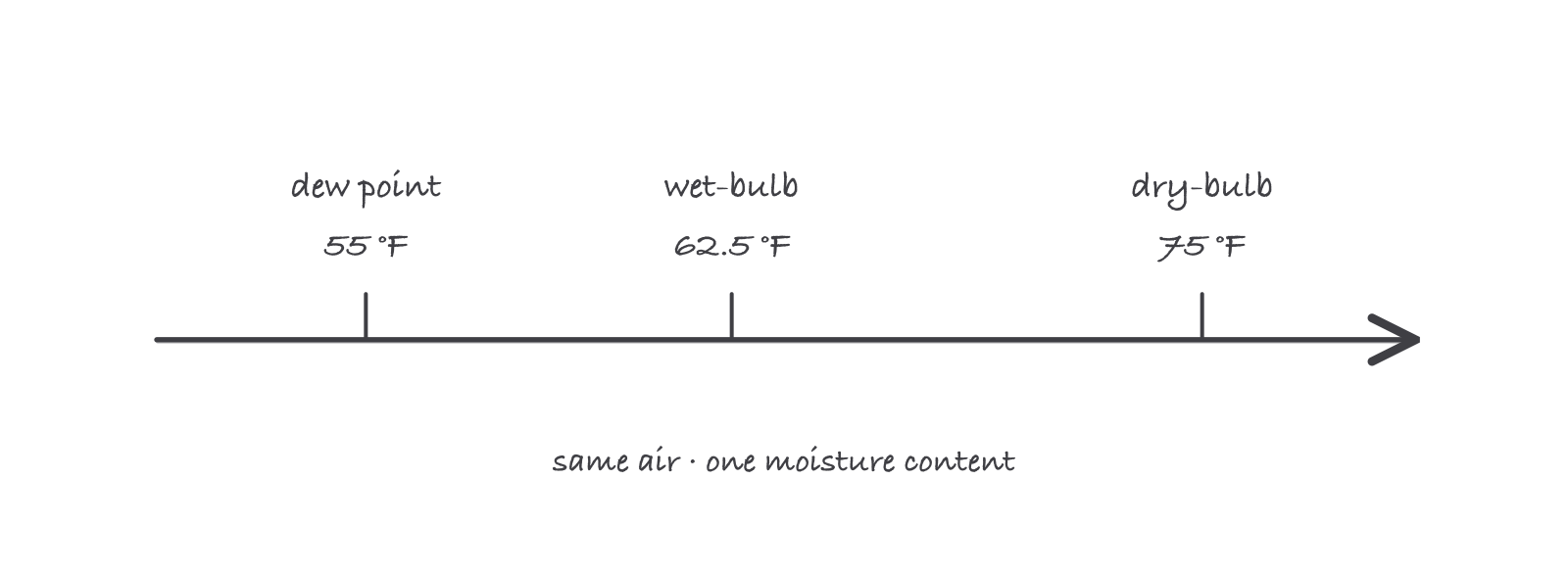
One parcel of air, three temperatures: the spread between them is the moisture story
Where it bites
- RH alone is a half-truth. Air at 90% RH and 40 °F is drier, in absolute water content, than air at 50% RH and 75 °F. When moisture problems are on the table, think dew point; it tracks actual water content and does not change with temperature.
- Sweating ducts are a dew point fact, not a duct defect. A supply boot below the crawl-space air’s dew point will drip. The fixes are insulation and sealing crawl-space humidity, not more airflow.
- A dry wick lies. Wet-bulb readings need a saturated wick or sensor sleeve and moving air across it. A half-dry wick reads high, and every capacity number computed from it inherits the error.
- “It cools fine but feels muggy” is a psychrometric complaint. Oversized equipment satisfies the thermostat before it has run long enough to wring out moisture. Short runtimes, low latent removal, clammy house: the gauges will all look normal, because the problem was never on the refrigerant side.