Learn · HVAC/R
Gauges and Manifolds
Part of HVAC Technician from Zero · step 37 of 49 · next: Evacuation and Vacuum
In learning paths: HVAC Technician from Zero
Assumes you know: Pressure-Temperature Relationships
A gauge manifold is two pressure gauges on a valved block: the blue compound gauge reads the system’s low side, the red gauge reads the high side, and hand valves control what flows between them and the center service hose. It is the instrument that turns Pressure-Temperature Relationships from a chart into live readings on a running machine.
Why it matters on the job
Nearly every refrigerant-side task routes through a manifold: reading system pressures, evacuating, charging, recovering. It is also the tool most often used badly. Every connection you make lets a little refrigerant out and a little air in, so knowing when NOT to connect gauges is as much a skill as reading them.
The instrument
Low side, blue. A compound gauge: it reads pressure above atmospheric and vacuum below it, which the low side of a system can actually reach. It connects to the suction service port.
High side, red. Pressure only, on a higher scale, connected to the liquid or discharge service port.
The center hose, yellow, is the working connection: to a refrigerant cylinder when charging, a vacuum pump when evacuating, a recovery machine when recovering. The manifold’s hand valves open each side to that center path. Valves closed, the gauges still read their ports; you open a valve only to move something.
The temperature scales printed inside each gauge face convert pressure to saturation temperature for a few common refrigerants, a built-in PT chart. Digital manifolds do the same conversion for a long refrigerant list and add temperature probes so superheat and subcooling appear computed on screen. The arithmetic is the one you already know; the tool does it live.
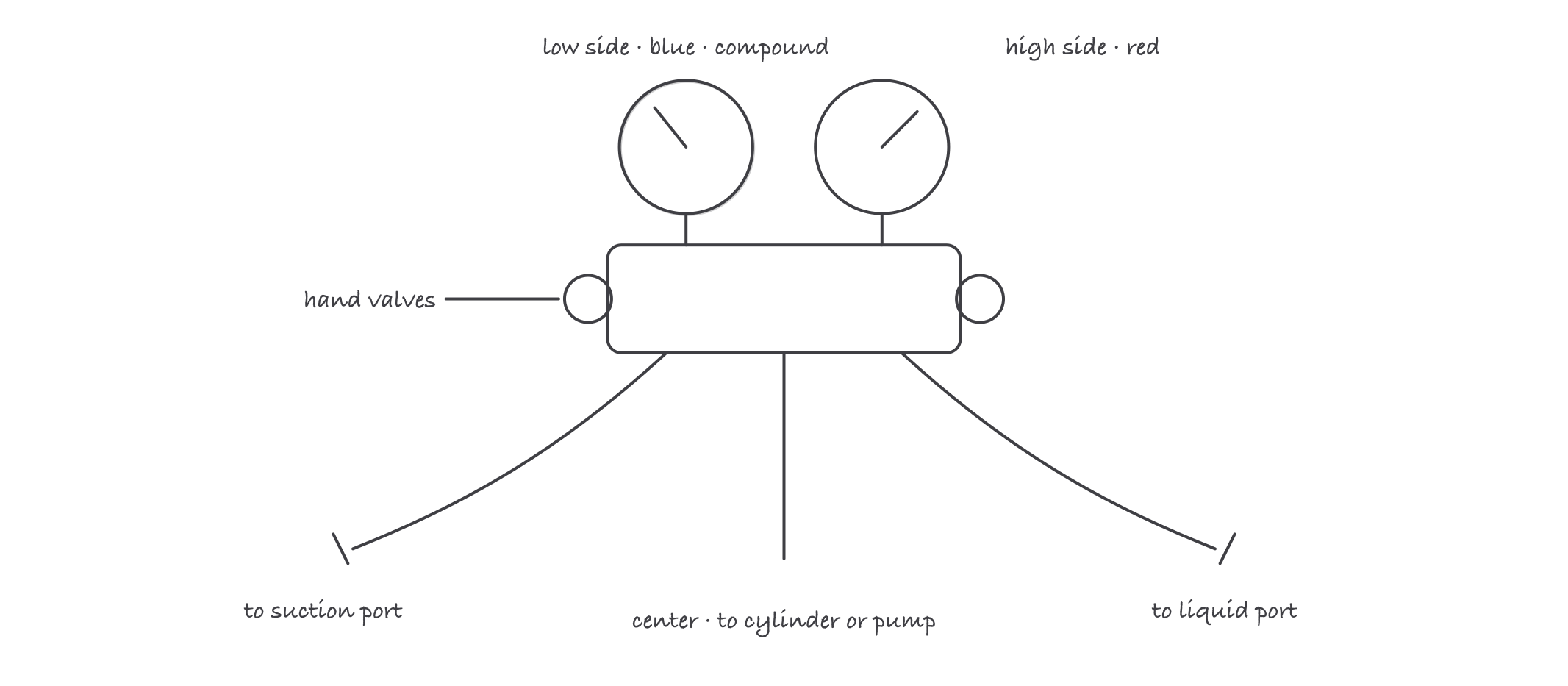
Two gauges watch the ports; the hand valves decide what moves through the center hose
Connections at the machine end are made through service valves and Schrader-cored ports; low-loss fittings on the hoses trap what is in the hose when you disconnect instead of blowing it into the air.
Worked example: reading a running system
An R-410A air conditioner, running steadily on a warm day, ambient 95 °F:
- Low side reads 118 psig. On the R-410A scale that saturates at 40 °F: the evaporator is boiling at 40 °F, right where a comfort cooling coil belongs.
- High side reads 365 psig, which saturates at 110 °F: the condenser is condensing at 110 °F.
- Condensing temperature over ambient: 110 − 95 = 15 °F, a plausible figure for a healthy condenser rejecting heat to 95 °F air.
No superheat probe yet, no verdict yet, but the two pressures alone already sketch the machine: coil boiling around 40 °F, condenser working about 15 °F above outdoor air. Numbers far from that sketch tell you where to look, and the diagnosis lessons build on exactly this reading.
Where it bites
- Gauges read saturation, thermometers read reality. The gauge’s temperature scale tells you where the refrigerant boils or condenses at that pressure, not the temperature of any pipe. Superheat and subcooling always need the separate line temperature measurement.
- The scale is only true for its refrigerant. 118 psig means 40 °F on R-410A and something else entirely on R-32 or R-454B. Read the scale, or set the digital manifold, for the refrigerant actually in the machine.
- Every gauge session costs refrigerant and risks contamination. Purge-free habits, low-loss fittings, and the discipline to diagnose from temperatures alone when gauges are not needed, mark the difference between a careful tech and a system slowly losing its charge to routine checkups.
- Wide-open manifold valves mix the sides. Both hand valves open on a running system lets high side blow into low side through the manifold. Valves stay closed except when you are deliberately moving something through the center hose.
- Zero and calibrate. A gauge that does not read 0 psig open to the air lies about everything else. Check the zero, and treat dropped manifolds with suspicion.