Learn · HVAC/R
Brazing for HVAC
Part of HVAC Technician from Zero · step 36 of 49 · next: Gauges and Manifolds
In learning paths: HVAC Technician from Zero
Brazing joins refrigerant piping by melting a filler alloy into the gap between fitted copper parts at temperatures above 840 °F, hot enough to glow, far below copper’s own melting point. The filler wicks into the joint by capillary action and freezes into a connection that holds system pressures for decades. Refrigerant circuits are brazed, not soldered: soft solder’s strength and temperature limits have no business on a pipe that sees hot discharge gas.
Why it matters on the job
Every repair that opens the circuit ends at a torch: compressor swaps, coil changes, line repairs, filter-drier installs on every opened system. A tech who brazes clean, tight joints works fast and never meets the joint again. A tech who does not, breeds the leaks that Leak Detection exists to find, and, worse, fills the system’s insides with oxide scale that kills valves and driers downstream.
The joint, the heat, the filler
Fit-up first. Brazing fills a capillary gap, not a canyon. Cut square, ream, clean to bright metal, and seat the tube fully into the fitting cup. The filler follows heat and gravity-defying capillarity into a close gap; it cannot bridge a sloppy one.
Heat the metal, not the filler. Bring the whole joint, tube and fitting cup, to brazing temperature, a dull cherry glow, then touch the alloy to the metal opposite the flame. If the base metal is hot, the filler flashes and races around the joint chasing the heat. Melting filler in the flame and dabbing it on builds a cold joint: a plug of alloy stuck to the surface with no capillary penetration, waiting to leak.
Filler and flux by combination. For copper to copper, the everyday joint, phosphorus-bearing copper-silver alloys are self-fluxing: the phosphorus does the cleaning, no flux needed. Joining copper to brass or steel calls for a higher-silver alloy with flux. Match the rod to the metals, and keep flux out of the system’s insides: it belongs on the outside surfaces only, applied thin.
Flow nitrogen, always
Heat copper glowing in ordinary air and the oxygen inside the pipe burns the inner wall, coating it with black cupric oxide scale. That scale flakes off into the refrigerant stream and lodges in the metering device, the drier, the compressor. The prevention is simple and non-negotiable: displace the oxygen. Flow dry nitrogen through the pipe while brazing, a whisper of flow, a few cubic feet per hour, felt barely at the far opening, not pressure. The inside stays silver-bright, and the system stays clean.
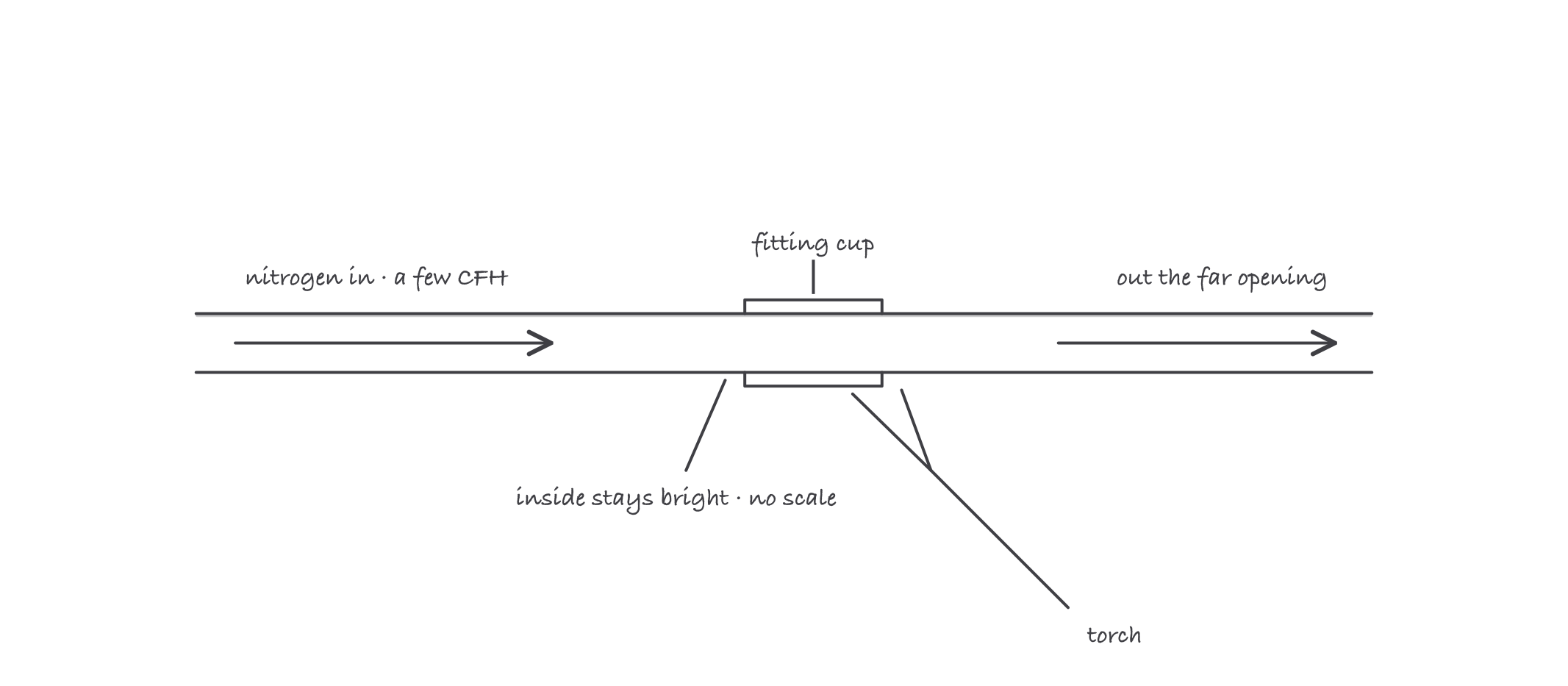
Heat outside, nitrogen inside: the flow costs pennies and keeps the black scale out of the system
The same regulator that purged the pipe pressurizes it later for the leak test: nitrogen is the working gas of the whole repair.
Worked example: reading a failed joint
A suction line joint you are re-making tells you its history when you cut it open.
- The old filler sits in a bead on the outside with bare, unwetted metal inside the cup: a cold joint, the base metal never reached temperature. This time, heat the fitting evenly to a dull red before feeding alloy.
- The pipe’s inner wall is coated black with scale that scratches off as flakes: brazed without nitrogen. Expect to find some of that scale at the filter-drier or metering device, and say so on the ticket.
- Re-make it: clean to bright, fit fully home, nitrogen flowing, heat the cup, feed from the side opposite the flame until a full fillet shows all round, then let it cool before moving it. Pressure test proves it; no test, no repair.
Where it bites
- Protect what lives near the flame. Service valves, TXVs, sight glasses and driers die at brazing temperatures. Wrap them in a wet rag or heat-blocking putty, aim the flame away, and disassemble what can be disassembled. A perfect joint next to a cooked valve is a failed repair.
- Anything holding pressure or refrigerant is off limits to the torch. Recover first, open the circuit, then braze. Heating a charged line turns it into a burst hazard, and torching refrigerant makes toxic decomposition products. Refrigerant vapor displaced by nitrogen, verified open to atmosphere: then light the torch.
- “It held vacuum” is not a braze test. Vacuum pushes a joint together; pressure pushes it apart. Nitrogen pressure test to the equipment’s rated test pressure, then evacuate.
- Overheating is as bad as underheating. Copper burned white-hot pits and thins, and phosphorus alloys grow brittle when cooked. The dull cherry glow is a temperature reading: learn it in good light, and shade your view outdoors.
- The fire triangle rides along. A brazing torch on a wood-framed attic platform next to insulation is the day’s biggest hazard. Clear or shield combustibles, keep an extinguisher in reach, and give the cooled joint a final hand-check before closing the space.