Learn · HVAC/R
Commercial Refrigeration Systems
Part of HVAC Technician from Zero · step 34 of 49 · next: Ice Machines
In learning paths: HVAC Technician from Zero
Assumes you know: How Superheat Works, How Subcooling Works
Commercial refrigeration is the same refrigeration cycle you know, run colder, run constantly, and run with money on the line: walk-in coolers and freezers, reach-in cases, and the display equipment that keeps a store’s inventory sellable. The physics does not change from comfort cooling. The duty, the temperatures, and the consequences do.
Why it matters on the job
Refrigeration work pays a premium and earns it. When an air conditioner fails, people sweat; when a walk-in fails, a restaurant loses its stock by morning. Systems run around the clock, evaporators live below freezing and must defrost on schedule, and every diagnosis leans on the superheat and subcooling skills you built in How Superheat Works and How Subcooling Works, applied at lower temperatures.
Temperature ranges define the equipment
The trade splits equipment by box temperature:
- Medium temperature: coolers and dairy or produce cases, box temperatures roughly in the mid 30s °F.
- Low temperature: freezers and ice cream cases, box temperatures around 0 °F and below.
Low-temperature systems work harder for every degree: lower suction pressure, higher compression ratio, hotter discharge, and mandatory defrost, because the evaporator spends its whole life below freezing.
The layouts you will meet
Self-contained equipment, a reach-in with everything built in, is serviced like a small packaged unit. Remote condensing units put the compressor and condenser elsewhere, on the roof or behind the store, piped to the fixture’s evaporator. Supermarkets scale that idea into rack systems: multiple compressors on a common frame sharing suction and discharge, feeding whole aisles of cases from one machine room. On racks, cases share refrigerant and share problems; one flooding case can starve the others.
Two more habits separate refrigeration from comfort work. Boxes hold food, so evaporator coils, drains and fan blades are sanitation items, and case airflow patterns matter: a display case’s cold air curtain is its insulation. And because the load never stops, refrigeration circuits carry controls comfort systems rarely need: pump-down solenoids, low-pressure switches that cycle the compressor, and defrost timers or boards on every below-freezing coil.
Worked example: coil TD and superheat in a walk-in
A medium-temperature walk-in cooler holds product at 35 °F. Its evaporator is designed to run about 10 °F colder than the box, the coil TD, so:
- Design saturated suction temperature: 35 − 10 = 25 °F
- On the gauge, you read the pressure for this refrigerant that saturates at 25 °F, using its PT chart, exactly as Pressure-Temperature Relationships taught.
- Superheat check at the coil outlet: suction line temperature reads 31 °F. Superheat = 31 − 25 = 6 °F, a normal reading for a refrigeration evaporator, which runs tighter superheat than a comfort coil.
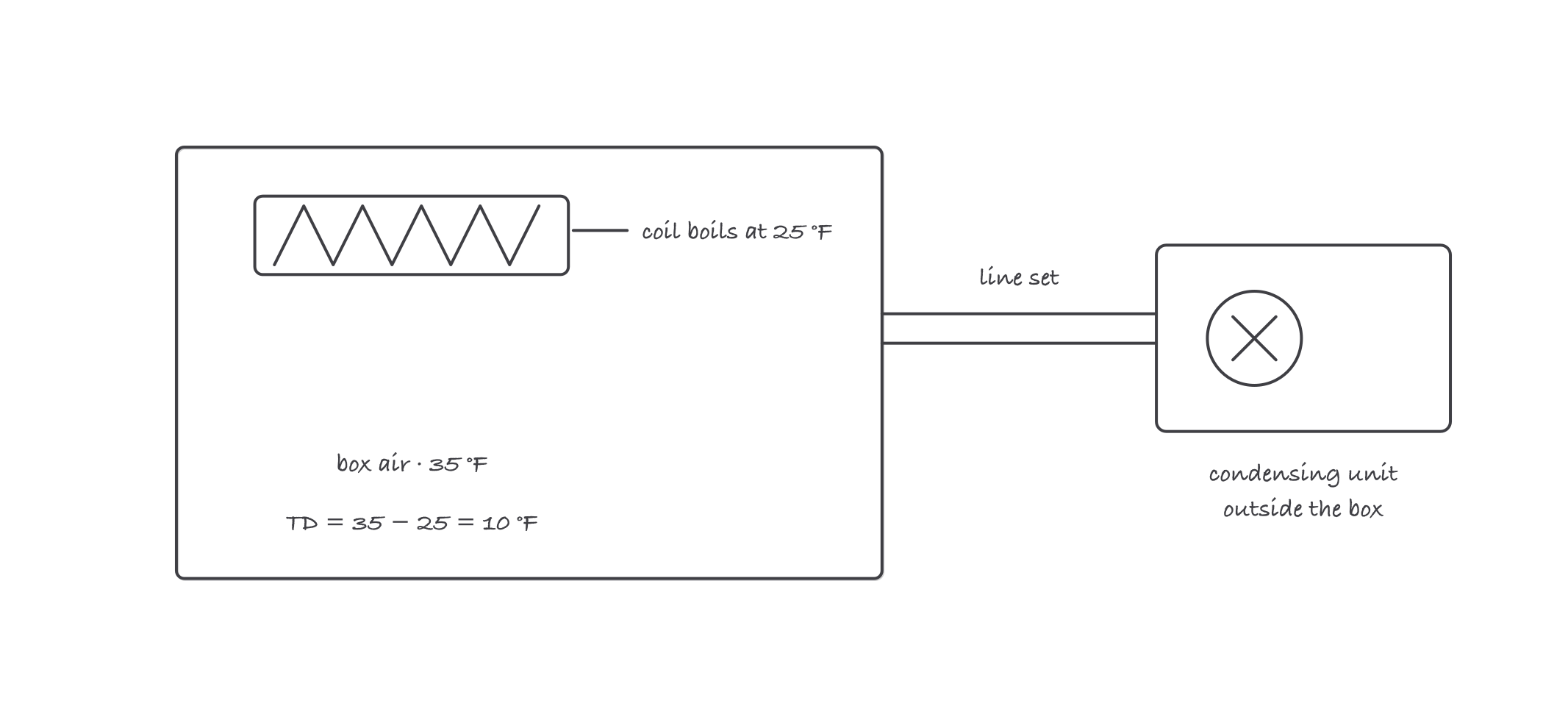
Box temperature minus coil TD gives saturated suction: the design arithmetic behind every gauge reading on a walk-in
Now the diagnostic power: if the box is warm at 45 °F and your saturated suction reads 15 °F with high superheat, the coil is starving or iced. If saturation sits near the box temperature, look at airflow or defrost. The TD arithmetic turns two readings into a direction.
Where it bites
- The TD is designed, not universal. Coil TD trades against humidity control: produce wants a small TD to keep humidity high, and different fixtures are engineered differently. Use the equipment’s design data; 10 °F is a common medium-temp figure, not a law.
- Defrost is scheduled operation, not a fault. Coils below freezing frost by design and defrost by clock, electric heat or hot gas. A tech who arrives during defrost and reads “no cooling” condemns healthy equipment. Know the schedule before judging.
- An iced coil is not a defrost verdict by itself. Failed defrost, dead evaporator fans, low charge, and a door left open all build ice. Melt it fully, find the cause, then watch a defrost cycle prove itself.
- Comfort-cooling habits undercharge freezers and misread gauges. Low-temp systems legitimately run suction pressures that would look catastrophically low on an air conditioner. The PT chart for the actual refrigerant, against the box’s design numbers, is the only frame that means anything.
- Food safety clock starts at failure. Ask when the box last held temperature, and say so in your ticket. The customer’s inventory decisions hang on it.