Learn · HVAC/R
Rooftop Units
Part of Commercial HVAC Systems · step 1 of 10 · next: Chillers
In learning paths: Commercial HVAC Systems
Assumes you know: Packaged Units and RTUs
A rooftop unit, or RTU, packages the heating, cooling, and air-moving sections into one cabinet mounted outdoors, commonly on a roof curb. Supply and return ducts connect the cabinet to the building below.
Why it matters on the job
An RTU can have a healthy refrigerant circuit and still fail the space. The fault may be outside-air dampers, filters, belts, airflow, heat, controls, or the roof opening itself. A good service call follows the air path before it reaches for refrigerant gauges.
Follow the air through the cabinet
Return air enters from the building. An economizer section may mix it with outdoor air. Filters protect the coil and blower. The air then crosses the cooling or heating section, the supply fan adds pressure, and the supply duct distributes the conditioned air.
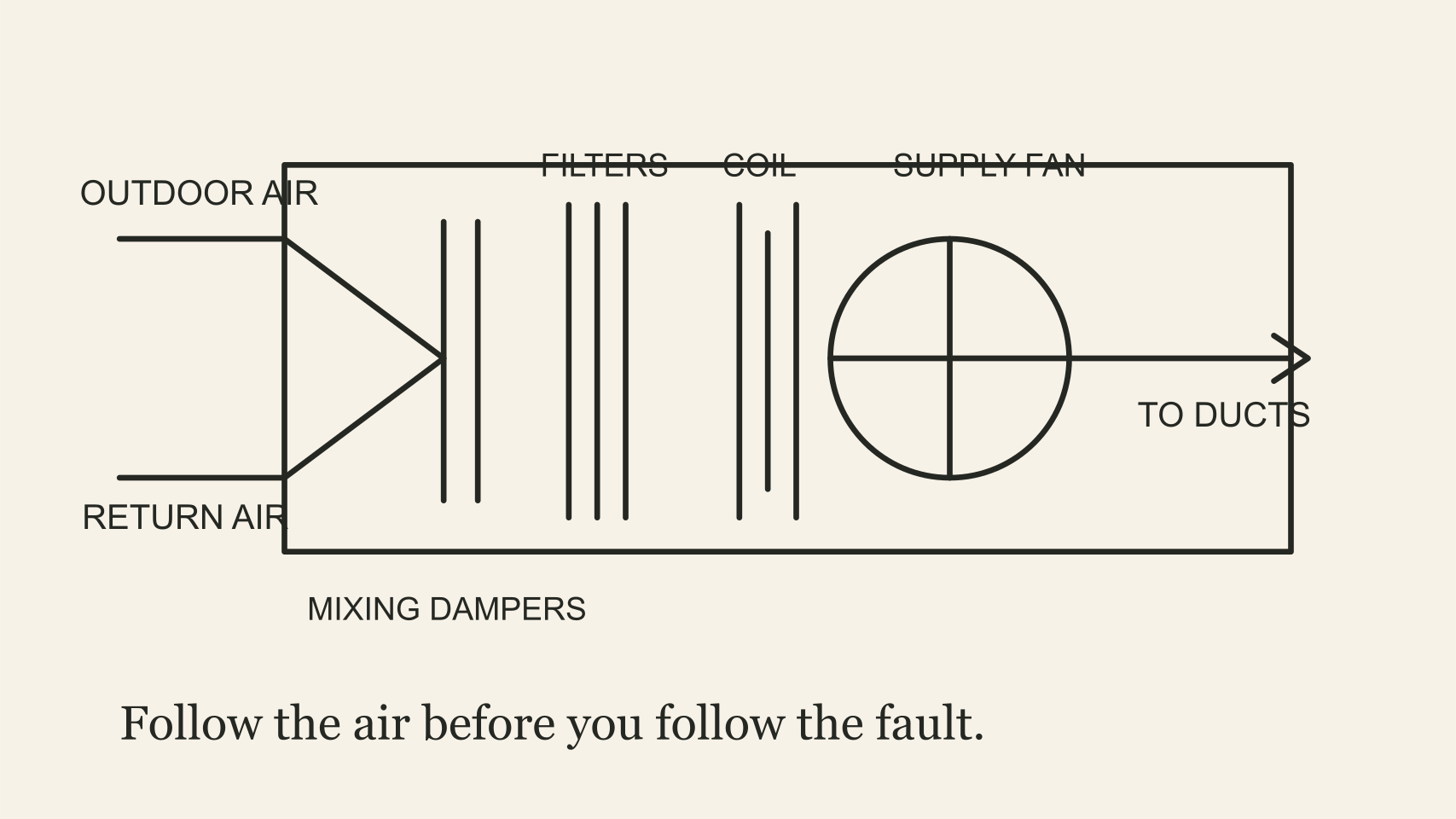
Follow the air path in order so one symptom does not become six guesses
The cabinet may be a single packaged unit or part of a split arrangement. The Department of Energy groups both under unitary HVAC: equipment that combines heating and cooling functions and commonly serves commercial buildings.
Start with the operating mode
Before measuring, establish what the controller is asking the unit to do. A compressor call, economizer call, heating call, and ventilation-only call create different normal readings.
Then verify the basics in order:
- The occupied schedule and space demand call for the expected mode.
- Dampers are commanded and physically moving to sensible positions.
- Filters, belts, fan rotation, and coils permit the intended airflow.
- Supply and return temperatures agree with the actual mode.
- Only then use refrigerant or combustion measurements to isolate the equipment section.
Worked example
An illustrative RTU mixes 80% return air at 75°F with 20% outdoor air at 95°F. Ignoring humidity and heat added by the fan, estimate the mixed-air temperature:
- Return-air contribution: 0.80 × 75°F = 60°F
- Outdoor-air contribution: 0.20 × 95°F = 19°F
- Mixed air: 60°F + 19°F = 79°F
If the measured mixed-air temperature is far from 79°F under steady conditions, investigate the actual damper positions, sensor accuracy, air leakage, and whether the assumed percentages are real. The calculation is a diagnostic expectation, not proof of a particular failure.
Where it bites
- The thermostat does not describe the whole sequence. Schedules, safeties, economizer logic, and building controls may override a space call.
- A moving actuator does not prove a moving damper. Linkages slip and blades bind.
- Low airflow can imitate a refrigeration fault. Verify filters, fan, belt, coil condition, and static pressure first.
- Roof work adds hazards. Follow the site’s access, fall-protection, weather, and electrical safety requirements.