Learn · HVAC/R
Gas Furnaces
Part of HVAC Technician from Zero · step 30 of 49 · next: Furnace Sequence of Operation
In learning paths: HVAC Technician from Zero
Assumes you know: Reading HVAC Schematics
A gas furnace burns natural gas or propane inside a heat exchanger and blows house air across the outside of it. The two air streams, combustion gases inside the exchanger and house air outside it, must never mix; the heat exchanger’s walls are the only thing between the flame and the living room. Everything about how a furnace is built and controlled follows from keeping those streams separate while moving heat across the metal.
Why it matters on the job
Furnaces are the winter half of residential service, and they carry stakes cooling work does not: combustion, flue gases and carbon monoxide. A tech who understands what each part does, and what the safeties are protecting against, reads the wiring against Reading HVAC Schematics, works faster, and never talks themselves into bypassing something that exists to keep a family alive.
The parts, following the heat
Burners and gas valve. The gas valve meters fuel to the burners, where it mixes with air and burns. Ignition is by hot surface igniter or intermittent spark on modern equipment; standing pilots belong to the old stock you will still meet.
Heat exchanger. Combustion gases pass through the exchanger’s cells and out the flue, giving up heat through the metal. House air, pushed by the blower, sweeps the outside of those cells and carries the heat to the ducts. A cracked or rusted-through exchanger breaks the separation between the streams, which is why exchanger inspection is a core service task.
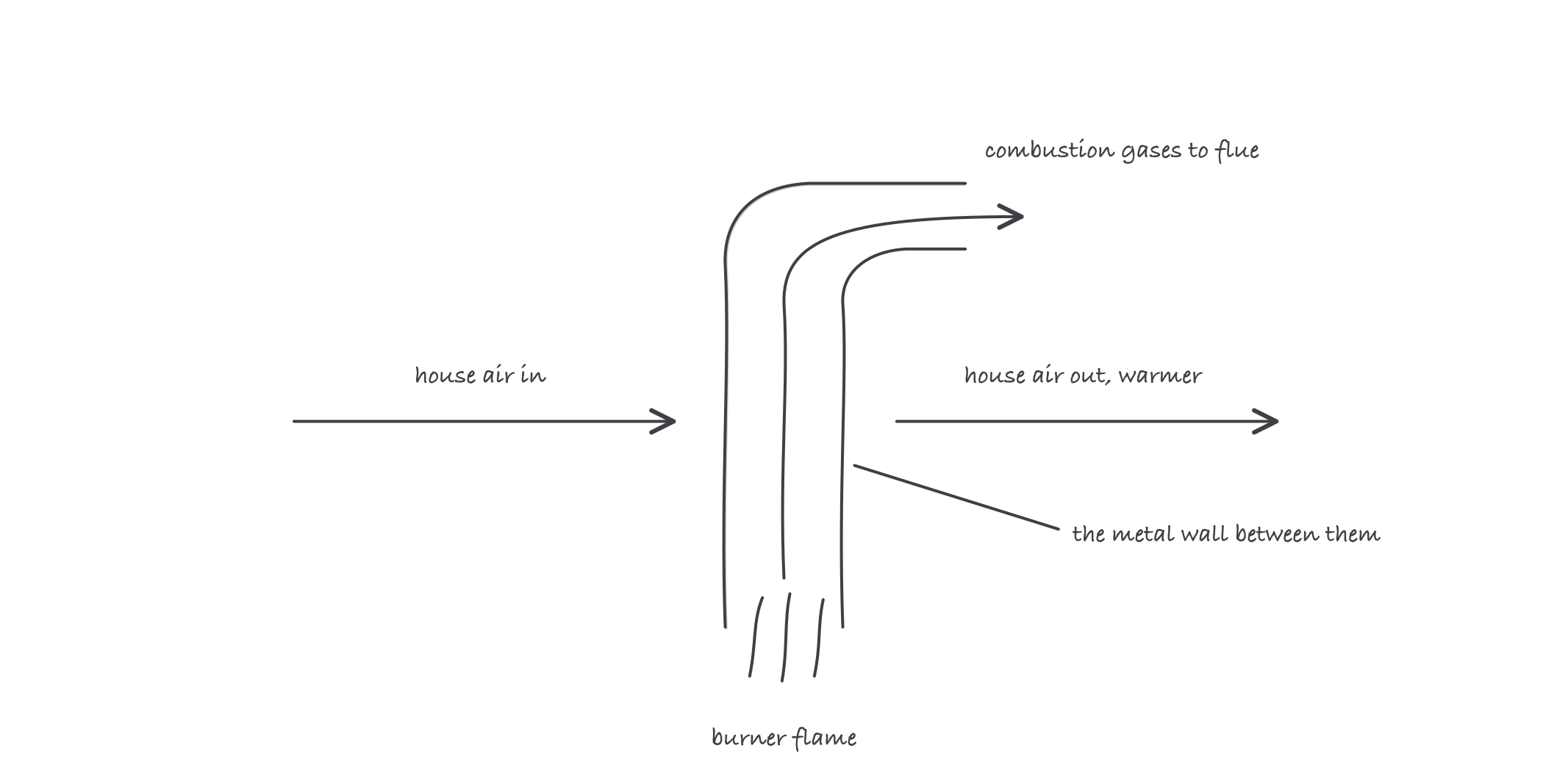
Two air streams, one wall: combustion products stay inside the exchanger, house air stays outside, heat crosses the metal
Draft inducer. A small fan that pulls combustion air through the exchanger and pushes flue products out. It runs before ignition, and a pressure switch proves it is actually moving air before gas is allowed to flow.
Blower. The house-air fan, shared with the cooling system. It starts after the exchanger warms so it never blows cold air, and keeps running after the flame stops to harvest remaining heat.
Safeties. The pressure switch proves draft, the flame sensor proves fire where it belongs, the high-limit switch shuts the gas off if the furnace overheats, and rollout switches trip if flame escapes the burner compartment. Furnace Sequence of Operation walks through how the control board choreographs all of this.
Efficiency: where the second exchanger came from
A furnace’s AFUE rating is the share of the fuel’s energy delivered as heat. Standard-efficiency furnaces (around 80 % AFUE) send hot flue gases up a metal vent. Condensing furnaces (90 %+ AFUE) add a second heat exchanger that pulls so much remaining heat that water vapor in the flue gas condenses, recovering its latent heat. The clues on sight: PVC venting instead of metal, and a condensate drain on a heating appliance. That condensate is mildly acidic and the drain system is a real service item.
Worked example: temperature rise
Temperature rise, supply air temperature minus return air temperature, is the furnace-side equivalent of the cooling split, and the nameplate states an allowed range, commonly something like 35 to 65 °F.
An 80,000 BTU/h input furnace at 80 % AFUE:
- Heat output: 80,000 × 0.80 = 64,000 BTU/h
- Measured: return 70 °F, supply 130 °F, rise = 130 − 70 = 60 °F
- Airflow this implies: CFM = output ÷ (1.08 × rise) = 64,000 ÷ (1.08 × 60) = 64,000 ÷ 64.8 ≈ 988 CFM
If the nameplate range tops out at 65 °F, this furnace is running hot for its airflow: legal, but at the edge. Drop the airflow further, a clogging filter is enough, and the rise climbs until the high limit starts tripping. Measured rise against the nameplate range is the fastest single health check a furnace offers.
Where it bites
- Never read supply temperature in line of sight of the exchanger. Radiant heat from the glowing exchanger inflates the reading. Measure a duct elbow away, out of the exchanger’s view.
- High limit trips are a symptom, not a fault. The limit is doing its job; the fault is almost always airflow: filter, blower, or closed registers. Resetting it and leaving is how exchangers get cooked.
- An 80 % furnace and a 90 % furnace vent differently because the flue gas is different. Condensing furnaces make acidic condensate and cool exhaust that metal flues cannot tolerate; venting is part of the appliance’s design, not a field preference.
- Flame color is a clue, not a diagnosis. Healthy gas flames burn steady and blue; lazy yellow flames say incomplete combustion or contaminated burners, and Combustion Analysis is how you turn that suspicion into numbers.