Learn · HVAC/R
Duct Design Basics
Part of HVAC Technician from Zero · step 13 of 49 · next: Refrigerant Types and Designations
Part of HVAC Design Fundamentals · step 4 of 9 · next: Why Load Calculations Exist
In learning paths: HVAC Technician from Zero · HVAC Design Fundamentals
Assumes you know: Static Pressure
Duct design is the spending of a pressure budget: the blower can produce a fixed total external static pressure, every component in the air path spends part of it, and whatever remains is what the ducts themselves may consume. Size the ducts so their friction spends exactly that remainder at design airflow, and the system delivers its rated CFM. That is the entire method; everything else is bookkeeping.
Why it matters on the job
Most airflow problems are built in on installation day. A replacement furnace with a stronger blower gets attached to ducts sized for a smaller one, or a flex run gets stretched “close enough,” and the system spends its life restrictive. Understanding the budget lets you read a duct system the way you read a circuit: where the pressure is being spent, and whether the layout ever could have worked. The industry-standard method is ACCA’s Manual D; what follows is its core logic.
The pressure budget
Start with the blower’s rated TESP and subtract the pressure drop of every accessory in the air path at design airflow: the wet cooling coil, the filter, balancing dampers, grilles and registers. What is left is the available static pressure for the supply and return duct runs.
Ducts spend pressure through friction, and friction charts and duct calculators express it as pressure drop per 100 ft of duct. So the design number you need is the friction rate:
Friction rate = (available static ÷ total effective length) × 100
Total effective length (TEL) is the longest supply-plus-return path through the system, with every fitting converted to its equivalent length: the feet of straight duct that would create the same loss. Fittings dominate. A sharp elbow can cost the same pressure as dozens of feet of straight run, which is why two duct systems with identical footage can behave completely differently.
With the friction rate in hand, a duct calculator or friction chart converts each branch’s required CFM into a duct size. Low available static or long effective length forces a low friction rate, which forces bigger ducts. There is no negotiating with it.
Worked example
A system needs 1200 CFM from a blower rated at 0.5 in. w.c. TESP:
- Spend the accessories first: wet coil 0.20, filter 0.10, supply registers and return grille 0.06 total. Sum: 0.36 in. w.c.
- Available static = 0.5 − 0.36 = 0.14 in. w.c. for the ductwork.
- The longest run measures 60 ft of straight duct, and its fittings (elbows, takeoff, boot) add 115 ft of equivalent length. TEL for that path plus the return side comes to 250 ft.
- Friction rate = (0.14 ÷ 250) × 100 = 0.056 in. w.c. per 100 ft. Every duct in the system gets sized from the chart at that rate.
Notice what the arithmetic just said: this is a low friction rate, so the ducts must be generous. A crew that instead sizes everything at a chart default of 0.1 would build a system that spends more pressure than the blower has, and it would run restrictive from day one.
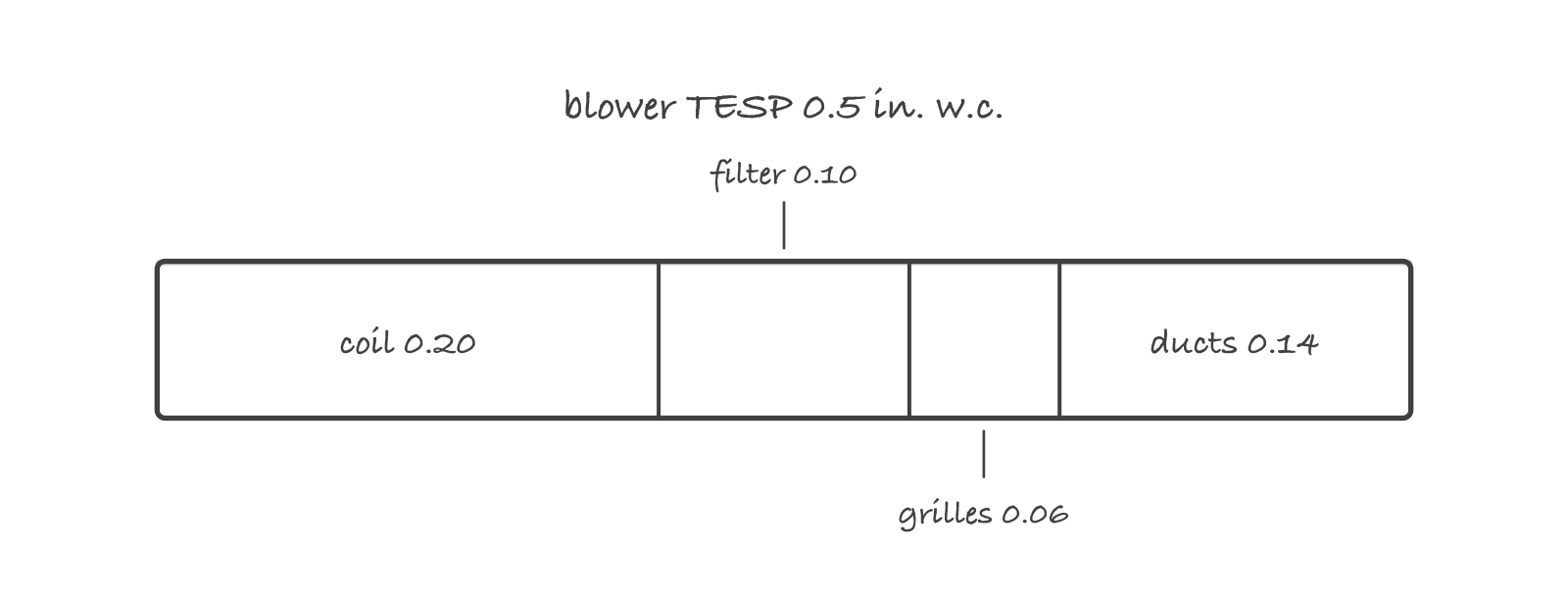
The blower’s 0.5 in. w.c. spent left to right: the ducts only get what the accessories leave behind
Where it bites
- The default friction rate is a trap. Sizing at 0.1 in. w.c. per 100 ft without computing available static is the single most common duct design failure. The budget math exists precisely because the default is so often wrong.
- Flex duct is priced in ideal condition. Its ratings assume the inner liner pulled taut. Compressed or sagging flex can multiply the friction several times over, and a beautiful design dies in a sloppy install.
- Equivalent length is where systems are won and lost. Trimming two hard elbows from a run can matter more than upsizing the duct. When retrofitting, attack the worst fittings first.
- Filters are part of the design. Swapping the builder-grade filter for a thick high-MERV pleat spends static the design never allocated. If the filter upgrade is wanted, the return side usually needs more area to pay for it.