Learn · HVAC/R
Electric Heat
Part of HVAC Technician from Zero · step 32 of 49 · next: Combustion Analysis
In learning paths: HVAC Technician from Zero
Assumes you know: Electrical Fundamentals for HVAC
Electric heat makes warmth the simplest way possible: current through a resistance wire, every watt becoming heat in the air stream. No flame, no flue, no combustion safeties. The trade-off is cost, because resistance heat delivers exactly one unit of heat per unit of electricity, the most expensive heat most utilities sell.
Why it matters on the job
Electric furnaces and air handlers with heat strips are everywhere: primary heat in mild climates, backup and emergency heat on heat pumps across the country. They are the most electrical machine you will service, the diagnosis is almost entirely meter work, and the loads are large: a strip package can draw more current than everything else in the house combined. Electrical Fundamentals for HVAC is doing full-time work in this lesson.
Heat strips and sequencers
The heating elements, heat strips, are coils of resistance wire suspended on insulators directly in the air stream, arranged in stages of roughly 5 kW each. A 15 kW package is three 5 kW elements.
Stages exist because of inrush and the power system: bringing 60-plus amps online in one instant dims lights and slams contacts. Sequencers, small time-delay switches, bring elements on one at a time a few seconds apart, and drop them out the same way. Modern air handlers do the same staging electronically.
Each element is protected in series by a limit switch that opens on overtemperature and usually resets itself, and a fusible link that melts open as the last line of defense and never resets. An element that cannot overheat the cabinet even with no airflow is the design goal; those two devices are how it is met.
Worked example: what 15 kW does
A 15 kW electric furnace on a 240 V supply, blower moving 1,200 CFM.
- Heat output: 15 kW × 3,412 = 51,180 BTU/h. Every watt arrives as heat; resistance heat is COP 1 by nature.
- Current draw of the elements: watts ÷ volts = 15,000 ÷ 240 = 62.5 A, before the blower is counted. This is why strip packages get their own large breakers and heavy conductors.
- Temperature rise: rise = output ÷ (1.08 × CFM) = 51,180 ÷ (1.08 × 1,200) = 51,180 ÷ 1,296 ≈ 39.5 °F. Air entering at 70 °F leaves at about 109.5 °F.
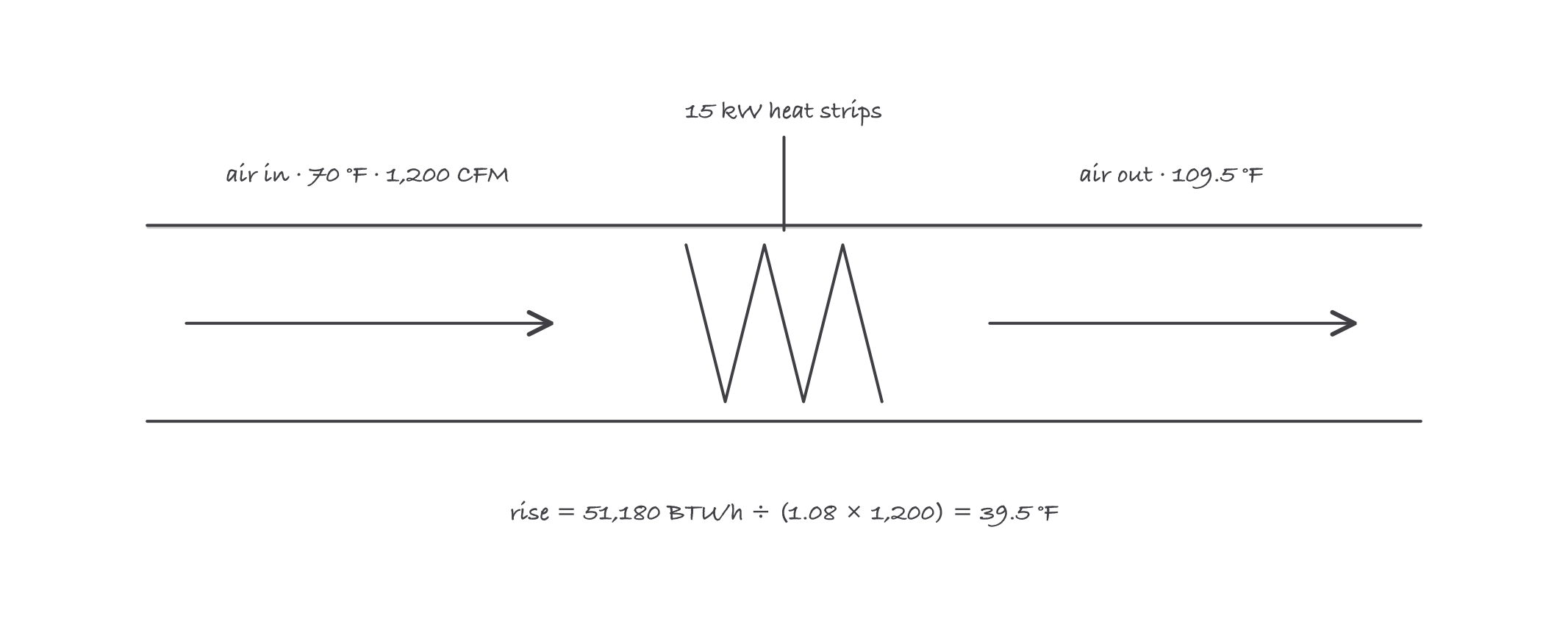
Every watt becomes heat in the air stream: 15 kW into 1,200 CFM lifts the air 39.5 degrees
Each number checks the others. If you measure only 41.7 A at 240 V, that is 10 kW, one dead 5 kW stage, and you found it with a clamp meter without ever opening the cabinet.
Where it bites
- “Emergency heat” and normal backup are different uses of the same strips. On a heat pump, strips normally assist below the balance point, staged in as needed. The emergency heat setting abandons the heat pump entirely and runs strips alone, at strip-heat operating cost. A homeowner who “fixed” a struggling heat pump by switching to emergency heat has bought the most expensive heat available until you find the real fault.
- Amperage is the honest witness. Elements fail open and everything else still runs: blower on, sequencers clicking, thermostat satisfied slowly. Clamp the element circuits; each stage either draws its share of current or it does not.
- A melted fusible link is a message, not just a failed part. Something let the element overheat: dead blower, blocked filter, crushed duct. Replace the link without finding the airflow cause and it melts again.
- Strips live downstream of the coil for a reason. On heat pump air handlers the strips heat air after the refrigerant coil; ordering and airflow direction matter when equipment is reconfigured in the field.
- Cheap to install is not cheap to run. Electric heat wins on install cost and loses on operating cost; the arithmetic in this lesson against How Heat Pumps Work’s COP of 3 is the entire economic case for heat pumps with strip backup.