Learn · HVAC/R
Furnace Sequence of Operation
Part of HVAC Technician from Zero · step 31 of 49 · next: Electric Heat
In learning paths: HVAC Technician from Zero
Assumes you know: Gas Furnaces
The sequence of operation is the fixed order of events a furnace control board walks through on every call for heat, with a safety check gating each step. Learn the sequence and a dead furnace stops being a mystery: wherever the board stopped is where your fault lives.
Why it matters on the job
No-heat calls are diagnosed by sequence. Instead of testing parts at random, you watch the furnace attempt a cycle, note the last step it completed, and test the gate that failed. It turns an anything-could-be-wrong machine into a short list, and it is exactly how the board itself thinks, which is why fault codes map onto sequence steps. Gas Furnaces gave you the parts; this lesson is the order they move in.
The sequence, step by step
- Call for heat. The thermostat closes W, and the board wakes up.
- Inducer prepurge. The draft inducer starts and runs alone for a purge period, clearing any unburned gas from the exchanger before ignition is attempted.
- Pressure switch proves draft. Inducer airflow closes the pressure switch. No closure, no ignition: the board will not light a fire it cannot vent.
- Ignition. The hot surface igniter heats to glowing, or the spark begins, and the gas valve opens.
- Flame proved. The flame sensor must confirm fire within a trial period of a few seconds. It works by flame rectification: the flame itself conducts a tiny DC current, measured in microamps, from sensor rod to grounded burner. No current, and the board closes the gas valve and retries; after a set number of failed trials it locks out.
- Blower on. After a warm-up delay, the blower starts and heats the house.
- Call ends. Gas valve closes, inducer post-purges, and the blower runs a cool-down period to harvest remaining heat before shutting off.
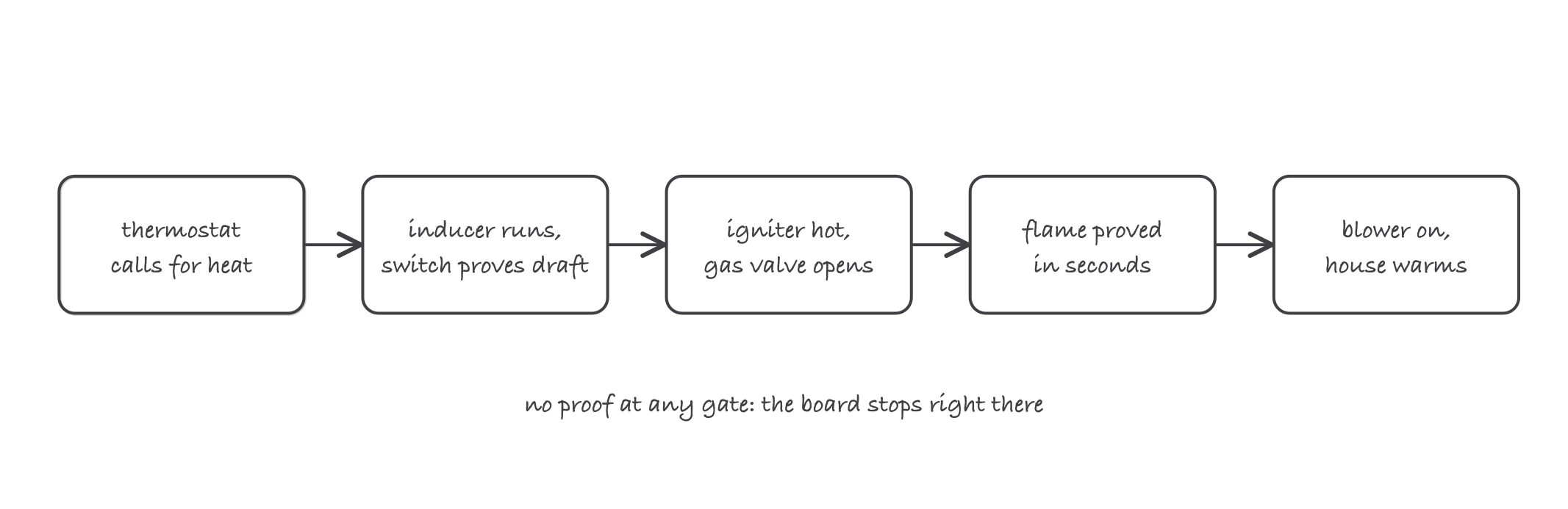
Every step is a gate: the board only advances when the previous step proves itself
Worked example: reading a stall
A furnace attempts to light, flame appears for about three seconds, then the gas valve snaps shut. It tries twice more, then locks out.
Walk the sequence: inducer ran, pressure switch closed, igniter glowed, gas valve opened, flame existed. The step that failed is step 5, proving the flame. The flame was real but the board could not see it.
- Measure flame current in series with the sensor: 0.8 microamps, and the manufacturer’s literature for this board wants several microamps to hold reliably.
- The usual cause is an oxide-coated sensor rod insulating itself from the flame. Clean the rod with fine abrasive, reassemble, retest.
- Flame current now: 3.2 microamps, steady. The furnace holds its flame and completes the cycle.
One measurement, taken at the step where the sequence stalled, found the fault. The exact microamp threshold varies by board; the manufacturer’s number governs, and the pattern, weak flame current from a dirty rod, is universal.
Where it bites
- The flame sensor does not make anything. It is not an igniter and produces no spark or heat; it only reports. Techs replace working sensors daily because the part is cheap and the concept is misunderstood. Measure the microamps instead.
- A pressure switch that will not close is usually telling the truth. The fault behind it is a venting or inducer problem: blocked flue, failed inducer, cracked hose, condensate in the tubing. Jumping the switch to “test” converts a safety into a hazard and is never a fix.
- Lockout hides the show. After lockout the furnace does nothing, and nothing is hard to diagnose. Cycle power or the thermostat to reset the board, then watch a full attempt with your own eyes: the sequence only tells its story while it runs.
- Reversed line voltage polarity breaks flame sensing. Flame rectification needs the right reference to ground; a furnace on a miswired outlet or backwards hot and neutral can light and drop out exactly like a dirty sensor. Check polarity and ground before condemning parts.