Learn · HVAC/R
Evacuation and Vacuum
Part of HVAC Technician from Zero · step 38 of 49 · next: Charging by Superheat and Subcooling
In learning paths: HVAC Technician from Zero
Assumes you know: Gauges and Manifolds
Evacuation is pulling a refrigeration system into deep vacuum to remove the two contaminants that destroy it from inside: air and moisture. A vacuum pump takes the system far below atmospheric pressure, low enough that water boils at room temperature and leaves as vapor. Every system that has been opened gets evacuated before refrigerant goes in. No exceptions.
Why it matters on the job
Air in a system is non-condensable gas: it collects in the condenser, raises head pressure, and drags efficiency down. Moisture is worse: it freezes into ice at the metering device, and it reacts with refrigerant and oil to form acids that eat motor windings and copper from the inside. Poor evacuation is a slow-motion compressor failure with your name on the work order. The evacuation is also your first leak test: a system that will not hold vacuum will not hold refrigerant.
Microns, and why gauges cannot see them
Deep vacuum is measured in microns of mercury, where atmospheric pressure is about 760,000 microns and a typical evacuation target is 500 microns or below, per the equipment specification. Your compound gauge’s vacuum scale is uselessly coarse down here; a separate electronic micron gauge is mandatory. Connect it to the system, ideally far from the pump, so it reads the system’s vacuum rather than the pump’s.
The pump’s job is bulk removal; the physics does the rest. At deep vacuum, water’s boiling point falls below room temperature, so trapped moisture boils off and the pump carries the vapor out. This is also why a wet system evacuates slowly: the pump is not just moving gas, it is boiling water dry.
Hose and connection quality decide the speed. Large-diameter hoses, dedicated vacuum-rated hoses, Schrader cores pulled with a core removal tool: every restriction between pump and system multiplies evacuation time. The pump’s oil matters too: it saturates with the moisture it swallows, and saturated oil cannot pull deep vacuum. Change it often.
Worked example: the decay test
The number that proves an evacuation is not the lowest reading with the pump running: it is what the system does after you isolate it, valve the pump out of the circuit and watch the micron gauge. Three signatures:
- Pull the system to 300 microns, isolate, wait 10 minutes.
- Tight and dry: the gauge drifts up to about 480 microns and levels off. Some rise is normal as remaining vapor equalizes; a rise that stops below your standing target is a pass.
- Moisture: the gauge climbs to the 1,000 to 2,000 micron neighborhood and plateaus, sitting near water’s vapor pressure at room temperature. The system is tight but still wet: keep evacuating, and consider heat or a nitrogen sweep to speed the drying.
- Leak: the gauge rises steadily and never levels, heading for atmosphere. Stop evacuating; you cannot pump a hole dry. Find the leak, and Leak Detection takes it from there.
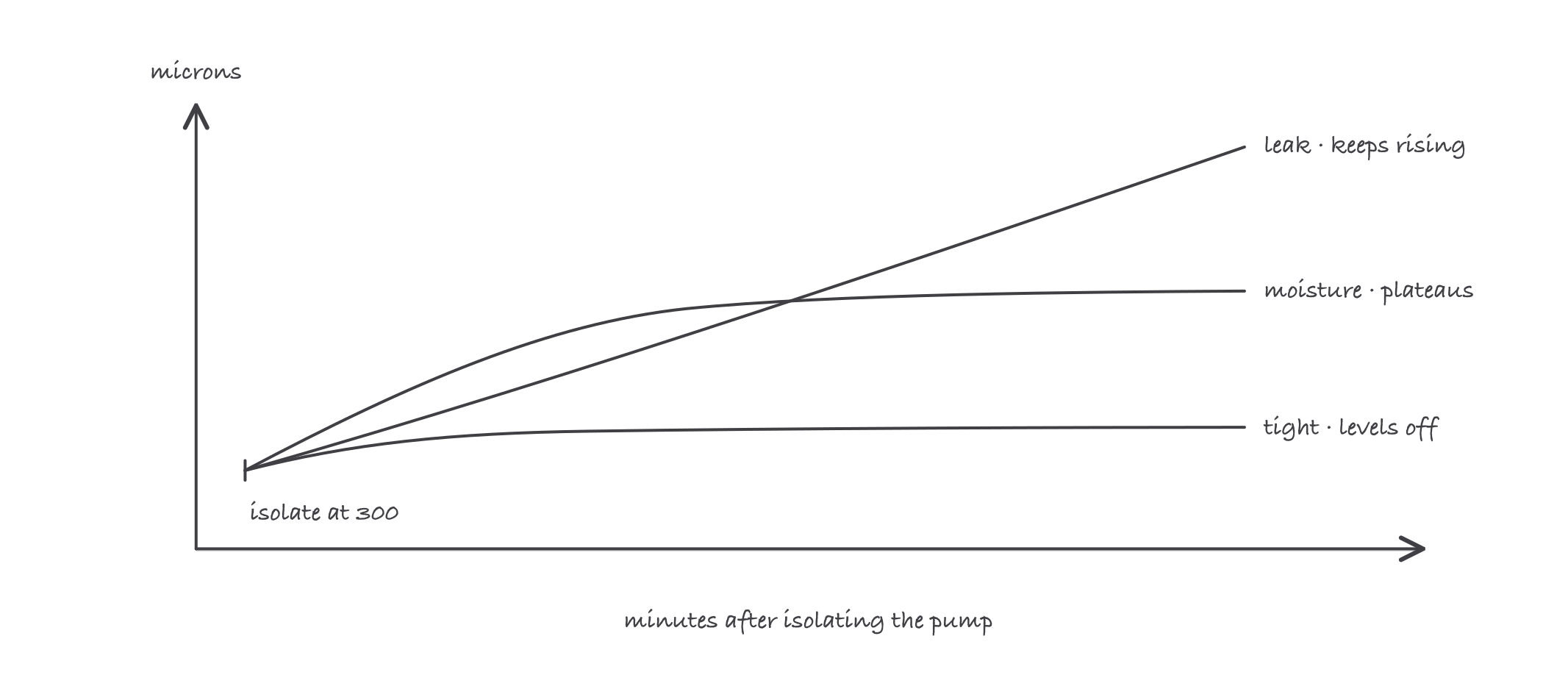
Isolate and watch: level means dry and tight, a plateau means moisture, a steady climb means a leak
The exact targets, evacuation level and allowed standing rise, come from the equipment manufacturer’s specification; 500 microns is a widely used benchmark, not a universal law.
Where it bites
- Running the pump longer is not the same as evacuating deeper. A restricted setup, cores in, skinny hoses, reads fine at the pump and terrible at the system. The micron gauge belongs on the system, far from the pump, and the decay test is the only verdict that counts.
- A micron gauge on the pump proves only that the pump works. Same trap, worth its own bullet, because reading vacuum at the pump is the most common way a bad evacuation gets certified as good.
- Moisture mimics patience running out. The wet-system plateau frustrates techs into declaring victory at 1,500 microns. That moisture stays in the system, becomes acid and ice, and comes back as a warranty compressor.
- Vacuum is for clean, empty systems, never a leak-finding shortcut on charged ones. Recovery comes first on any charged system, and pressure testing with nitrogen finds leaks far better than vacuum: vacuum can pull a joint tight that pressure would push open.
- Never run the compressor under vacuum, and never megohm-test one in deep vacuum. Motor windings arc in rarefied gas, and a compressor started against vacuum can be destroyed in seconds. Break the vacuum with refrigerant charge before any of it.