Learn · HVAC/R
Refrigerant Safety and Handling
Part of EPA 608: All Four Exams · step 12 of 20 · next: The A2L Transition: R-410A to R-32 and R-454B
Part of HVAC Technician from Zero · step 16 of 49 · next: The A2L Transition: R-410A to R-32 and R-454B
In learning paths: EPA 608: All Four Exams · HVAC Technician from Zero
Assumes you know: Refrigerant Types and Designations
Every refrigerant carries an ASHRAE safety class, a letter for toxicity and a number for flammability, and that class plus a short list of handling rules is what stands between routine service and a hospital visit. The rules are few, they are old, and every one of them exists because somebody learned it the hard way.
Why it matters on the job
Refrigerants are heavier than air, displace oxygen, decompose into acid gases in a flame, and now, with A2Ls mainstream, some of them burn. You work with them in basements, attics, and machine rooms, often alone. The safety class tells you which hazards the jug in your hand actually has, so you protect against the real ones instead of guessing.
Reading the safety class
The letter is toxicity: A means lower toxicity, B means higher. The number is flammability:
- 1: no flame propagation. R-410A, R-22, R-134a.
- 2L: lower flammability. Burns, but only in a rich mix with a sustained ignition source, and the flame moves slowly. R-32, R-454B, R-1234yf.
- 2: flammable.
- 3: highly flammable. R-290 (propane), R-600a (isobutane).
Ammonia, R-717, is B2L: toxic and mildly flammable, which is why it lives in industrial plants with trained operators. The class that dominates your decade is A2L: safe enough for homes when the equipment is designed for it, flammable enough that your torch, your recovery machine, and your work area all have to respect it.
The handling rules that do not bend
- Never vent. Venting regulated refrigerants during service is illegal under current EPA rules. Recover before opening a system. A2L classification changes nothing here.
- Never overfill a recovery cylinder. Liquid refrigerant expands with temperature; a hydraulically full cylinder becomes a bomb in a hot truck. The universal limit is 80% of capacity, tracked by weight on a scale, never by sound or frost line.
- Never pressurize with oxygen or compressed air. Oxygen meets compressor oil and detonates. Air introduces moisture and, mixed with refrigerant and oil under pressure, can ignite. Leak-test with dry nitrogen through a regulator.
- Keep flames off refrigerant. Halogenated refrigerants passing through a flame or glowing surface decompose into acid gases, including hydrogen fluoride. If you smell something sharp and acrid while brazing, stop and ventilate. Recover and purge with nitrogen before heat touches the lines.
- Respect low places. Refrigerant vapor pools at floor level and displaces oxygen without any warning smell. A machine-room or basement leak is an asphyxiation hazard first and everything else second. Ventilate before you work; use a monitor where one is fitted.
Worked example
You are recovering R-410A into a cylinder stamped with a water capacity of 47.6 lb and a tare weight of 24 lb:
- Maximum refrigerant fill = 80% of 47.6 lb = 38 lb.
- Cylinder on the scale before you start: 24 lb empty.
- Stop recovery when the scale reads 24 + 38 = 62 lb gross, no matter how much refrigerant remains in the system. Swap cylinders and continue.
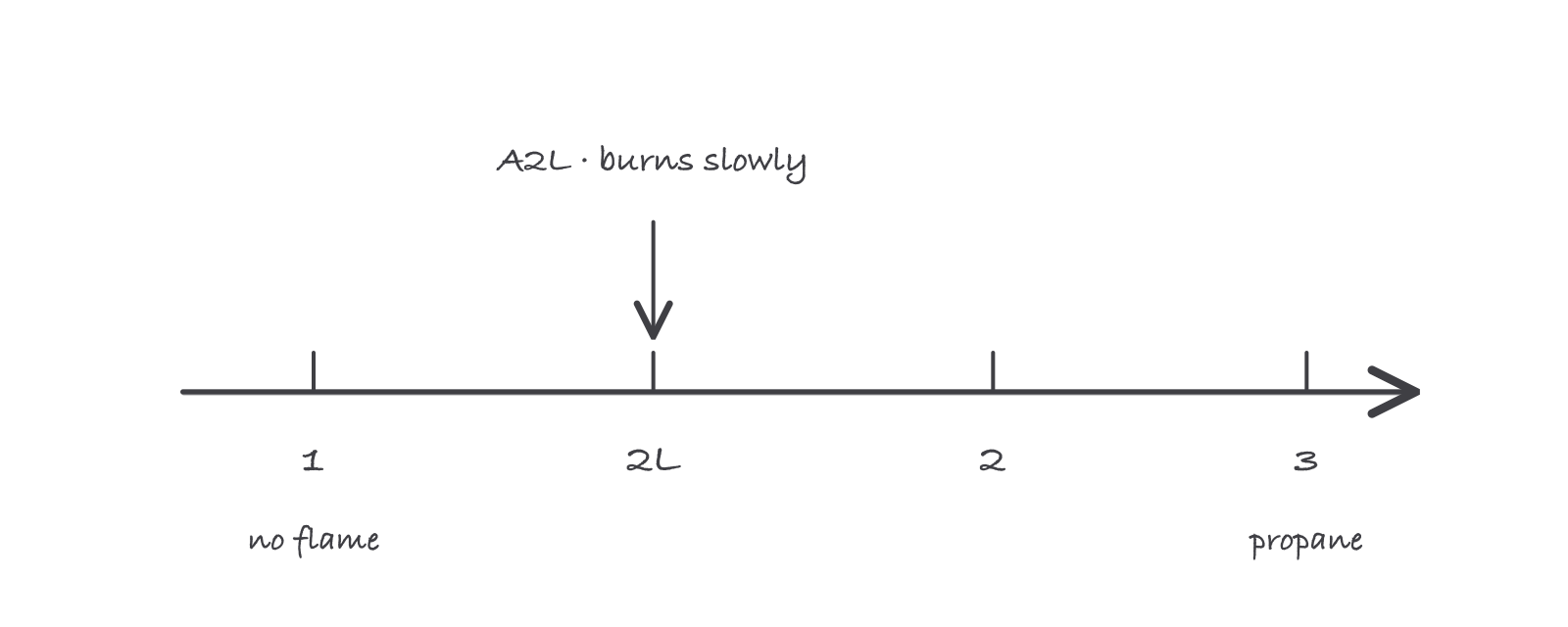
The flammability scale: A2L sits one rung above nonflammable, not next to propane
Where it bites
- “Mildly flammable” gets rounded in both directions. Treating A2L like propane wastes effort; treating it like R-410A skips the ventilation and ignition-source checks that A2L procedures require. It is its own category. Work it by the A2L rules.
- The 80% rule fails silently. An overfilled cylinder looks exactly like a properly filled one. Only the scale knows.
- Mixed refrigerants are a dead cylinder. Recovering different refrigerants into one cylinder creates a mixture nobody can reclaim; it goes for destruction at your cost. One refrigerant per cylinder, labeled.
- Nitrogen without a regulator is its own accident. A full nitrogen cylinder holds pressure far beyond what any refrigeration circuit tolerates. Regulator and relief, every time.
Exam relevance
EPA 608 tests this material directly and heavily: venting prohibitions, recovery requirements, cylinder fill limits, nitrogen practice, and decomposition hazards are core exam territory across all certification types. Know the 80% computation cold; it appears as arithmetic, exactly like the worked example above.
Verified requirements
| Where | Expires | Renewal | Continuing education |
|---|---|---|---|
| United States (federal) | No | Confirm with issuer | Confirm with issuer |
Information comes from issuing-authority sources. Confirm current rules, fees and eligibility with the authority before acting.