Learn · HVAC/R
Split System Air Conditioners
Part of HVAC Technician from Zero · step 26 of 49 · next: How Heat Pumps Work
In learning paths: HVAC Technician from Zero
Assumes you know: How the Refrigeration Cycle Works
A split system is the refrigeration cycle divided between two cabinets: an outdoor unit holding the compressor and condenser coil, and an indoor unit holding the evaporator coil and blower, joined by two refrigerant lines. It is the most common air conditioning arrangement in US homes, and the machine most residential techs learn to service first.
Why it matters on the job
Almost every residential service call puts you in front of one of these. Knowing which component lives in which cabinet, and what each of the two lines should feel like, lets you form a working diagnosis before a gauge ever comes out. It is also the layout every other cooling machine in this subject is a variation of. How the Refrigeration Cycle Works taught you the loop; this lesson bolts it onto real equipment.
Two cabinets, four components
The outdoor unit, called the condensing unit, contains the compressor, the condenser coil, and the condenser fan. Heat pulled from the house is rejected here to outdoor air.
The indoor unit is either a gas furnace with an evaporator coil set on top of it, or an air handler with the coil and blower built into one cabinet. The blower pulls house air through a filter, pushes it across the cold evaporator, and sends it back out through the supply ducts. The metering device sits at the evaporator inlet.
The line set
Two copper lines connect the cabinets, and they are deliberately different:
- The suction line is the larger pipe, always insulated. It carries cool, low-pressure refrigerant vapor from the evaporator back to the compressor. On a healthy running system it feels like a cold drink can and sweats where insulation is missing.
- The liquid line is the small, uninsulated pipe. It carries warm, high-pressure liquid from the condenser to the metering device.
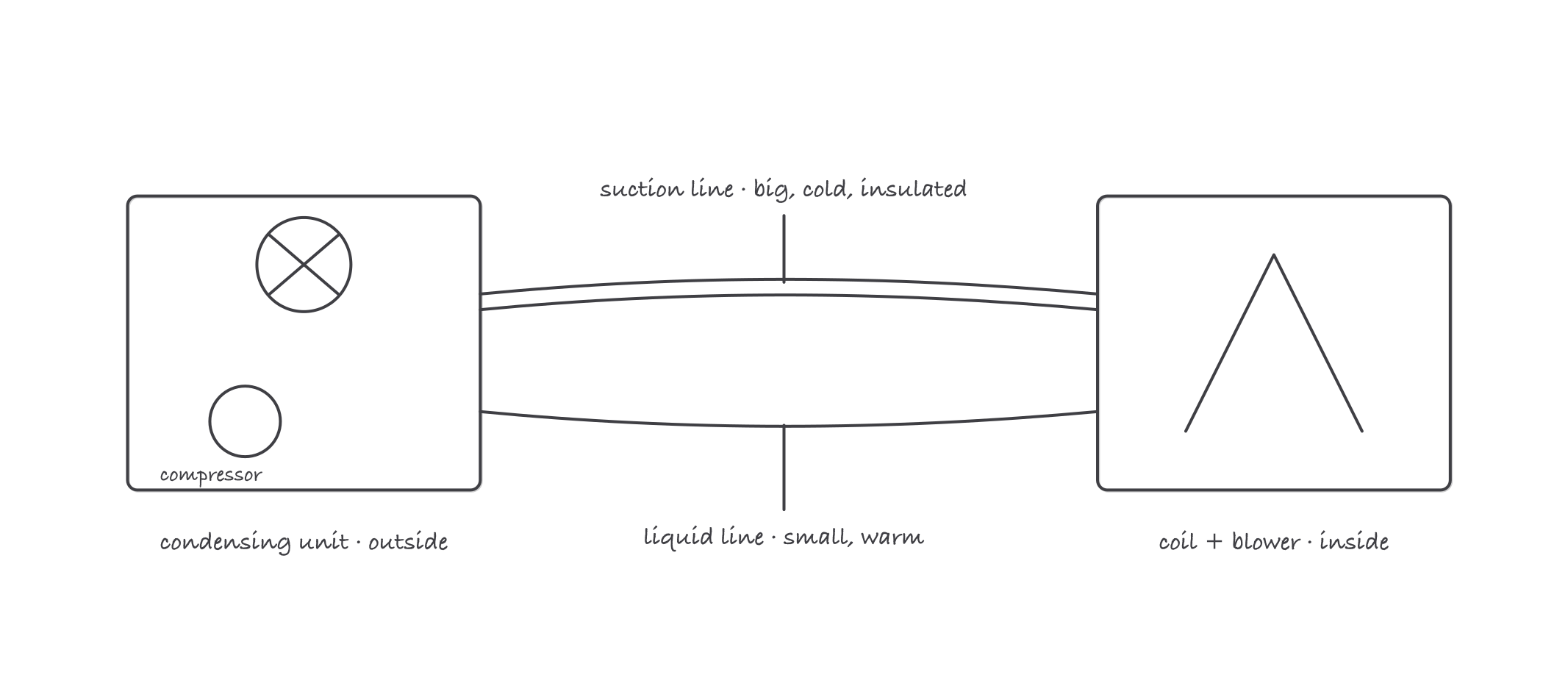
The whole machine at a glance: compressor and condenser outside, evaporator and blower inside, two very different pipes between them
Touch tells you a lot. A suction line that is warm, or a liquid line that is cold, is a system telling you where to look next.
Worked example: the temperature split
A quick health check on any split system is the temperature drop across the evaporator, the split. On a 3-ton system moving about 1,200 CFM (the 400 CFM per ton rule of thumb):
- Return air entering the coil: 75 °F
- Supply air leaving the coil: 55 °F
- Split = 75 − 55 = 20 °F
Sensible cooling delivered = 1.08 × CFM × split = 1.08 × 1,200 × 20 = 25,920 BTU/h. That is the sensible share of the work; the rest of the system’s capacity is spent wringing moisture out of the air. A split far below normal says low capacity or high airflow; a split far above normal usually says weak airflow, and Diagnosing Airflow Problems takes that thread further.
Where it bites
- “Condenser” names the coil, not the box. Techs say condenser for the whole outdoor unit, and the trade understands, but the condensing unit also holds the compressor and fan. Precision matters when you order parts.
- The evaporator does half its job in water. Cooling capacity includes latent heat, moisture condensed out of the air. Judging a system on air temperature split alone ignores that share of the work, especially on humid days.
- The two cabinets are one matched machine. Coil, metering device, and condensing unit are rated together. Swapping one side casually, common after a compressor failure, can leave a mismatched system that never performs to its rating.
- The line set is a component too. Kinked, undersized, or absurdly long line sets change what the system can do, and a suction line missing its insulation loses capacity and drips condensate wherever it runs.