Learn · HVAC/R
Capacitors in HVAC
Part of HVAC Technician from Zero · step 19 of 49 · next: HVAC Motors: PSC, ECM and Beyond
In learning paths: HVAC Technician from Zero
Assumes you know: Electrical Fundamentals for HVAC
A capacitor gives a single-phase motor the second phase it was never wired for. Single-phase power alone cannot start a motor turning: it pushes and pulls along one axis. The capacitor shifts current in a second winding out of step with the first, and that phase shift creates the rotating magnetic field that makes the shaft turn. When a capacitor drifts out of spec, the motor loses torque long before it loses power.
Why it matters on the job
Capacitors are among the most commonly replaced electrical parts in residential HVAC, and among the most commonly misdiagnosed. A weak run capacitor can leave a compressor humming and tripping on overload, drawing high amps, or starting only on cool mornings. Knowing how to test one, against its rating and tolerance rather than by guesswork, separates a repair from a parts cannon.
Run capacitors and start capacitors are different tools
Run capacitors stay in the circuit the whole time the motor runs. They are oil-filled, rated for continuous duty, and sized in the tens of microfarads: 5 µF for a small fan motor, 35 to 60 µF for a compressor. Many condensing units use a dual run capacitor, one can with three terminals: C (common), FAN (condenser fan), and HERM (hermetic compressor). One can, two capacitors sharing a common leg.
Start capacitors are in the circuit for a fraction of a second. They are electrolytic, physically lighter, and much larger in value, often 100 to 300 µF, to deliver a hard starting kick. A relay must remove the start capacitor once the motor is up to speed; left in the circuit, it overheats and fails. Continuous duty is exactly what a start capacitor cannot do.
The microfarad test
The label states capacitance in microfarads (µF or MFD) with a tolerance, commonly ±6% on run capacitors. The test logic is arithmetic:
- Kill power, pull the disconnect, and verify dead.
- Discharge the capacitor before touching the terminals. A capacitor’s whole job is storing charge, and it holds it after power is gone. Use a bleed resistor, never a screwdriver across the terminals.
- Pull the wires off, set the meter to capacitance, and read across the terminals. On a dual cap, read C to FAN and C to HERM separately.
- Compare against the rated band. Below the low edge, replace it.
Worked example: 45 µF rated, 38.7 µF measured
The HERM section of a dual capacitor is rated 45 µF ±6%.
- Acceptable band: 45 × 0.06 = 2.7 µF, so 42.3 to 47.7 µF.
- Meter reads 38.7 µF.
- 38.7 is below 42.3. The capacitor has lost 6.3 µF, which is 14% of its rating. Replace it.
That capacitor still “works”: the motor may even run today. But capacitance loss is progressive, torque falls with it, and the compressor pays the price in heat and amps. Marginal is a failure result, not a pass.
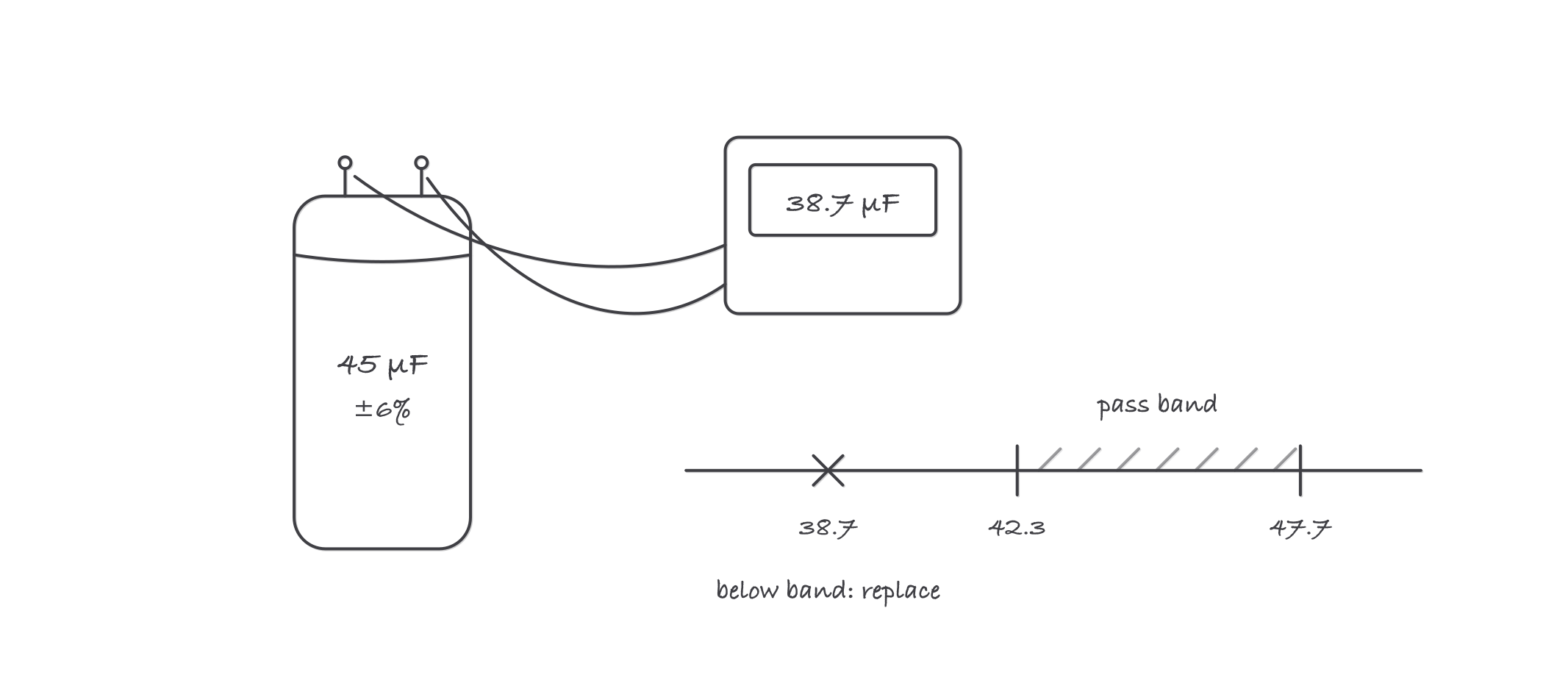
The whole test in one picture: the reading either lands inside the rated band or the capacitor is done
Where it bites
- A visual pass is not a test. A bulged or leaking can is definitely bad, but a clean flat-topped capacitor can still measure far out of tolerance. The meter decides, not the eyeball.
- Discharge first, every time. Capacitors bite technicians after the disconnect is pulled. Shorting one with a screwdriver can pit the terminals and can weld the tip; a resistor does the same job without the fireworks.
- Match microfarads exactly, voltage the same or higher. A 440 V rated can replacing a 370 V can is fine; the reverse is not. Changing the µF value changes the phase shift the motor was designed around.
- Wiring a dual cap wrong is a one-second mistake. Herm to the compressor start terminal, FAN to the fan, C to the contactor side. Photograph the wiring before you pull it.