Learn · HVAC/R
Airflow Fundamentals
Part of HVAC Technician from Zero · step 10 of 49 · next: Psychrometrics
Part of HVAC Design Fundamentals · step 1 of 9 · next: Static Pressure
In learning paths: HVAC Technician from Zero · HVAC Design Fundamentals
Airflow is the volume of air a system moves per minute, measured in cubic feet per minute (CFM), and it is governed by one relationship: volume equals area times velocity. Every duct, register, and blower problem you will ever chase reduces to that equation and to one design target: roughly 400 CFM of air per ton of cooling.
Why it matters on the job
The refrigerant circuit can only move the heat that the air delivers to it. Low airflow starves the evaporator of heat, drives coil temperature down, and produces symptoms that look exactly like low charge: low suction pressure, low superheat readings that will not stabilize, and eventually a coil iced solid. Techs who cannot verify airflow end up adding refrigerant to systems that needed a filter. Airflow first, refrigerant second: that order of diagnosis will save you more callbacks than any other habit.
The one equation
In words: the volume of air passing a point equals the cross-sectional area of the duct times the speed of the air through it.
Q = A × V
Q is airflow in CFM, A is duct area in square feet, and V is velocity in feet per minute (fpm). Measure velocity with an anemometer, know the duct size, and you have the airflow. The equation also runs in reverse: for a required CFM and a chosen velocity, it hands you the duct area, which is the seed of all duct sizing.
The companion number is the design target: nominal cooling airflow is about 400 CFM per ton of capacity. Manufacturers specify the exact figure per unit and application (dry climates run higher, humid climates lower, down toward 350 CFM per ton to improve moisture removal), but 400 is the working benchmark for a quick sanity check.
Worked example
A 3-ton air conditioner, and you want to know whether the return duct is actually delivering design airflow:
- Target: 3 tons × 400 CFM per ton = 1200 CFM.
- The return duct measures 18 in by 12 in. Area = (18 × 12) ÷ 144 = 1.5 sq ft.
- An anemometer traverse across the duct averages 800 fpm.
- Q = 1.5 × 800 = 1200 CFM. On target.
Had the traverse averaged 530 fpm, the duct would be moving about 800 CFM, two-thirds of design, and the low-suction “charge problem” upstairs would have its real explanation.
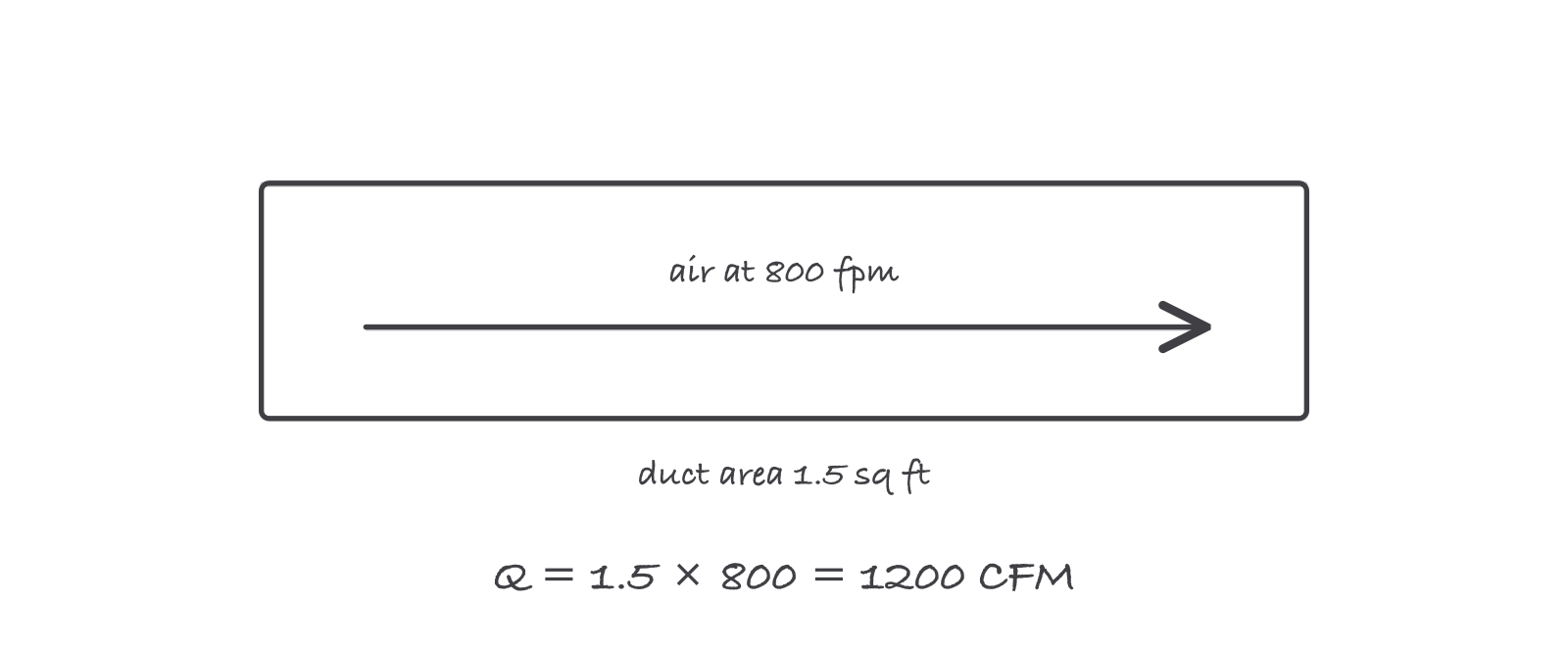
The whole subject in one duct: area times velocity is the airflow
Where it bites
- One velocity reading is not a traverse. Air moves faster in the middle of a duct than near the walls. Average several readings across the face in a grid; a single center reading flatters the number.
- Closing registers does not save energy. Blocking outlets raises system pressure and cuts total airflow; the blower works against the restriction and the coil runs colder. The “close the guest room vents” habit creates the exact problems you get paid to fix.
- Grille size is not duct size. A 20 in by 20 in return grille has far less free area than its face dimensions suggest; the bars and mesh eat a third or more. Use the duct behind it for area, or use the grille manufacturer’s free-area figure.
- Ice on the coil is an airflow suspect first. Before touching the charge on an iced system, thaw it, then verify filter, blower wheel, and airflow. Refrigerant is the last suspect, not the first.