Learn · HVAC/R
Control Board Diagnostics
Part of HVAC Technician from Zero · step 23 of 49 · next: Defrost Controls
In learning paths: HVAC Technician from Zero
Assumes you know: Contactors and Relays
A control board is a box of relays with an opinion. It takes inputs: 24 V power, thermostat calls, safety switches. It produces outputs: voltage to the inducer, the igniter, the gas valve, the blower. Its opinion arrives as a flashing LED. Board diagnosis is the discipline of checking the opinion against the evidence, because boards report faults honestly but get blamed dishonestly.
Why it matters on the job
The board is the most expensive electrical part on the truck and the easiest to condemn. “Replaced board, no change” is a story every senior technician has heard and most have lived. The board earns replacement only after its inputs are proven good and its outputs proven absent. That standard, applied every time, is what board diagnostics is.
Read the code first
The status LED flashes a pattern, and the legend for that pattern is printed on the panel door or the board itself. A code like three flashes might mean a pressure switch fault on one furnace and something else entirely on another brand: the legend on this unit is the only legend that counts.
The code is a starting pin on the map, not a verdict. “Pressure switch open when it should be closed” tells you where the board got stuck in its sequence. It does not tell you whether the switch, the hose, the inducer, or the vent caused it. That is your job.
Two habits make codes more useful. Watch the LED before you cycle power, because some boards clear stored codes on reset. And note the last-fault memory if the board has one; an intermittent fault’s history is worth more than its current mood.
The meter method
When the code points at a circuit, the meter walks it in order. The pattern is always the same three questions:
- Is the board fed? 24 V across the board’s R and C terminals, and line voltage at its power connector. No inputs, no verdict on the board.
- Is the input the board wants actually arriving? Follow the sequence of operations. If the board is waiting on the pressure switch, measure across the switch: 24 V across it means open, near 0 V means closed and the signal should be reaching the board.
- Is the output leaving? When the sequence says the board should be firing the igniter or pulling the gas valve, measure at those output terminals. Command present at the output with a dead component: bad component or wiring. Command absent with all inputs satisfied: now, finally, the board is the suspect.
Worked example: three flashes on a no-heat call
The door legend on this furnace reads three flashes as pressure switch open with inducer running. Sequence check: the inducer is indeed spinning.
- Board power: R to C reads 25.7 V. Fed.
- Across the pressure switch terminals: 25.7 V. The switch is open even though the inducer runs. The board is telling the truth.
- Pull the sensing hose at the switch: it is soft, cracked, and sucking air. The inducer never develops proof-of-draft vacuum at the switch port.
A new hose closes the switch, the sequence proceeds, and the board that “needed replacing” was the only honest witness on the scene. Total meter work: two readings.
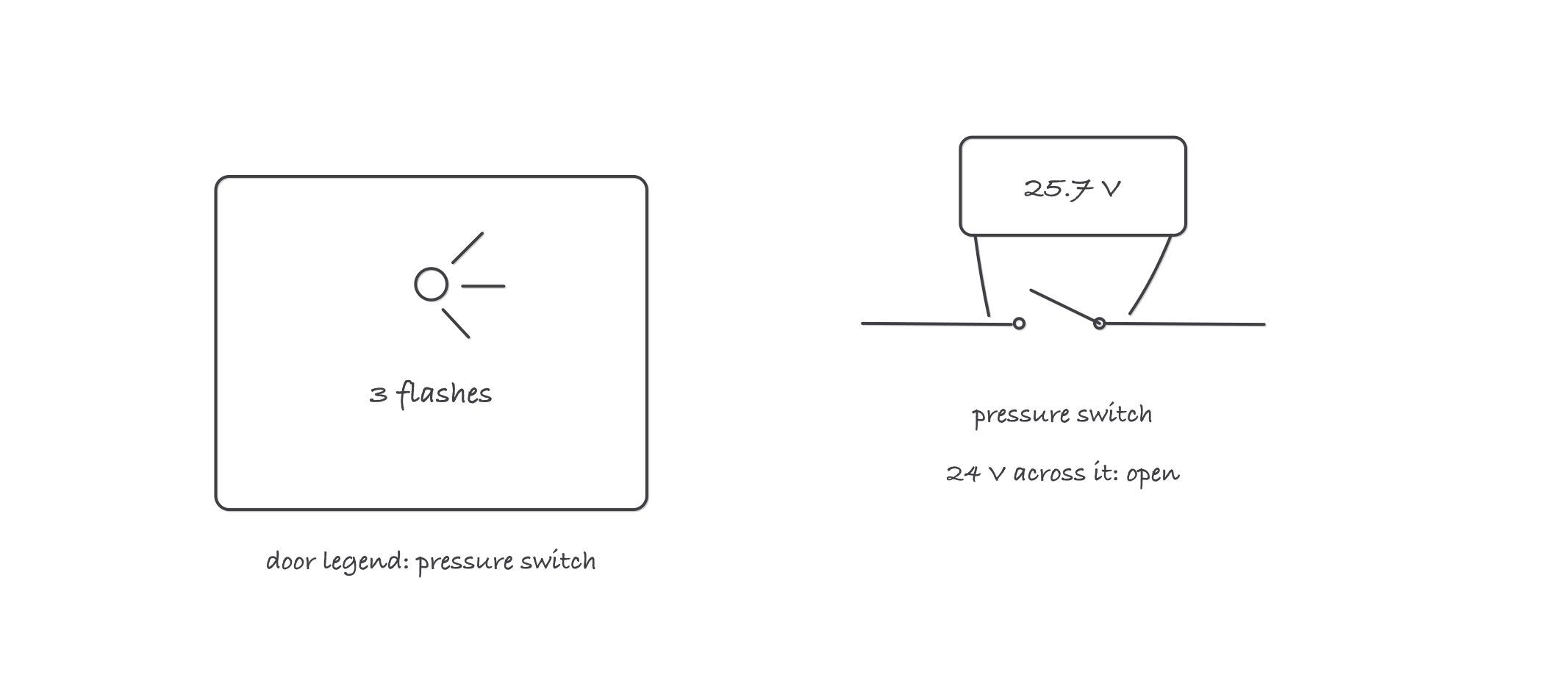
The code names the stuck step, the meter finds the guilty part: 24 V across the switch is the board saying open, and the meter agreeing
Where it bites
- Codes clear when power cycles. Kill the disconnect to work and you may erase the one clue the homeowner’s complaint left behind. Read first, reset second.
- A satisfied safety is near 0 V across it. Technicians misread 0 V across a closed switch as “no power here.” Across a closed switch in a live circuit, 0 V is exactly right; full control voltage across it is the open.
- Grounds and polarity fool flame sensing. Furnace boards prove flame through microamp rectification, and a poor equipment ground or reversed line polarity can lock out a perfectly clean burner. Check the basics before chasing the exotic.
- Boards fail too. After inputs are proven and a commanded output never appears, replace with confidence. The discipline is not “never the board”; it is “the board last, and proven.”