Learn · HVAC/R
Static Pressure
Part of HVAC Technician from Zero · step 12 of 49 · next: Duct Design Basics
Part of HVAC Design Fundamentals · step 2 of 9 · next: Psychrometrics
In learning paths: HVAC Technician from Zero · HVAC Design Fundamentals
Assumes you know: Airflow Fundamentals
Static pressure is the pressure the air exerts against the walls of the duct system, measured in inches of water column (in. w.c.), and it is the blood pressure of an air system: a cheap two-minute reading that tells you whether the airflow is healthy before you open anything. High static means restriction; the blower is pushing against more resistance than the system was designed for.
Why it matters on the job
You cannot see airflow, and measuring it properly takes a traverse. Static pressure is the shortcut: two probe holes and a manometer give you a number to compare against the equipment’s design rating. It is the fastest way to catch the crushed flex duct, the choked filter, or the undersized return that is quietly killing capacity, and it turns “the airflow seems weak” into a measurement you can defend.
Total external static pressure
The blower produces a pressure difference. On the return side it pulls air, so the duct runs below atmospheric pressure: a negative reading. On the supply side it pushes, so the duct runs positive. Total external static pressure (TESP) is the sum of the two magnitudes, measured directly at the equipment:
TESP = |return-side reading| + |supply-side reading|
“External” means external to the furnace or air handler as the manufacturer rates it: you probe between the filter or coil and the cabinet per the manufacturer’s rating notes, because what counts as inside the equipment varies. Drill your test ports where the airstream enters and leaves the rated equipment, read each side with a manometer and a static-pressure tip, and add the magnitudes.
Most residential equipment is rated to deliver its airflow at a TESP of about 0.5 in. w.c. The rating is on the nameplate or in the blower table. That number is the whole diagnosis: measured TESP near rating means the duct system is a fair match; measured TESP far above it means the blower is fighting restriction.
Worked example
A 3-ton system, blower rated for 1200 CFM at 0.5 in. w.c. TESP. You drill test ports and measure:
- Return side, between filter and blower: −0.5 in. w.c.
- Supply side, above the coil: +0.4 in. w.c.
- TESP = 0.5 + 0.4 = 0.9 in. w.c., nearly double the 0.5 design rating. This duct system is restrictive, and the blower is not delivering rated airflow.
- The split points at the return: 0.5 of the 0.9 is on the suction side. Check the filter first, then return duct sizing. A second reading across the filter alone shows 0.35 in. w.c.: a high-resistance pleated filter is eating most of the budget.
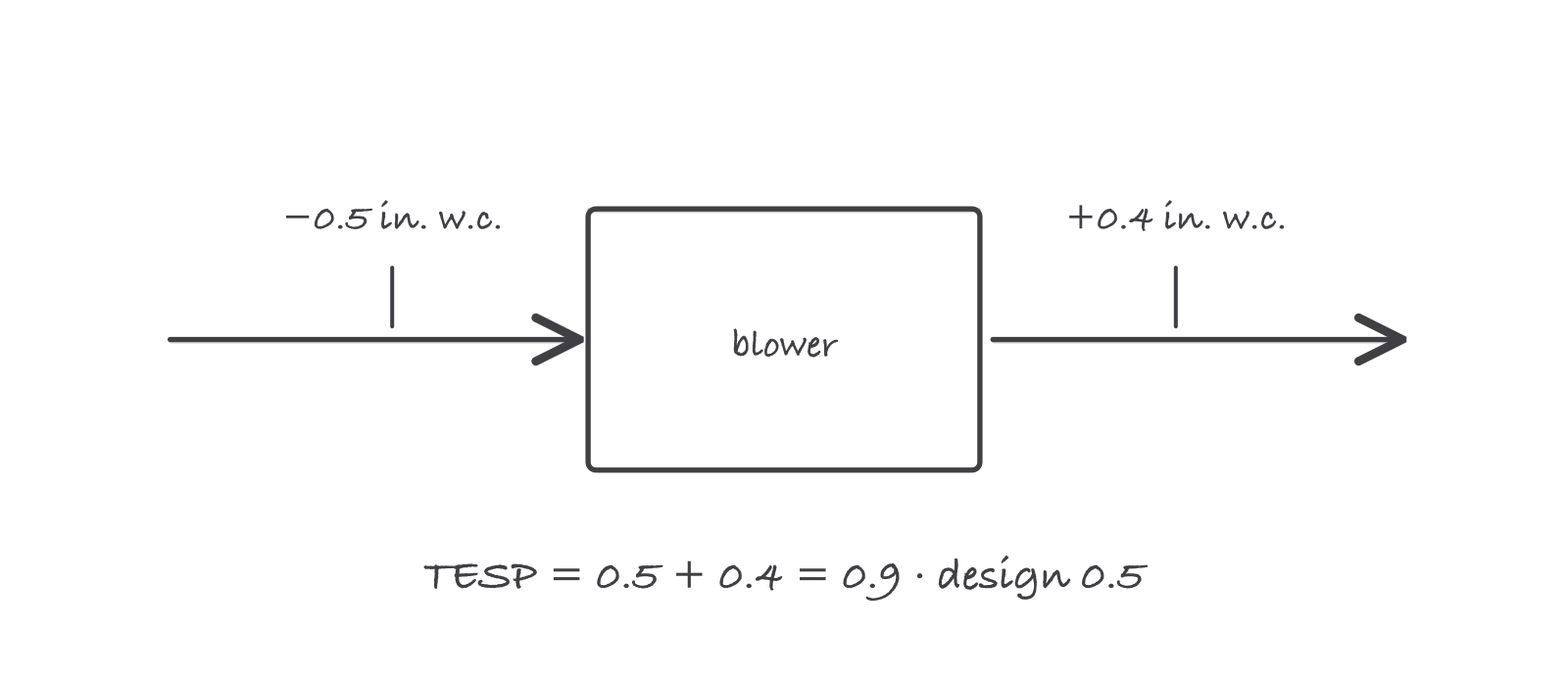
Two probes and an addition: 0.9 measured against 0.5 design says restriction, and the bigger side says where
Where it bites
- An ECM blower hides the symptom. A variable-speed motor ramps up to hold CFM against high static, so the house still cools while the motor runs hot, loud, and expensive. A PSC blower moves less air. Same duct problem, different disguise.
- High static is a system diagnosis, not a part diagnosis. The fix is usually more return area, a lower-resistance filter, or replacing a crushed run: airflow surgery, not a blower swap. A bigger blower into the same restriction buys a louder version of the problem.
- Probe placement decides the number. Reading on the wrong side of the filter or coil silently adds their pressure drop to “external” static and condemns an innocent duct system. Match your ports to how the manufacturer rates the equipment.
- The static tip matters. A bare tube end facing the airstream reads velocity pressure as well as static. Use a static-pressure tip pointed into the airflow, per its instructions, or your numbers drift with every gust.