Learn · HVAC/R
Refrigerant Oils
Part of EPA 608: All Four Exams · step 11 of 20 · next: Refrigerant Safety and Handling
Part of HVAC Technician from Zero · step 15 of 49 · next: Refrigerant Safety and Handling
In learning paths: EPA 608: All Four Exams · HVAC Technician from Zero
Assumes you know: Refrigerant Types and Designations
Compressor oil does not stay in the compressor: it travels the whole circuit with the refrigerant, and it only comes home if the oil and the refrigerant are matched to each other. That is the entire subject. Match them and the compressor lives; mismatch them and the oil drops out somewhere in the system while the compressor runs dry.
Why it matters on the job
Every refrigerant family brought its own oil, so the oil in a system is set by the refrigerant era: get it wrong during a retrofit or a top-up and you starve the compressor. And the modern oil, POE, has a vice the old oil never had: it pulls moisture out of the air on contact, and wet POE slowly destroys the system from the inside. Half of oil discipline is matching; the other half is keeping POE dry.
Matching oil to refrigerant
- Mineral oil dissolves well in chlorinated refrigerants, so it paired with CFCs and HCFCs. An R-22 system almost certainly runs mineral oil (or its cousin, alkylbenzene).
- POE (polyolester) dissolves in chlorine-free HFCs, which mineral oil does not. R-410A and R-134a systems run POE, and the A2L refrigerants, R-32 and R-454B, keep using POE. The oil did not change in the A2L transition; the handling rules around it did not either.
- PAG oil belongs to automotive R-134a systems; you will meet it at the parts counter, not in a furnace closet.
Miscibility is the working word: the oil must dissolve in the circulating refrigerant so that velocity and solubility drag it around the loop and back to the crankcase. Mineral oil in an HFC system does not dissolve; it wads up in the evaporator, coats the tubes, cuts heat transfer, and leaves the compressor running on whatever film remains.
POE and moisture
POE is hygroscopic: an open container pulls moisture straight from humid air, and unlike mineral oil it holds that water chemically. Wet POE hydrolyzes into acids, and acid circulating in a sealed system etches windings, plates copper onto bearing surfaces, and ends in a burnout months after the mistake. The discipline: keep POE sealed until the moment of use, keep system open time short, always install a new filter-drier when a system has been opened, and prove dryness with a vacuum gauge, not a wristwatch.
Worked example
You replace a failed compressor on an R-410A system, which means fresh POE in the new compressor and a system that has been open to the air:
- Swap the compressor with the line openings capped until the last minute, and install a new liquid-line filter-drier.
- Evacuate to 500 microns on a micron gauge at the system, not at the pump.
- Valve off the pump and watch: pressure creeps to 900 microns and keeps climbing. That is moisture still boiling out of the oil, so you keep pulling.
- Second decay test: rises to 700 microns and holds steady. Dry and tight. Now the system can be charged.
The micron gauge is your only honest witness that the POE is dry; nothing about the oil’s look or the elapsed time tells you.
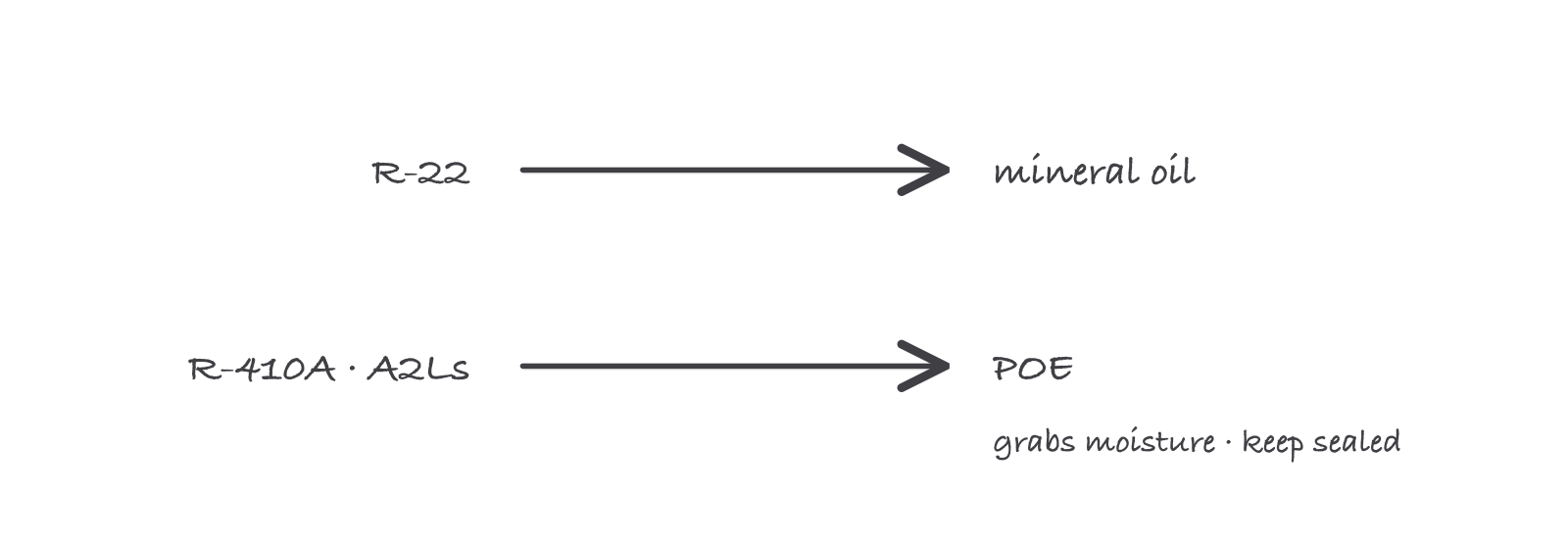
The pairing rule on one card: the refrigerant era picks the oil, and POE stays sealed until use
Where it bites
- Topping up with the wrong oil is invisible until it is fatal. A quart of mineral oil in a POE system will not show on any gauge; it shows up a year later as a starved compressor.
- POE open time is measured in minutes. Leaving a new compressor uncapped overnight in a humid garage can wet the oil before installation.
- POE is a solvent. In a system converted from mineral oil it scrubs old sludge off the tubing walls and delivers it to the filter-drier and expansion valve screen. Conversions follow the manufacturer’s flushing procedure, which typically takes several oil changes to bring residual mineral oil down to a few percent, and clogged screens afterward are a known symptom, not a mystery.
- A burnout poisons the oil. After a compressor burnout, acid rides in the residual POE. Follow the cleanup procedure, including suction-line drier, or the replacement dies the same death.
Exam relevance
EPA 608 touches oils mainly through moisture and system cleanliness: why deep vacuum matters, what filter-driers do, and safe handling of contaminated oil. Trade exams like NATE go further: oil and refrigerant pairing, miscibility, and retrofit procedure are standard question material.
Verified requirements
| Where | Expires | Renewal | Continuing education |
|---|---|---|---|
| United States (federal) | No | Confirm with issuer | Confirm with issuer |
Information comes from issuing-authority sources. Confirm current rules, fees and eligibility with the authority before acting.