Learn · HVAC/R
Ice Machines
Part of HVAC Technician from Zero · step 35 of 49 · next: Brazing for HVAC
In learning paths: HVAC Technician from Zero
Assumes you know: Commercial Refrigeration Systems
An ice machine is a refrigeration system that batches: it freezes water on an evaporator surface for a while, then deliberately reverses course and warms that surface just enough to release the ice. Freeze, harvest, repeat. Most of what makes ice machines their own specialty lives in that two-phase cycle and in the water that feeds it.
Why it matters on the job
Restaurants and bars treat ice as an ingredient, and health inspectors treat the machine as a food-contact surface. Ice machine accounts are steady, year-round refrigeration work, and the machines fail in their own characteristic ways: mostly water problems wearing a refrigeration disguise. A tech fluent in Commercial Refrigeration Systems who also understands the batch cycle owns this niche.
The freeze cycle
During freeze, the machine is a straightforward refrigeration circuit: the compressor runs, the evaporator sits behind a metal freezing surface (cube mold, plate, or the cylinder of a flake machine), and a small pump recirculates water over that surface. Ice builds in layers as the water passes again and again; water that does not freeze falls back to the sump and goes around again. Layered freezing from moving water is also a purifier: minerals stay behind in the sump as pure water freezes out, which is why the sump concentrates minerals and why the machine flushes it.
The freeze ends when the ice reaches size, sensed by thickness probe, time, or temperature, depending on the maker.
The harvest cycle
To release the ice, the machine warms the freezing surface from behind, most commonly by opening a hot gas valve that routes hot discharge vapor from the compressor straight into the evaporator, skipping the condenser. The surface warms a few degrees, the bond layer of ice melts, and the slab or cubes drop into the bin by gravity, helped on some machines by deflectors or a push from the next batch. Cuber, flaker and nugget machines differ in mechanism, flakers harvest continuously with an auger, but the freeze-then-release idea is the family trait.
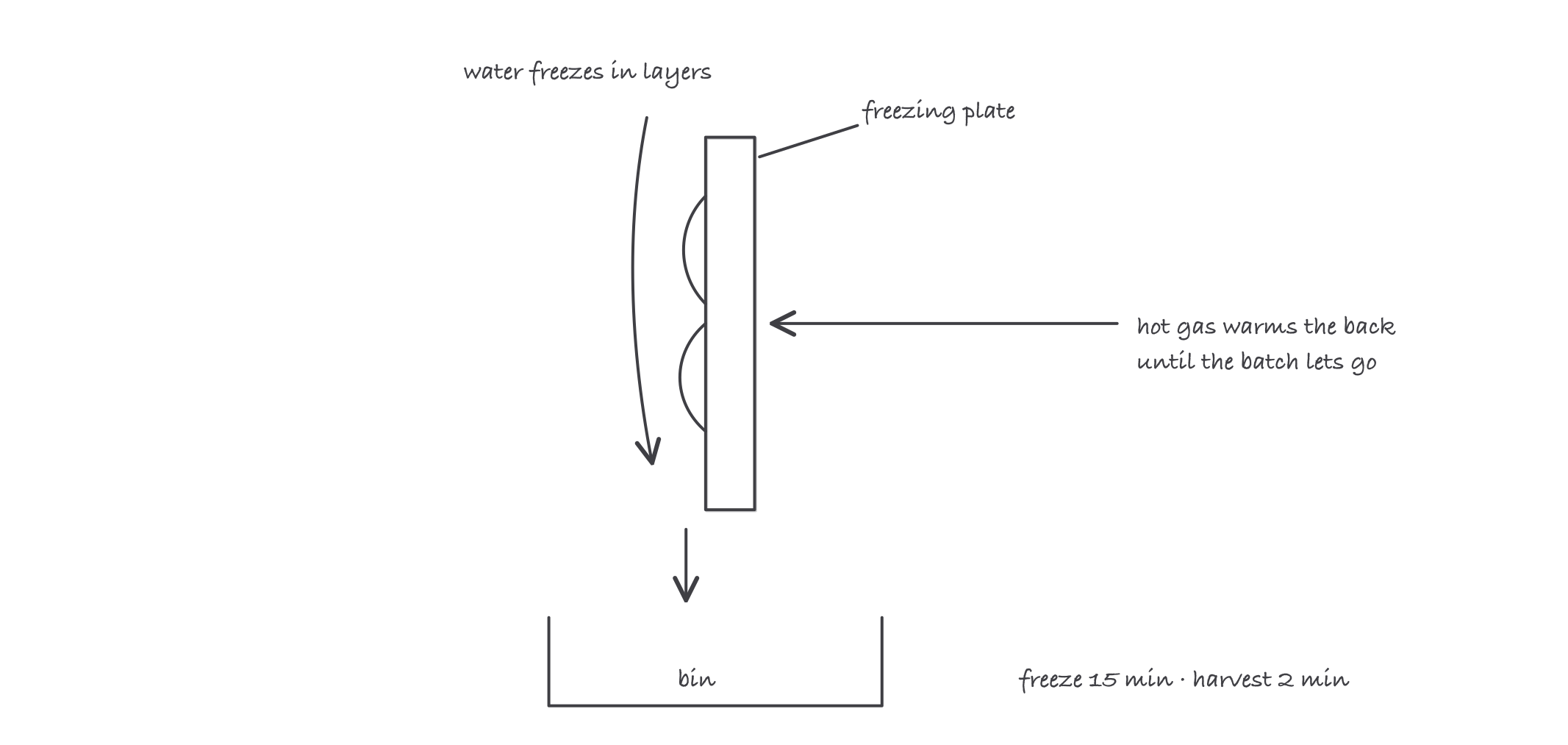
Two cycles on one surface: water freezes in layers on the front, then hot discharge gas warms the back until the batch lets go
A bin thermostat or sensor stops the machine when the storage bin fills. The bin itself is unrefrigerated storage: the ice keeps it cold, melting slowly into a drain.
Worked example: cycle time is production
Ice machine capacity is nothing more than batch size times batches per day. A cuber that freezes for 15 minutes, harvests for 2 minutes, and drops 5 lb of ice per batch:
- Cycle time: 15 + 2 = 17 minutes
- Cycles per day: 1,440 ÷ 17 ≈ 84.7
- Production: 84.7 × 5 = about 423 lb of ice per day
Now stretch the freeze cycle to 20 minutes (warm water feed, weak condenser, or a low charge will do it): 1,440 ÷ 22 ≈ 65.5 cycles, 65.5 × 5 ≈ 327 lb per day, a quarter of the machine’s production gone without a single “broken” part. Rated capacity is stated at reference water and air temperatures, so a healthy machine on a hot day in a hot kitchen makes less ice than the brochure says, honestly.
Where it bites
- Water quality is the number one failure source. Scale coats the freezing surface and the thickness sensor, cubes come out shallow or cloudy, harvests hang. Freeze-ups from scale mimic refrigerant faults. Check water treatment, filters and the flush cycle before reaching for gauges.
- Cleaning and sanitizing are different chemicals doing different jobs. Scale remover dissolves minerals; sanitizer kills slime and mold. A machine “cleaned” with only one of them is half-serviced, and the nickel-plated evaporators on many cubers tolerate only approved cleaners at approved strengths: the manufacturer’s manual governs.
- A harvest that will not release looks electrical and usually is not. Long or failed harvests trace to scale on the plate, a leaking or stuck hot gas valve, or low charge, before they trace to the control board.
- Diagnose against the cycle, not against a snapshot. Every reading means something different in freeze than in harvest, the machine swaps its own refrigerant path between them. Know which phase you are watching, then read the gauges; a full cycle observed beats an hour of static readings.