Learn · HVAC/R
Building Controls and BAS Basics
Part of Commercial HVAC Systems · step 10 of 10
In learning paths: Commercial HVAC Systems
Assumes you know: Control Board Diagnostics
A building control system turns sensor readings and schedules into equipment commands. Sensors report conditions, controllers apply logic, actuators move dampers and valves, and a network lets the pieces share status and alarms.
Why it matters on the job
Commercial equipment often does exactly what the control system tells it to do, even when that command makes the room uncomfortable. Before condemning a motor, valve, damper, or refrigeration circuit, separate a bad command from a device that failed to obey a good command.
The control loop
Every loop has four useful questions:
- What condition is being measured?
- What target or schedule is active?
- What decision did the controller make?
- Did the final device produce the expected physical result?
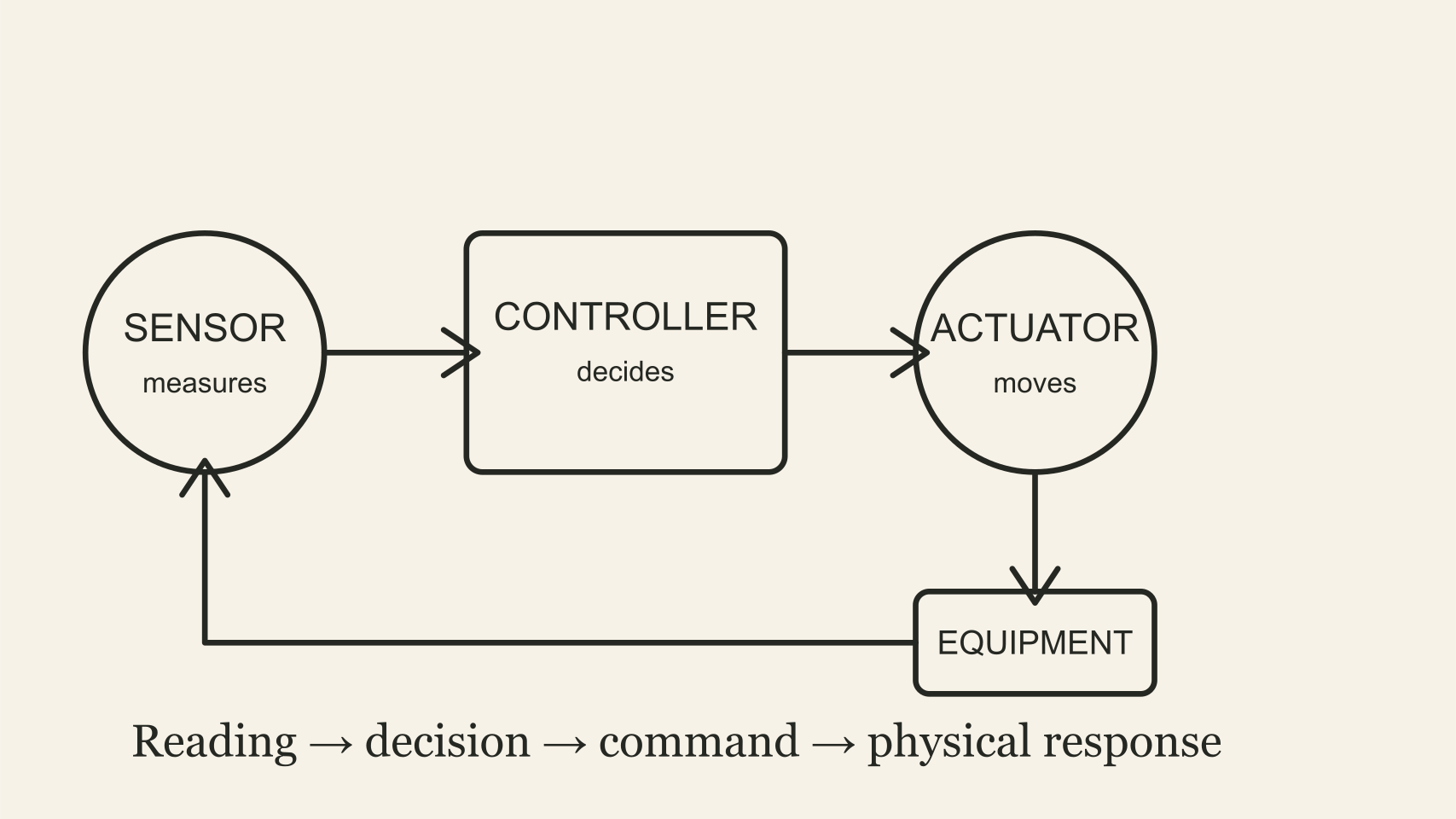
A complete diagnosis checks the reading, the decision, the command, and the physical response
Building automation may combine HVAC, lighting, metering, and other systems. Open communication protocols such as BACnet and internet-based networking can help systems exchange information, but a shared protocol does not guarantee that every point name, sequence, or interface behaves the same way.
Commands are not proof
A graphic that says a valve is 100% open may show the command, not verified position or water flow. A fan status point may come from an auxiliary contact, current switch, pressure switch, or software assumption. Identify what each point physically represents before trusting it.
Trends are often stronger evidence than a snapshot. Plot the request, sensor, output command, and proof point over the same period. Their timing can expose hunting, overrides, stuck hardware, bad sensors, and schedules that never release.
Worked example
An illustrative supply fan draws 5 kW. The building is occupied for 10 hours, but a schedule error runs the fan for 24 hours.
- Excess runtime: 24 h − 10 h = 14 h/day
- Excess energy: 5 kW × 14 h = 70 kWh/day
- Over 30 days: 70 kWh/day × 30 = 2,100 kWh
This estimate does not include changing fan power, heating, or cooling effects. It shows why a schedule is an operating condition worth verifying, not a minor software detail.
Where it bites
- Point labels can lie by omission. Determine whether a point is a command, measured value, calculated value, or proof.
- Overrides outlive the service call. Record and remove temporary overrides under the site’s control procedure.
- A controls fix must make physical sense. Watch the valve, damper, fan, temperature, or pressure respond.
- Do not rewrite a sequence to hide a mechanical fault. Preserve the design intent and document any approved change.