Business · General Contracting
Prompt Payment Laws
Part of Contractor License, Start to Finish · step 17 of 21 · next: Unlicensed Work: Penalties and Enforcement
In learning paths: Contractor License, Start to Finish
Assumes you know: Mechanics Liens
Prompt payment laws put a statutory clock on construction money: once a proper payment application is in the payer’s hands, or once the payer has itself been paid, payment is due within a set number of days, and lateness accrues interest by operation of law. They exist because “we’ll pay you when we pay you” was the industry’s default, and legislatures decided the parties who finance that float, subs and suppliers, needed a backstop.
Coverage and figures are state-specific: nearly every state has prompt payment statutes for public work, many extend them to private work, and the federal government runs its own regime on federal jobs. As with lien law, learn the mechanism here and pull the numbers from your state’s statute.
Why it matters on the job
Cash flow kills more contractors than bad workmanship does. A profitable job that pays in 120 days can sink a company that meets payroll weekly. Prompt payment statutes give you three practical things: a defined due date you can put in writing, automatic interest you can invoice without renegotiating the contract, and in some states leverage like suspension-of-work rights or attorney fees. You only get them if you know they exist and how the clock starts.
How the clock works
The mechanism has three moving parts:
A trigger. For the owner-to-prime leg, the clock usually starts when the owner receives a proper pay application: complete, in the agreed form, with required backup like waivers and certified payroll where applicable. A defective application typically does not start the clock, and the payer must usually say what is wrong within a set time.
A window per link. The statute gives the owner a number of days to pay the prime, then gives the prime a shorter number of days to pass each sub’s share down after receiving it, and so on down the chain. The clocks relay: each lower link’s clock starts when its payer gets paid.
A penalty. Late amounts accrue statutory interest, sometimes at rates deliberately above market to make float expensive. Some statutes add attorney fees for collection, or a right to stop work after notice.
Statutes also police withholding: a payer may generally withhold only for a good-faith, identified reason, defective work, missing documentation, and often only an amount reasonably related to the problem, with the rest still due on time.
Prompt payment meets the contract
Two clauses you will meet in Construction Contract Fundamentals interact with these statutes:
- Pay-when-paid treats the owner’s payment as a timing device: the prime must still pay the sub within a reasonable time even if the owner never pays.
- Pay-if-paid tries to shift the risk of owner nonpayment onto the sub entirely, payment to the sub is conditioned on the owner paying. Courts read these narrowly, and some states refuse to enforce them.
Prompt payment statutes generally run alongside these clauses rather than erasing them, which is why the same late check can raise both a statutory interest claim and a contract dispute.
Worked example: pricing the float
Hypothetical statute: owner pays the prime within 30 days of a proper application, the prime pays subs within 7 days of receiving payment, and late amounts accrue interest at 1% per month. Example figures again; your statute sets its own.
Your pay application for $48,000 is received complete on March 1.
- Owner’s due date: March 1 + 30 days = March 31.
- The owner pays May 30 instead. Days late: April (30) plus May 1 through 30 (30) = 60 days, two full months.
- Statutory interest: $48,000 × 1% × 2 = $960, invoiced as of right, no renegotiation needed.
- Your electrician’s share of that application is $20,000. Their clock starts when you are paid: May 30 + 7 days = June 6. Miss it and you owe the same kind of interest one link down.
Notice what the arithmetic rewards: submitting clean, complete applications, because a rejected application on March 1, corrected March 20, moves the whole schedule 19 days without anyone being “late.”
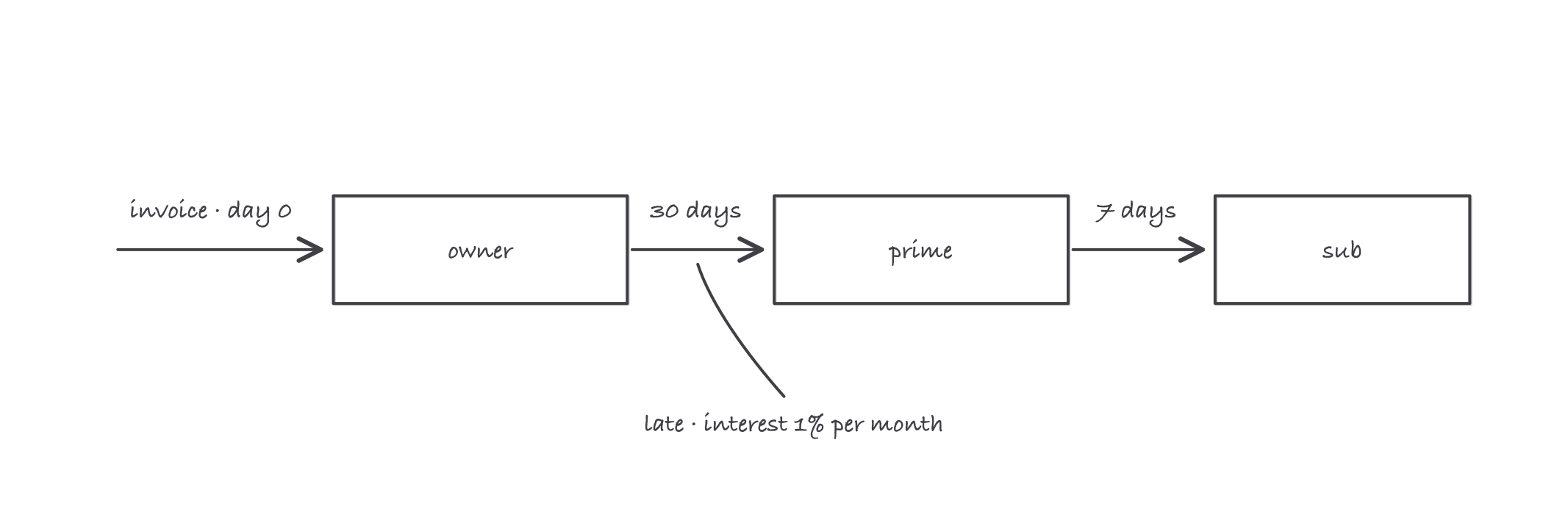
The clock relays: each payment down the chain starts the next window, with example figures shown
Where it bites
- The clock starts on a proper application, not any application. Missing waivers or a wrong schedule of values means, in many statutes, that no clock is running at all. Perfect paperwork is a cash-flow strategy.
- Interest rarely pays itself. Most payers will not add statutory interest voluntarily. Invoice it, in writing, citing the statute, or it quietly evaporates in the final reconciliation.
- Public and private jobs run different rules. The same state can have a strict public prompt payment act and a looser private one, with different windows, rates, and remedies. Check which regime your job sits under before quoting deadlines at anyone.
- Withholding must be surgical. Backcharging a $4,000 punch-list dispute by freezing a $48,000 payment is exactly what these statutes prohibit; the undisputed balance stays on the clock.
- Stopping work is a statutory procedure, not a mood. Where suspension rights exist they require notice and waiting periods. Walking off without following them converts their breach into yours.
Exam relevance
Business and law exams test the concepts more than any one state’s day counts: that prompt payment statutes exist for public and often private work, that interest accrues on late payment, and the difference between pay-when-paid and pay-if-paid. NASCLA-based exams draw these from the business and law reference’s payment chapters. For your state’s exam, learn its actual windows and interest rate, and whether its statute covers private jobs.
Verified requirements
| Where | Expires | Renewal | Continuing education |
|---|---|---|---|
| California | Yes | 2 years (CSLB: 'Active licenses expire every two years.' Inactive licences expire every four years.) | Confirm with issuer |
| Florida | Confirm with issuer | Confirm with issuer | Confirm with issuer |
| Arizona | Confirm with issuer | Confirm with issuer | Confirm with issuer |
Information comes from issuing-authority sources. Confirm current rules, fees and eligibility with the authority before acting.