Business · General Contracting
Public vs Private Bidding
Assumes you know: Preparing a Bid
Public work is bid by rule; private work is bid by relationship. The estimating is the same arithmetic in both worlds, but the game around the number is played entirely differently, and playing one world’s game in the other is expensive.
Why it matters on the job
Public agencies spend taxpayer money, so the process is designed for fairness and transparency: advertised openly, sealed bids, public opening, award to the lowest responsive and responsible bidder, with little or no negotiation. A private owner can hire whoever they like, however they like: negotiate, ask for revisions, choose the second-lowest bid because they trust that contractor more. Your bid strategy, paperwork discipline and pricing all shift with the setting.
The public game
- Low bid usually wins, within two tests. Responsive means your bid followed the rules: every blank filled, every addendum acknowledged, bid security attached, delivered on time. Responsible means your firm is qualified: licensed, bonded, financially sound, with the required experience. A low bid that fails either test is set aside.
- Bid security is commonly required, typically a bid bond for a percentage of the bid amount; the invitation states the percentage and the rules. It backs your promise to sign the contract at your price.
- Wage requirements may apply. Many public jobs carry prevailing wage obligations, with rates published in the bid documents. Reprice labor from the wage determination, not from your normal payroll; your $28.00 shop wage assumption is void here. The specific rules and rates always come from the bid documents and the issuing agency.
- The rules are unforgiving on purpose. Late is late. Mistakes generally cannot be negotiated away after opening, and withdrawal is restricted. The paperwork discipline from the bid preparation lesson is not optional here; it is the entry fee.
The private game
- Best value beats low price. Owners weigh reputation, schedule, financing comfort and chemistry. Your qualifications package and references are part of the bid.
- Everything is negotiable: scope, price, payment terms, schedule. A first bid is an opening position, and value engineering conversations can win a job your number alone would not.
- Less protection, more diligence. Public owners are generally reliable payers with prescribed processes. A private owner’s ability and willingness to pay is your job to verify before you bid, not after you invoice.
Worked example: reading a public bid opening
The invitation requires bid security of 5 percent. Your bid is $472,000, so the bond’s penal sum is $472,000 × 0.05 = $23,600. At the public opening the results are read aloud:
- Your bid: $472,000
- Second bidder: $541,000
- Third bidder: $558,000
You are low by $69,000, which is $69,000 ÷ $541,000 = 12.8 percent below the next bid, while second and third sit 3.1 percent apart ($17,000 ÷ $541,000). Clustered competitors and one far-low bid is the classic signature of a missed scope item, and the low bid is yours. Before celebrating, re-walk your takeoff against the checklist. If the number holds, you won honestly; if it does not, you have a hard conversation to have while options still exist, because the bid bond exists precisely to make walking away costly.
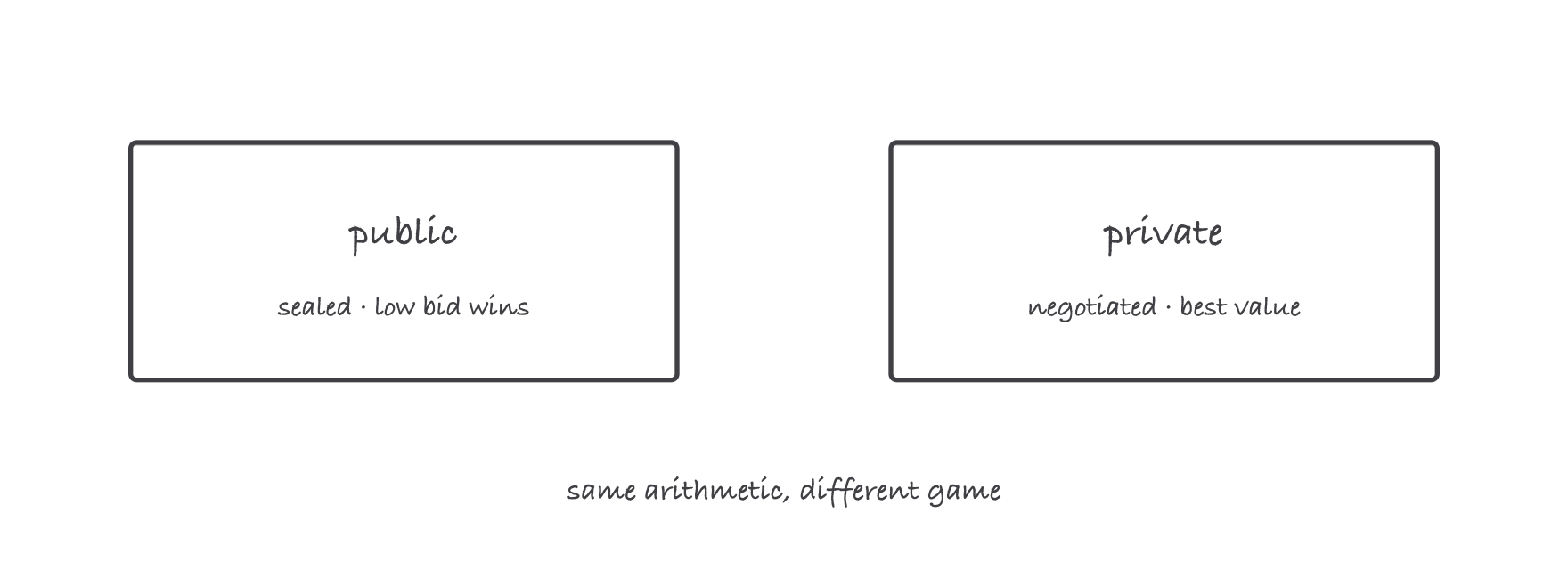
The estimate is computed the same way in both worlds; everything around it changes
Where it bites
- Private habits on public bids. There is no “let me explain my number” meeting after a sealed opening. The form, the security and the clock decide, and they do not care about your relationship with the agency.
- Public pricing on private work. Stripping your bid to the bone to be lowest, when the private owner was choosing on confidence, loses twice: you either miss the award or win it thin.
- Prevailing wage priced at shop rates. On covered public work, labor priced from your normal payroll instead of the published determination understates the largest number in the bid.
- Ignoring the responsible test. Chasing public work beyond your bonding capacity or experience record wastes the bid: you can be low and still lose, publicly.