Business · General Contracting
Unlicensed Work: Penalties and Enforcement
Part of Contractor License, Start to Finish · step 18 of 21 · next: OSHA Duties as an Employer
In learning paths: Contractor License, Start to Finish
Assumes you know: How Contractor Licensing Actually Works
Contracting without a required license is illegal in every state that licenses contractors, and the fine is rarely the expensive part. The expensive part is civil: in most licensing states an unlicensed contractor cannot enforce the contract, cannot record a lien, and in the harshest states can be forced to hand back money already earned. The penalty structure is designed to make unlicensed work not just risky but uncollectable.
How Contractor Licensing Actually Works covers who needs a license and when. This lesson covers what happens when that line gets crossed, deliberately or by accident, because most violations are accidents: a lapsed renewal, a job over a monetary threshold, work outside a classification.
Why it matters on the job
You will be tempted, or asked, to work in the gray: start before the license issues, take one job over the threshold, “help out” under a friend’s number. Knowing the actual penalty structure turns those from judgment calls into arithmetic. It also protects you from the other side, because hiring an unlicensed sub can drag your own license into the mess.
The enforcement stack
State boards and prosecutors work with several layers, and they stack:
- Criminal charges. Unlicensed contracting is typically a misdemeanor for a first offense, with fines and possible jail, and repeat offenses escalate in many states, sometimes to felony level. Boards run sting operations against unlicensed operators; this is enforced law, not shelf law.
- Administrative citations and fines. Boards issue citations and civil penalties without going to court, against unlicensed operators and against licensees who aid them.
- The civil bar. The quiet killer: statutes in most licensing states bar an unlicensed contractor from suing to collect payment for work that required a license. Build the job, finish the job, and have no legal path to the money.
- Disgorgement. The harshest states go further: the customer can sue to recover everything already paid to an unlicensed contractor, even for flawless work.
What counts as unlicensed
The statute catches more situations than “never had a license”:
- Lapsed license. A missed renewal can make you unlicensed mid-project. Some states forgive brief gaps through substantial-compliance doctrines; others count every unlicensed day literally.
- Wrong classification. Holding a plumbing classification and taking a general building job, or vice versa, is contracting outside your license.
- Over the threshold. In states that exempt small jobs below a dollar amount, a job priced above it, or split into pieces to duck it, requires the license. Splitting is itself a violation.
- Using someone else’s license. “Renting” a license, or lending yours as a qualifier to a company you do not actually supervise, exposes both parties to discipline and criminal charges.
Licensees have their own ladder: citation, fine, probation, suspension, revocation, plus claims against the license bond. Aiding an unlicensed contractor, or subbing work to one, is a discipline ground in many states.
Worked example: the price of a lapsed renewal
Hypothetical but realistic structure; your state’s statute sets the real rules.
A contractor misses a renewal and works unlicensed for two months in the middle of a $180,000 remodel. The owner discovers it at the end and refuses to release the final $45,000.
- In a state with a strict civil bar, the contractor may be unable to sue for the $45,000 at all. Immediate exposure: $45,000.
- In a state with disgorgement, the owner can also sue to recover the $135,000 already paid. Total exposure: $45,000 + $135,000 = $180,000, the entire contract, plus any administrative fine on top.
- The compliant alternative was a renewal fee and a calendar reminder.
That asymmetry, the whole contract price against a routine fee, is the actual lesson of licensing law enforcement.
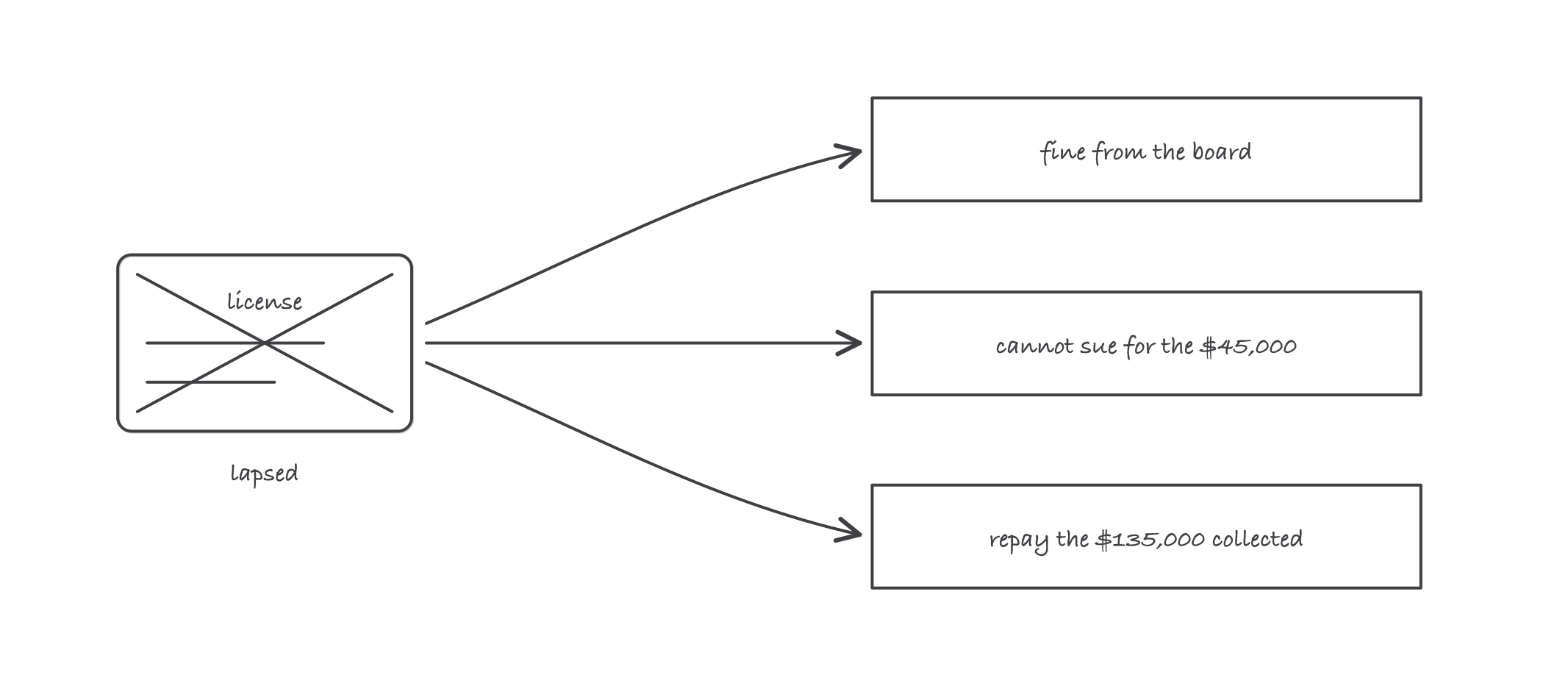
One lapse, three layers: the fine is the small one
Where it bites
- “The work was perfect” is not a defense. The civil bar and disgorgement statutes punish the unlicensed status, not the workmanship. Courts apply them even when the result feels harsh, because the legislature wrote them to sting.
- Check your subs’ licenses like you check their insurance. In many states, using an unlicensed sub is a citable offense for the GC, and the sub’s workers can become your payroll problem.
- The threshold is the contract price, not your profit, and generally includes labor plus materials. Pricing a job at the exempt limit “plus materials billed separately” is the oldest trick the board knows.
- Qualifying a company you do not supervise is a violation on its own. The qualifying-party rules exist precisely to stop license renting.
- Homeowner recovery funds in some states pay consumers harmed by contractors and then pursue the contractor; the debt can survive bankruptcy and block relicensing until repaid.
Exam relevance
Business and law exams test this area directly: what penalties attach to unlicensed contracting, that unlicensed contractors typically cannot lien or sue for payment, and the discipline grounds for licensees, including aiding unlicensed work. NASCLA-based exams frame these as scenario questions. For your state exam, learn the actual monetary threshold, the criminal grade of a first offense, and whether your state has a disgorgement remedy, all from the state board’s law and rules.
Verified requirements
| Where | Expires | Renewal | Continuing education |
|---|---|---|---|
| California | Yes | 2 years (CSLB: 'Active licenses expire every two years.' Inactive licences expire every four years.) | Confirm with issuer |
| Florida | Confirm with issuer | Confirm with issuer | Confirm with issuer |
| Arizona | Confirm with issuer | Confirm with issuer | Confirm with issuer |
Information comes from issuing-authority sources. Confirm current rules, fees and eligibility with the authority before acting.