Business · General Contracting
A Contractor Business Plan That Works
Assumes you know: Choosing a Business Structure
A contractor business plan is not a document for a bank drawer. It is one page of arithmetic that starts from the profit you want and works backward to the number of bids you must send this year. If the page does not change what you do on Monday, it is decoration.
Why it matters on the job
Most shops run forward: take the work that shows up, do it well, see what is left in December. Running backward inverts that: decide what must be left in December, then compute what has to show up, and go make it show up. The same effort, pointed. The plan is also the first thing a lender or bonding agent will probe, and the versions that survive contact are the ones built on real numbers from your own jobs.
The backward chain
Start at the bottom line and climb:
- Target profit. What the business must earn beyond every cost, including your own market-rate salary inside overhead. Profit is the return for risk, not your wages.
- Overhead. The annual cost of existing: salary, office, trucks, insurance, estimating time. A real dollar figure, not a guess.
- Gross margin. What your jobs historically keep after direct costs. From your job costing, not from hope.
- Required revenue. The volume that makes the first three numbers consistent.
- Jobs, then bids. Divide revenue by average job size, then divide jobs by your hit rate.
Worked example: from profit target to Monday morning
Say the targets are: profit $40,000, overhead $150,000 including your salary, and a demonstrated 20% gross margin.
Required revenue = ($150,000 + $40,000) ÷ 0.20 = $950,000.
Check it: $950,000 of revenue at 20% gross margin throws off $190,000, which covers $150,000 of overhead and leaves the $40,000.
Your average job is $50,000: $950,000 ÷ $50,000 = 19 jobs this year. Your hit rate is 1 win in 4 bids: 19 × 4 = 76 bids, about 1.5 bids every week.
That last number is the plan. If you sent 40 bids last year, the page just told you the profit target is fiction until either bidding volume, hit rate, job size or margin moves. Each of those four is a lever with its own lesson in this subject.
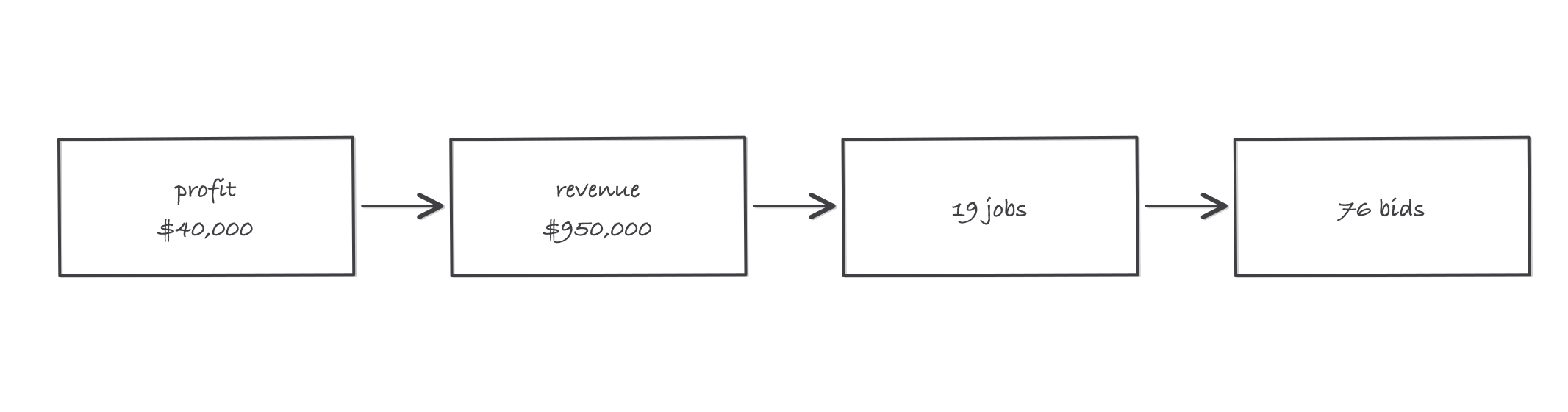
The plan is the arithmetic that connects December’s profit to Monday’s bidding
The rest of the page
Under the chain, four short commitments: who the target customer is (and who you will decline), the pricing floor you will not bid below, the cash reserve you are building toward (a common target is enough to cover 2 to 3 months of overhead), and the one growth move for the year. One page, pinned where you estimate. Reviewed quarterly against job-costing actuals, revised when reality disagrees with it.
Where it bites
- Salary confused with profit. If the plan only works because you pay yourself nothing, the plan does not work. Your salary is overhead; profit is what remains after it.
- A margin number from optimism. Use last year’s job-costing actuals. A plan built on the margin you wish you earned fails silently until December.
- A plan with no bid count. Revenue targets without the bids-per-week number are wishes. The chain has to reach an action you control weekly.
- Writing it once. Volume shifts, margins drift, overhead grows. A quarterly recheck takes an hour; a year run on stale numbers can quietly unrecover tens of thousands of overhead dollars.