Business · General Contracting
Cash Flow: Why Profitable Contractors Go Broke
Assumes you know: Overhead, Markup and Margin
Cash flow is the timing of money, not the amount of it. A job can be genuinely profitable and still sink you, because every dollar of cost leaves your account weeks or months before the revenue dollar arrives. Profit is an opinion until the check clears; payroll is a fact every Friday.
Why it matters on the job
Construction runs on a brutal timing mismatch. You pay labor weekly and suppliers on 30-day terms, but owners and GCs commonly pay 30 to 90 days after invoice. In between, you are the bank. Contractors rarely die of losses; they die of running out of cash while profitable work is still on the books.
The worked example: a profitable job that starves you
The job: price $60,000, direct cost $50,000, so $10,000 of true profit. Six weeks of work, one invoice at completion, owner pays 60 days after invoice.
Cash going out:
- Materials: $26,000, paid in week 1 to get the job started.
- Payroll: $4,000 every week for 6 weeks = $24,000, and payroll cannot slip.
By the end of week 6 you have paid out the full $50,000. You invoice on day 42. The owner pays 60 days later, on day 102, the middle of week 15.
So the gap: from week 6 to week 15, roughly two months, you are out of pocket $50,000 on a job that is finished, correct and profitable. The $10,000 profit exists on paper the whole time; the $60,000 of cash arrives at week 15. Now imagine starting the next job in week 7 with the same shape. The floats stack. Two overlapping jobs like this put you $100,000 out before the first check lands. That is how a growing, profitable contractor hits a Friday with no payroll money.
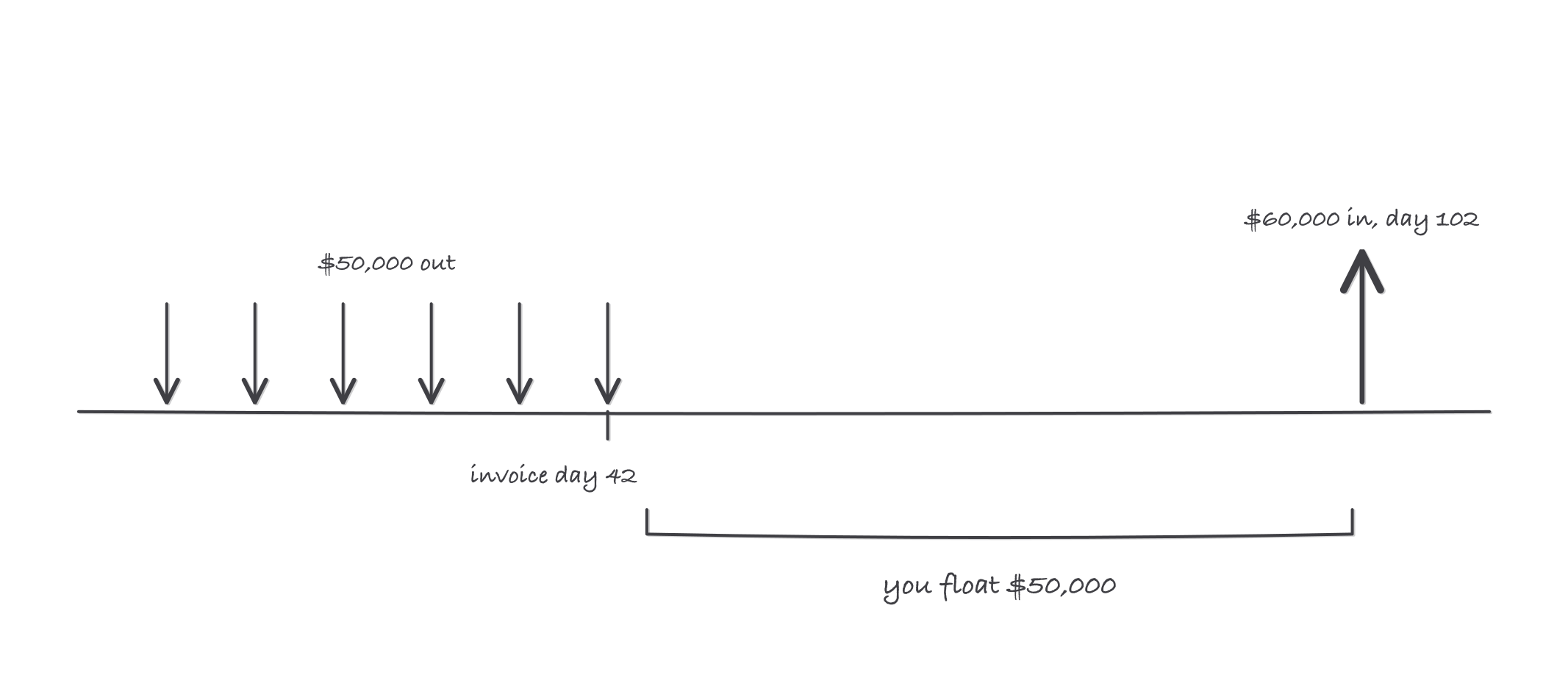
The gap between the last dollar out and the first dollar in is money you must have or borrow
Closing the gap
Every tool of contractor cash management attacks one of the two ends:
- Move money in earlier. Deposits before mobilization. Progress billing instead of one invoice at the end (its own lesson, next). Invoice the day the milestone hits, not at month-end. Chase day-31 receivables politely and relentlessly.
- Move money out later, honestly. Supplier terms are negotiable, especially with volume. Time material buys to the schedule, not the discount.
- Carry a buffer. A cash reserve or a working line of credit sized to your real float, arranged before you need it. Banks lend umbrellas in sunshine.
The management habit is a 13-week cash forecast: one row per week, cash in from invoice dates plus payment terms, cash out from payroll and supplier due dates. It is an hour a week, and it turns “surprise” into “decision made in advance.”
Where it bites
- Reading the profit and loss statement as if it were the bank account. The P&L says $10,000 earned; the account says $50,000 gone. Both are true. Only one pays wages.
- Growth as a cash trap. Every new job adds a new float before it adds a payment. Doubling revenue can halve your cash. Grow at the speed of your reserve, not your ambition.
- Funding the gap with the next job’s deposit. That is robbing week 15 to pay week 6, and it works until one payment is late. One slow receivable then topples jobs that were each individually fine.
- Waiting to invoice. Ten days between finishing and invoicing adds ten days to day 102 for free. The cheapest financing in construction is sending the bill the day you earn it.