Business · General Contracting
Jobsite Safety Management
Jobsite safety management is the GC’s system for making sure nobody on the project gets hurt, including the workers of every subcontractor on site. As the general contractor you typically control the site, the schedule and the conditions everyone works in, and both regulators and courts treat that control as responsibility. “It was the sub’s employee” has never been a complete answer, and it should not be.
Why it matters on the job
The human reason needs no elaboration: construction consistently ranks among the most dangerous industries in the country, and falls remain the leading killer. The business reasons stack on top. Under federal OSHA’s approach to multi-employer worksites, a general contractor can be cited as a controlling employer for hazards it did not create, if it had the authority to correct them. Your experience modification rate follows your claims history and reprices your insurance for years. And a serious incident stops the job: investigation, shutdown, crew morale, schedule, all at once. Safety is not a compliance line item; it is operational competence.
The system, not the poster
A working safety program on a GC-run site has recognizable parts:
- Planning before work. Site-specific hazards identified before mobilization: falls, excavations, cranes, energized systems, traffic. High-hazard activities get task-level planning, a job hazard analysis walking each step against its hazards and controls, done with the crew that will do the work.
- The hierarchy of controls. Controls in order of strength: eliminate the hazard first (prefabricate at ground level instead of working at height), then guard it with engineering (guardrails, covers, ventilation), then manage it administratively (training, rotation, signage), and only last rely on personal protective equipment. PPE is the floor of the system, not the system: it protects one worker, partially, only when worn.
- Orientation and toolbox talks. Every worker oriented to site rules before badge one; short, task-relevant talks at a steady rhythm, tied to what is actually happening on site that week, not read off a card.
- Inspections with teeth. Regular documented walks, hazards logged with a responsible party and a correction date, and verified closed. An inspection log full of findings nobody closed is worse than none: it proves you knew.
- Incident response and near-miss reporting. Serious incidents have regulatory reporting duties on short clocks; know yours before you need them. Near misses are free tuition: the scaffold plank that almost failed is the same lesson as the one that did, minus the ambulance.
Authority completes the system: the GC’s superintendent must have, and use, the power to stop any sub’s unsafe work immediately. A safety program the schedule can override is a schedule program.
Worked example: the hierarchy applied
A crew must install rooftop units near an unprotected roof edge. PPE-first thinking sends them up in harnesses. Hierarchy thinking asks the questions in order. Eliminate: can the units be set by crane with rigging attached at ground level, keeping workers away from the edge? Engineer: temporary guardrail along the edge for the work that remains. Administer: limit roof access to the trained crew, flag the zone. PPE: harnesses as the final layer for anyone crossing the warning line. Same task, four layers, and the worker’s survival no longer depends on a single strap being clipped.
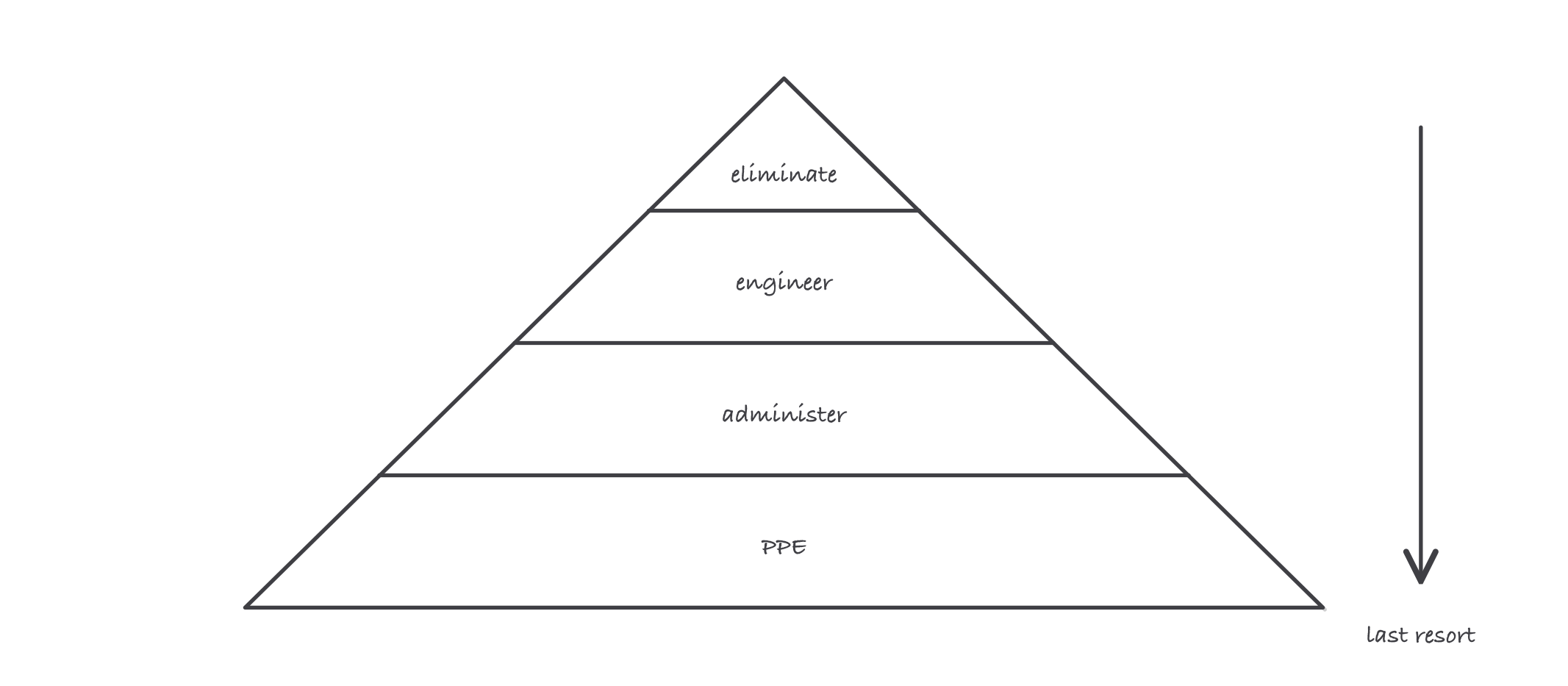
Controls in order of strength: the harness is the last layer, never the plan
Where it bites
- Delegating safety to the subs entirely. Each employer owns its employees’ safety, but the controlling employer’s duty does not delegate away. If you can direct the work, you can be cited for the hazard you walked past.
- The paper program. A binder in the trailer with no site-specific content and no field behavior behind it fails workers and inspections alike. Regulators read the site, then the binder.
- Production pressure overriding stop authority. The first time a superintendent is overruled for stopping unsafe work, the whole site learns the real policy. Back the stop, every time, publicly.
- Ignoring near misses. Sites that only react to injuries are managing by luck. The near-miss log is the cheapest safety data you will ever get; treat every entry as a rehearsal of the incident you still have time to prevent.