Business · General Contracting
Overhead, Markup and Margin
Part of Contractor License, Start to Finish · step 10 of 21 · next: Construction Contract Fundamentals
In learning paths: Contractor License, Start to Finish
Assumes you know: Labor Costing and Burden
Overhead is what it costs your company to exist. Markup is what you add to a job’s cost. Margin is what you actually keep, measured against the price. These are three different numbers, and contractors who treat them as one number go broke slowly and then suddenly.
Why it matters on the job
Every estimate you finish becomes a price by adding something on top of cost. If that something does not first recover your share of the office, the truck, the insurance and your own salary, the “profit” on the bid is an illusion: you are buying work with your own money. And if you then confuse markup with margin, you keep even less than you think.
Overhead: the cost of the doors being open
Overhead is every cost that is not chargeable to a specific job: office rent, the estimator’s time, your salary, bookkeeping, general insurance, phones, the pickup that visits every site. Add it up as an annual dollar figure. Say yours is $180,000 per year, and you expect to put $1,200,000 of direct job cost in place this year:
Overhead rate = $180,000 ÷ $1,200,000 = 15% of direct cost.
Every job must carry 15 cents per direct-cost dollar just to break even. The rate is only as good as the volume forecast under it: if volume drops to $900,000 and you keep charging 15 percent, you recover $135,000 against $180,000 of real overhead, and the missing $45,000 comes out of your pocket. Overhead is fixed dollars wearing a percentage costume.
Markup is not margin
Here is the required arithmetic, once and forever. Job cost $100,000, and you add 20 percent markup:
- Price = $100,000 × 1.20 = $120,000.
- Gross profit = $20,000.
- Margin = $20,000 ÷ $120,000 = 16.7%.
A 20 percent markup is a 16.7 percent margin. Markup measures against cost; margin measures against price, and price is the bigger number, so the same dollars are a smaller percentage of it. If you promise yourself “20 percent” and apply it as markup, you quietly gave away 3.3 points.
To hit a true margin, divide, never multiply:
Price = cost ÷ (1 − margin). For a 20 percent margin on $100,000 of cost: $100,000 ÷ 0.80 = $125,000, which is a 25 percent markup. Multiplying by 1.20 would have left you $5,000 short of your own target on one job.
Worked example: cost to price, the whole chain
Direct job cost: $100,000. Overhead at the 15 percent rate: $15,000. Breakeven: $115,000. You want a true 8 percent profit margin:
Price = $115,000 ÷ (1 − 0.08) = $115,000 ÷ 0.92 = $125,000.
Check it: profit is $125,000 − $115,000 = $10,000, and $10,000 ÷ $125,000 = 8 percent of the price. Exactly what you aimed for, because you divided.
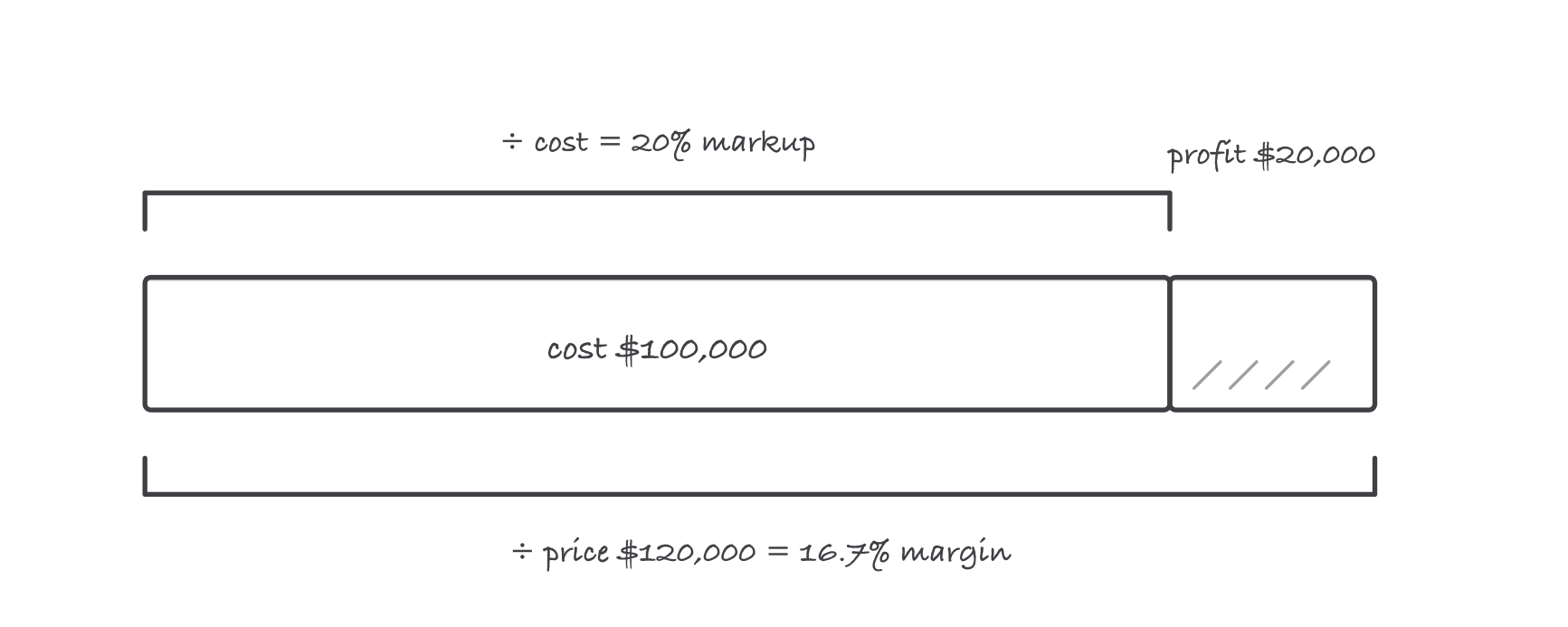
Same 20,000 dollars, two denominators: against cost it is 20 percent, against price it is 16.7 percent
Where it bites
- Quoting your markup as your margin. The 3.3-point gap between 20 percent markup and 16.7 percent margin is roughly the entire net profit of many contracting businesses.
- Leaving your own salary out of overhead. If the business only pays you when there is profit left over, the business does not work; it just employs you for free in the bad years.
- Percentage overhead in a shrinking year. Overhead is dollars. When volume falls, the rate must rise or the dollars go unrecovered. Recompute the rate every year, and mid-year if volume moves.
- Matching the competitor’s markup. Their overhead is not your overhead. A shop run from a kitchen table can healthily charge a rate that would bankrupt a shop with a yard and an office manager.