Business · General Contracting
Project Closeout
Assumes you know: Quality Control and Inspections
Project closeout is the organized handover that converts a construction site into the owner’s building and your remaining contract balance into cash. It is a defined sequence of deliverables and milestones, not a mood at the end of the job, and the contract’s closeout section lists exactly what you owe: read it at project start, because half the closeout documents are far easier to collect during the work than after it.
Why it matters on the job
Your profit is parked at the end of the project. Retainage, often 5 to 10 percent of the contract value, is frequently more than the entire planned margin, and it is released through closeout. A $2,000,000 job at 10 percent retainage is holding $200,000 hostage to punch lists and paperwork. Slow closeout also has a quieter cost: it keeps supervision assigned to a job that has stopped earning, and the last 2 percent of a project can consume months if it is not run like the phase it is.
Substantial completion: the hinge date
Substantial completion is the point at which the work is complete enough for the owner to use the building for its intended purpose, typically certified in writing by the architect or owner with an attached list of remaining items. The date matters because so much law and money hinge on it. In common contract forms: liquidated damages stop accruing, warranty periods generally begin, responsibility for utilities, insurance and security shifts toward the owner, and a defined share of retainage often becomes releasable. Some of these effects vary by contract and state, which is exactly why the certificate is worth pursuing formally, with a date on paper, rather than letting “basically done” drift for weeks. Where the building is occupied in stages, seek substantial completion area by area so each date starts its own clocks.
The closeout sequence
- Punch list. Walk the work with the owner and architect, produce one written list of deficiencies with locations, and drive it to zero with dated sign-offs per item. Discipline point: one consolidated list, then a documented process for late additions, or the list becomes a subscription that never ends.
- Final inspections and approvals. The authority’s final inspections and whatever occupancy approval the jurisdiction issues. No owner move-in without the jurisdiction’s paper, whatever the schedule pressure.
- The document package: operation and maintenance manuals for equipment, warranties from subs and manufacturers, as-built drawings recording what was actually installed and where, attic stock and spare parts, and training for the owner’s staff on the systems they now own. Collect these from every sub as a condition of their final payment: the sub who demobilized in June has no reason to produce a warranty letter in November.
- Financial closeout: all change orders resolved and executed, final pay application, the lien waivers and releases your contract and state procedure require from you and your subs, and release of retainage. Waiver forms and their legal effect are state-specific: use the forms your state’s law and your contract prescribe, and track sub waivers as rigorously as the owner tracks yours.
Worked example: pricing slow closeout
Contract $1,800,000, retainage 10 percent: $180,000 outstanding at punch walk. Closeout drifts three months on missing O&M manuals and two stubborn punch items, with a superintendent still assigned at a fully loaded $12,000 per month. Cost of drift: $36,000 in supervision against a job earning nothing, plus $180,000 of your cash financing the owner’s patience. Now run it as a phase: closeout requirements collected from subs all year, punch list attacked with a dedicated push in week one, document package submitted with the final pay application. The same job closes in three weeks, and the $180,000 arrives while the crew still remembers where the as-builts are.
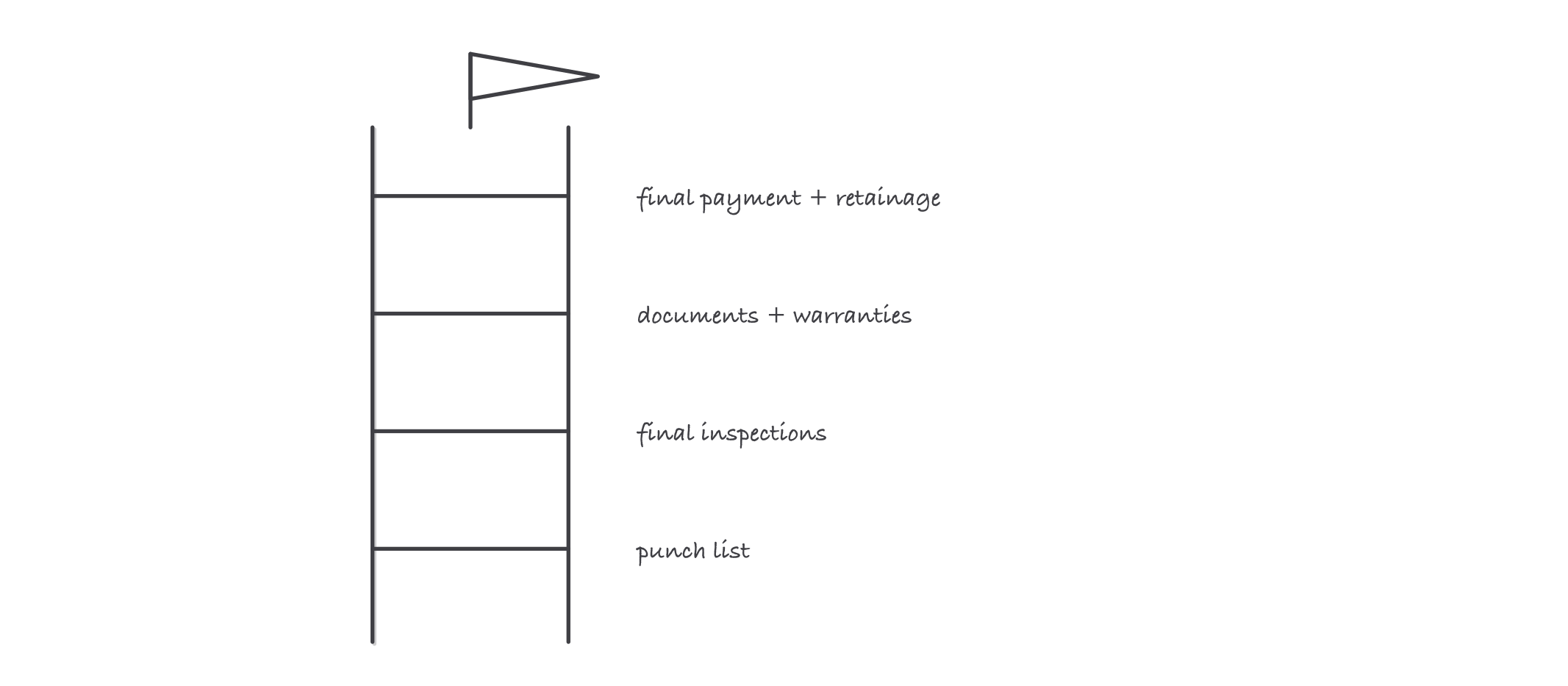
The last climb of the job: each rung releases the next, and the money sits at the top
Where it bites
- Treating closeout as an afterthought. The team mentally leaves at substantial completion, and the job bleeds supervision cost for months. Assign closeout an owner, a schedule and a weekly review like any phase.
- Collecting closeout documents at the end. Warranties, as-built markups and O&M data are cheap to collect while subs are on site and need their next payment, and nearly impossible after final payment clears.
- A punch list with no floor. Accepting endlessly appended items converts punch into a warranty program you are funding with retainage. Close the list formally; handle genuine later discoveries under warranty, where they belong.
- Loose lien waiver handling. Paying a sub final money without the required releases, or signing a broader waiver than your state form requires, trades real legal rights for convenience. Match every payment to its paper.