Business · General Contracting
Hiring and Employment Law Basics
Assumes you know: Choosing a Business Structure
The day you hire your first employee, you stop being a tradesperson with a helper and become a regulated employer. A payroll tax collector, an insurance policyholder, a record keeper and a safety officer, all before lunch. None of it is hard; all of it is mandatory, and the penalties fall on people who did not know the list existed.
This lesson is the list and the cost math, not legal advice. Employment rules vary by state and change; a payroll service and an accountant, and for policies an employment attorney, are cheap compared to one wage claim.
Why it matters on the job
Hiring is how a shop grows, and mishandled hiring is one of the fastest ways a shop dies: back wages, tax penalties and uninsured injuries all arrive with interest. Just as practically, the true cost of an employee is far above the wage, and a contractor who bids using the wage number is losing money on every labor hour sold.
What switches on with employee number one
- Payroll withholding and employer taxes. You withhold income and payroll taxes from wages, add the employer’s own payroll tax share, and remit both on a schedule. Unemployment insurance contributions join them. A payroll service automates all of it for a modest monthly fee; doing this by hand in a spreadsheet is false economy.
- Workers compensation. Required in most states once you employ, and in construction often verified at permit and license level. An uninsured injury is an uncapped personal liability.
- New-hire basics. Verifying work eligibility, reporting the new hire to the state, required postings, and collecting the tax forms that set withholding. Your payroll provider’s checklist covers the sequence.
- Wage and hour rules. Minimum wage, overtime for non-exempt workers past the weekly threshold, timely final paychecks, and pay records kept for years. Field crews are essentially always overtime-eligible: “salary” does not remove the overtime obligation just by existing.
- Safety responsibility. With employees comes formal responsibility for a safe workplace, training and recordkeeping. Construction safety has its own subject; here, know that the obligation attaches to the employer.
Worked example: the loaded labor rate
Wage is the sticker price, not the cost. Say you hire a carpenter at $28/hour. Employer payroll taxes, workers comp premium and basics like paid time off add, for this example, $9/hour of burden (your real burden comes from your actual quotes and rates):
Loaded cost = $28 + $9 = $37/hour.
Now productivity. Of a 40-hour week, shop time, travel between jobs and rain steal hours; say 32 hours land on billable work. The cost of a billable hour is:
$37 × 40 ÷ 32 = $46.25 per billable hour.
That is the number that belongs in your estimates: 65% above the wage. Bid labor at $28, or even at $37, and every hour sold ships money out the door with a smile.
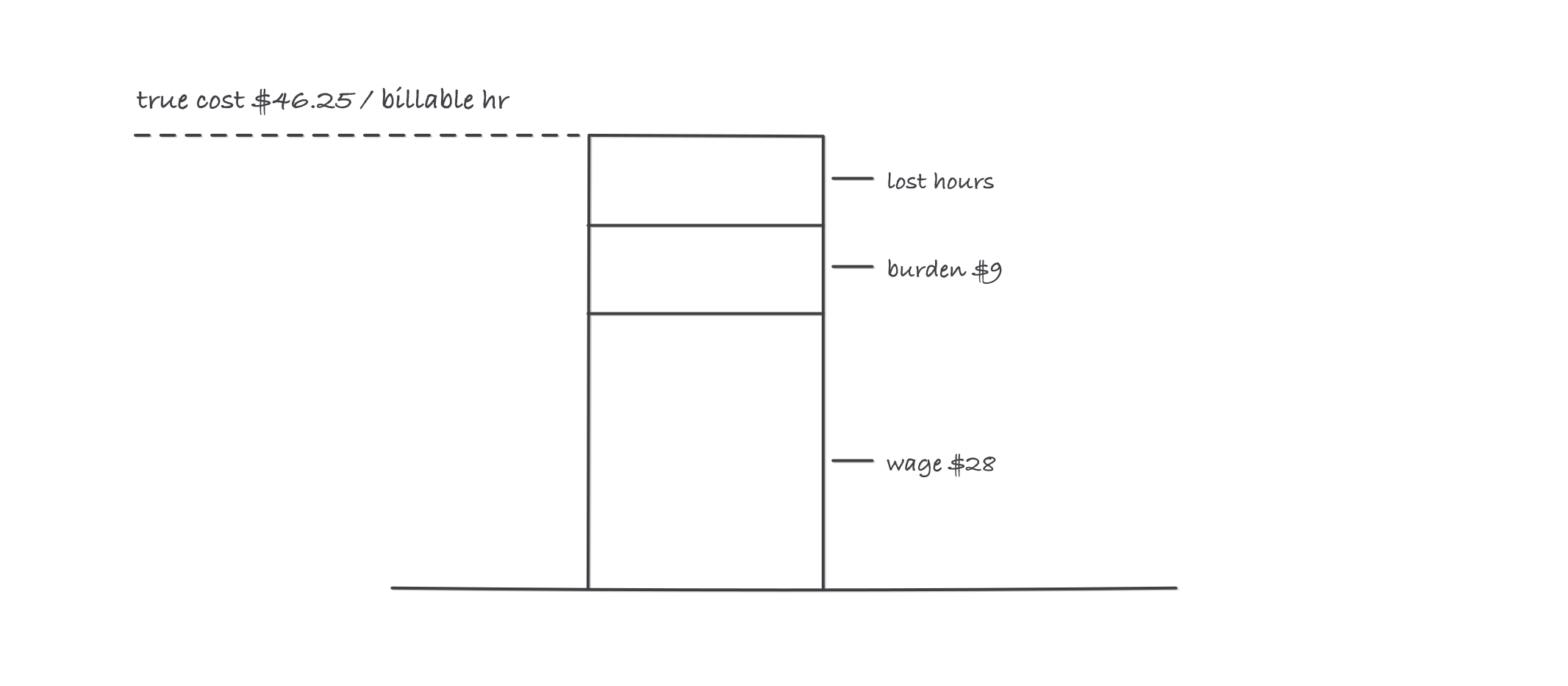
The wage is the bottom of the stack: the estimate must carry the whole bar
The employer habits that prevent claims
Written offer with wage and classification. Accurate time records, kept, every day, including for salaried field staff. Overtime paid when earned, not banked informally. Personnel file per employee. Terminations documented and final pay on the state’s schedule. Boring, and each line is the cheap version of a dispute.
Where it bites
- Bidding the wage instead of the loaded billable rate. The $18.25 gap in the example, times two crews, times a season, is a bankruptcy in slow motion.
- Casual overtime. “We square it up with time off later” violates wage law in most circumstances and is the most common claim there is. Pay the overtime; price your jobs so you can.
- Skipping workers comp on a “temporary” helper. The injury does not check the calendar. Coverage runs from the first hour of the first day.
- Calling a worker a subcontractor to skip this list. That is misclassification, the subject of the next lesson, and it un-happens retroactively with penalties.