Business · General Contracting
Labor Costing and Burden
Part of Contractor License, Start to Finish · step 9 of 21 · next: Overhead, Markup and Margin
In learning paths: Contractor License, Start to Finish
Assumes you know: Quantity Takeoff
Labor costing starts from one fact: the wage is not the cost. A $28.00 per hour carpenter does not cost you $28.00 per hour, and every estimate priced as if they do is losing money on every labor hour before the job even starts.
Why it matters on the job
Labor is usually the largest and least certain number in a general contracting estimate. Materials come with quotes; labor comes from your own judgment twice over: how many hours the work takes, and what an hour truly costs. Get the second one wrong and the error multiplies through every task on the job.
Building the loaded rate
Take a carpenter at $28.00 per hour and price a full year of employing them.
| Annual cost | Amount |
|---|---|
| Wages, 2,080 hr × $28.00 | $58,240 |
| Payroll taxes at 11% (FICA 7.65% plus unemployment) | $6,406 |
| Workers comp at $10 per $100 of payroll | $5,824 |
| General liability insurance at 2.5% of payroll | $1,456 |
| Health insurance, $520 per month | $6,240 |
| Small tools, PPE, consumables | $1,500 |
| Total annual cost | $79,666 |
The rates above are illustrative; your actual tax, comp and insurance rates come from your own policies and payroll, and comp in particular varies widely by work classification.
Now the second half of the truth: you do not get 2,080 productive hours. Subtract 128 hours of paid vacation and holidays, and about 232 hours of drive time, shop time and weather, and 1,720 billable hours remain.
Loaded rate = $79,666 ÷ 1,720 hr = $46.32 per hour.
That is 1.65 times the wage. Burden multipliers of roughly 1.5 to 1.7 are common once real productive hours are counted, which is why estimators talk about the loaded rate and never the wage.
From loaded rate to a line item
Labor cost for a task = quantity ÷ production rate × loaded rate. Take the 640 sq ft partition from the quantity takeoff lesson, hung and finished at a production rate of 32 sq ft per labor hour: 640 ÷ 32 = 20 labor hours. At the loaded rate: 20 × $46.32 = $926.40. Priced at the wage instead, the same line reads 20 × $28.00 = $560.00, and the missing $366.40 comes out of your pocket, not the customer’s.
Production rates are the other half of this multiplication. Track them from your own job costing; published tables are a starting point, your crews are the truth.
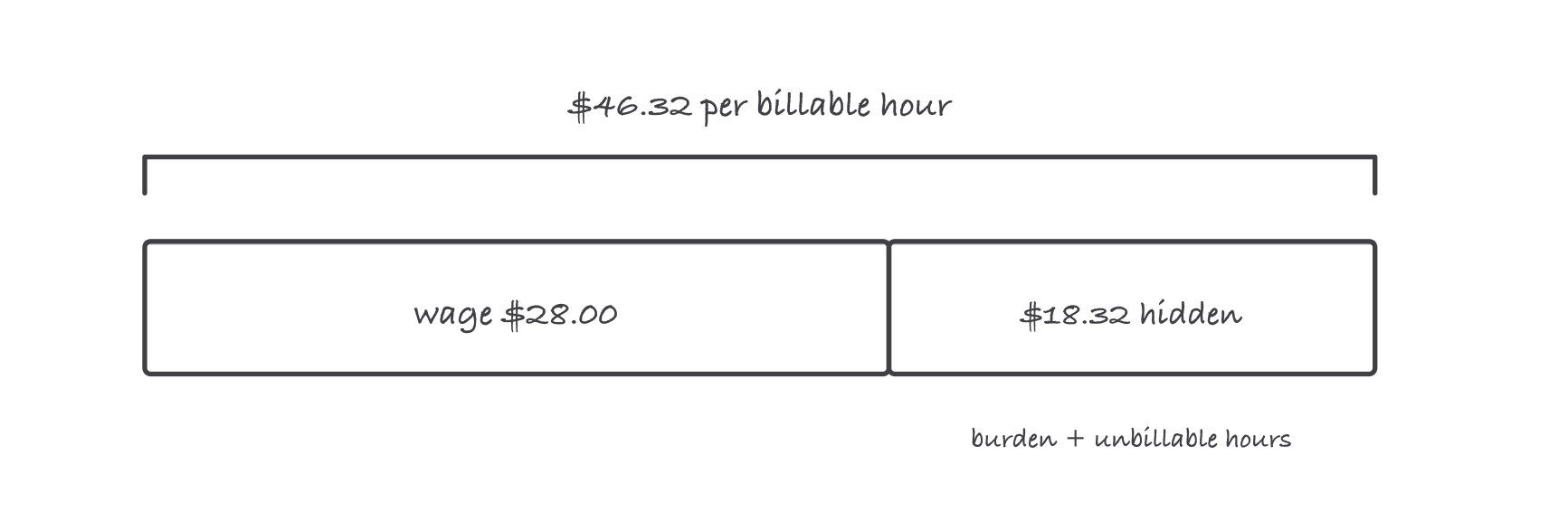
The wage is the visible part; the burden and the unbillable hours are the part that sinks estimates
Where it bites
- Bidding at the wage. The most common labor mistake in a new contractor’s estimate, and the quietest: the job looks profitable until the payroll taxes, comp premium and rained-out days land.
- One loaded rate for every worker. A foreman, a journeyman and a laborer carry different wages and different comp classes. Blend deliberately into a crew rate, or price each classification.
- Overtime. Premium hours raise the wage but not the output proportionally. A schedule that depends on sustained overtime needs its own, higher rate.
- Utilization drift. The 1,720-hour assumption is a yearly average. A winter-heavy schedule or a remote job with long drives pushes billable hours down and the true rate up. Recompute; do not hope.