Qualifications · General Contracting
How Contractor Licensing Actually Works
Part of Contractor License, Start to Finish · step 1 of 21 · next: The Business and Law Exam
In learning paths: Contractor License, Start to Finish
Contractor licensing is how states decide who may sell and take responsibility for construction work. It is not one system but fifty, ranging from strict statewide licensing with exams and financial checks to states that barely license general contractors at all. Understanding the machinery, not any one state’s rules, is what lets you navigate all of them.
*Learn the Trades is a free study resource. We are not a licensing body, an authorized training provider, or an exam administrator. Reading this page does not award any card, license, or certification. Always verify requirements with the issuing authority linked in the sources.*What a contractor license actually is
Strip away the state differences and a contractor license is four claims the state has verified about you:
- Competence, usually a trade exam, a business and law exam, or both.
- Experience, documented years in the trade, often with references or a qualifying individual who has them.
- Financial responsibility, bonding, insurance minimums, sometimes net-worth statements; the state wants your failures to be survivable for your customers.
- Accountability, a named qualifying party the license binds to, a registered entity, and a board with the power to discipline you.
Every state assembles those four differently; almost none skips them entirely.
The moving parts
- Classifications: most boards license by scope, general building, residential, electrical, mechanical, specialty classifications, sometimes with monetary tiers that cap the job size a class may take.
- The qualifying party: the human whose exam and experience qualify the company. Their departure typically starts a clock to replace them.
- The business and law exam: near-universal, covering contracts, lien law, payroll, insurance and licensing law, the material the rest of this Business section teaches.
- Local layers: city and county registrations stack on top in many states, and a few big cities run licensing regimes of their own.
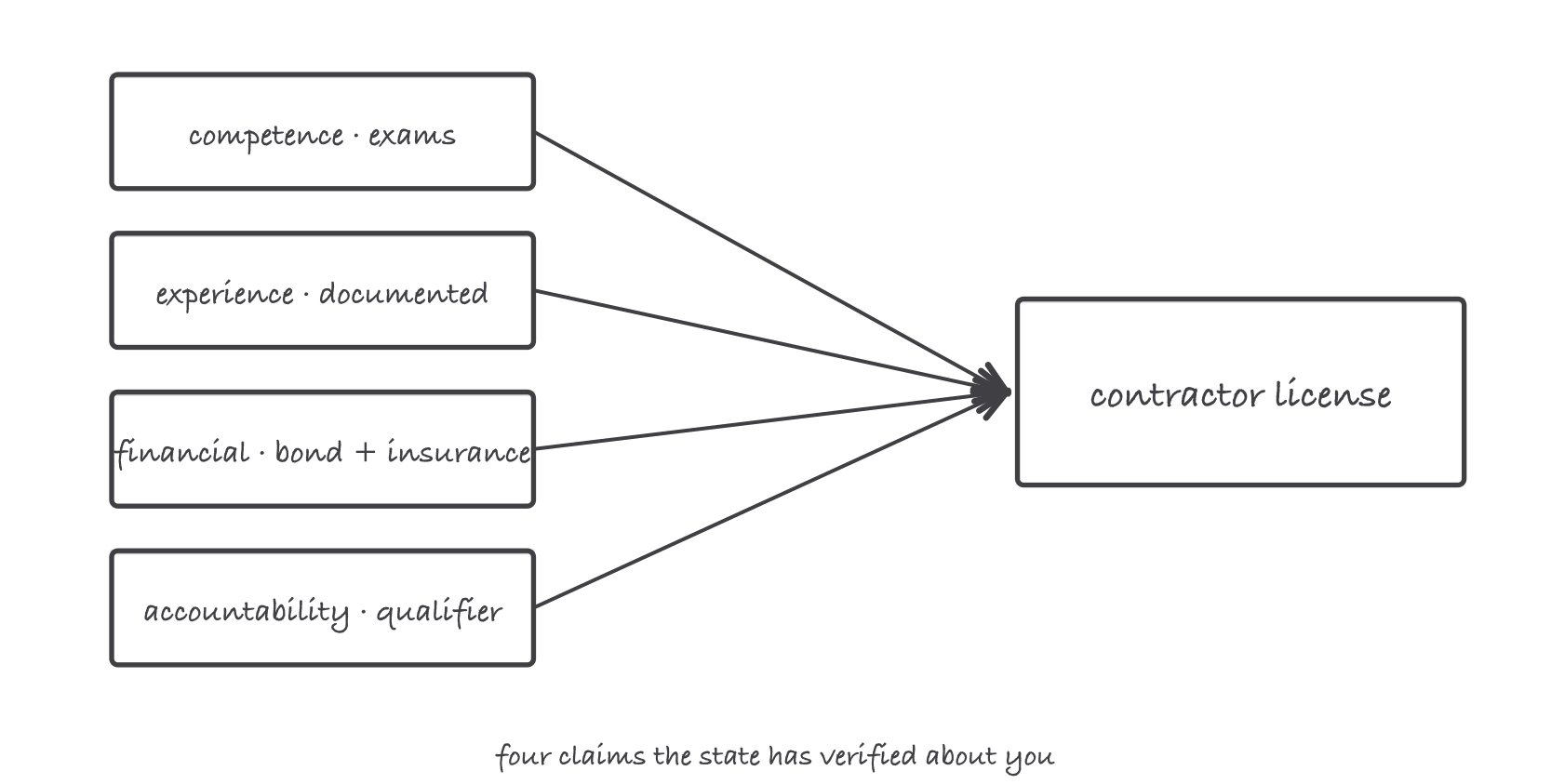
Strip away the state differences and every license is these four claims
Where it bites
- Working unlicensed is not a paperwork problem. Penalties range from fines to felonies, and in several states an unlicensed contractor cannot enforce their contract at all: the customer can refuse to pay, lawfully.
- Thresholds catch small operators: many states trigger licensing at surprisingly low job values. Handyman exemptions are narrow and literal.
- Licenses do not cross state lines, but the NASCLA exam (next lesson) can save you re-examination in participating states.
Sources
- NASCLA, accredited examination program and contractor business and law materials
- Bureau of Labor Statistics, construction managers (industry structure)
Verified requirements
| Where | Expires | Renewal | Continuing education |
|---|---|---|---|
| California | Yes | 2 years (CSLB: 'Active licenses expire every two years.' Inactive licences expire every four years.) | Confirm with issuer |
| Florida | Confirm with issuer | Confirm with issuer | Confirm with issuer |
| Arizona | Confirm with issuer | Confirm with issuer | Confirm with issuer |
Information comes from issuing-authority sources. Confirm current rules, fees and eligibility with the authority before acting.