Business · General Contracting
OSHA Duties as an Employer
Part of Contractor License, Start to Finish · step 19 of 21 · next: Permits and Inspections
In learning paths: Contractor License, Start to Finish
Assumes you know: Jobsite Safety Management
The moment you put a worker on payroll, federal law makes their safety your legal duty. The Occupational Safety and Health Act binds every private construction employer: comply with the standards, keep the workplace free of recognized serious hazards, train, provide, record, and never retaliate. Jobsite Safety Management covers how you run a safe site day to day; this lesson covers what the law obligates you to do as the employer of record, because as a licensed contractor the citations now come to you.
Why it matters on the job
OSHA duties follow the employment relationship, not the org chart you wish you had. When you sign your first employee, you inherit the full set. When you become the general contractor running a site, you inherit exposure for other employers’ hazards too, under the multi-employer doctrine. Contractors who think of OSHA as “the safety guy’s problem” discover at citation time that every duty was theirs, personally, as the employer.
The employer’s core duties
The Act and the construction standards in 29 CFR Part 1926 spell out the set:
- Comply with every applicable standard. Trigger heights, excavation protection, scaffold rules: these are employer obligations, not crew suggestions.
- The General Duty Clause covers the gaps: even where no specific standard exists, you must furnish YOUR OWN employees a workplace free of recognized hazards causing or likely to cause death or serious physical harm, where a feasible fix exists. The clause runs to your employees; the multi-employer policy below is what can reach a subcontractor’s workers, and it is a different instrument. OSHA Duties as an Employer in the construction-safety track works this clause in depth.
- Train workers in a language and vocabulary they understand. Training a Spanish-speaking crew in English satisfies nothing.
- Provide most required PPE at employer cost. The rules carve narrow exceptions, ordinary safety-toe footwear and prescription eyewear among them, but the default is employer-paid. Harnesses and respirators are never the worker’s bill.
- Designate competent persons where standards demand them, excavations, scaffolds, fall protection, with real authority to stop work.
- Keep records, report severe incidents, and post the OSHA poster. Workers get access to their own exposure and medical records.
- Never retaliate against a worker who raises a hazard, files a complaint, or talks to an inspector. Retaliation is its own violation with its own enforcement track.
One site, many employers, shared duties
Construction sites stack employers, so OSHA’s enforcement policy sorts them into four roles for any given hazard: the employer who creates it, the employers whose workers are exposed to it, the employer responsible for correcting it, and the controlling employer running the site. More than one can be cited for the same hazard at the same time. As a GC you are almost always the controlling employer, which means a subcontractor’s unprotected trench can become your citation even though none of your direct employees went near it. The duty has a limit worth knowing: OSHA’s own directive (CPL 02-00-124) holds the controlling employer to REASONABLE CARE, explicitly “less than what is required of an employer with respect to protecting its own employees”. You are expected to inspect at reasonable intervals and act on what a reasonable inspection would find, not to supervise every trade continuously.
Worked example: one trench, three citations
You are the GC on a commercial pad. Your excavation sub digs a 7 ft trench and leaves it unprotected. Your plumbing sub’s crew enters it to set pipe. An inspector arrives.
Sort the employers into roles:
- Excavation sub: creating employer. They made the hazard. Citable.
- Plumbing sub: exposing employer. Their employees were in the trench. Citable, even though they did not dig it.
- You: the controlling employer. You run the site, your superintendent walked past that trench twice, and you had authority to stop the work. Citable under the reasonable-care standard, though none of your own employees were exposed. The correcting employer is the one actually engaged to fix that hazard, which on most sites is the excavation sub rather than you.
Three employers, one hazard, three defensible citations. The doctrine exists precisely so that pointing at the sub is never a complete answer.
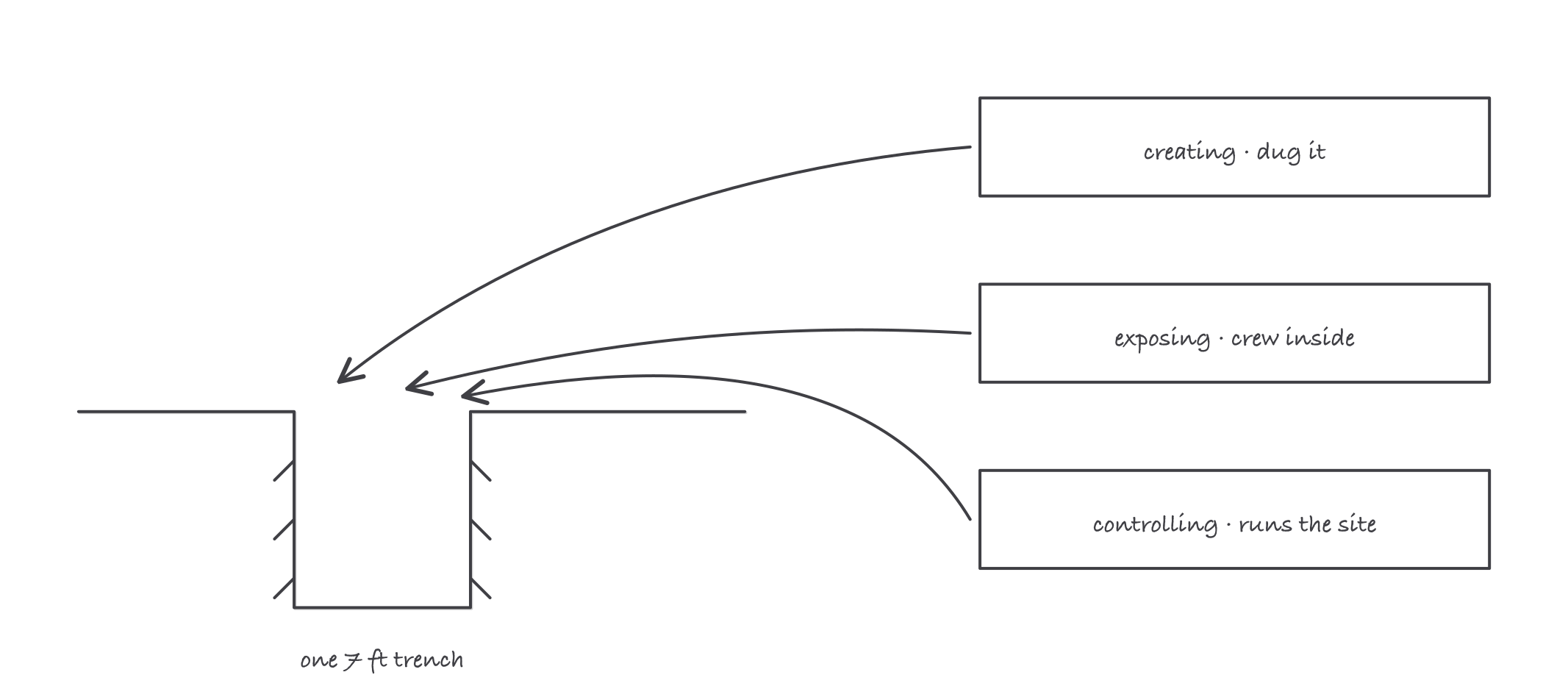
One hazard can produce citations for every employer with a role in it
Where it bites
- “They’re all subs” does not shed the duty. The controlling-employer role attaches to whoever has general supervisory authority over the site. That is you, by contract, whether or not you staffed the job.
- Misclassifying employees as independent contractors does not just create a tax problem, covered in Employee versus Subcontractor: it muddies who owes OSHA duties, and enforcement looks at the reality of control, not the paperwork label.
- The General Duty Clause is narrower than its reputation but wider than silence. No standard for a hazard does not mean no duty; recognized plus serious plus fixable equals obligated.
- Employer-paid PPE exceptions are narrow. Everyday boots, yes. Charging workers for fall protection, never.
- A rule nobody enforces is no rule. The employee-misconduct defense only holds where a work rule existed, was communicated, and was actually enforced. Your daily documentation habits from Documentation and Daily Logs are what make that defense real.
Exam relevance
Business and law exams include a safety and OSHA section: expect questions on the employer’s basic duties, the General Duty Clause, employer-paid PPE, and recordkeeping and poster obligations. NASCLA-based exams also touch multi-employer responsibility, the scenario in the worked example is exam material almost verbatim. Learn the duty list cold; the specific standards behind it live in the construction-safety track.
Verified requirements
| Where | Expires | Renewal | Continuing education |
|---|---|---|---|
| California | Yes | 2 years (CSLB: 'Active licenses expire every two years.' Inactive licences expire every four years.) | Confirm with issuer |
| Florida | Confirm with issuer | Confirm with issuer | Confirm with issuer |
| Arizona | Confirm with issuer | Confirm with issuer | Confirm with issuer |
Information comes from issuing-authority sources. Confirm current rules, fees and eligibility with the authority before acting.