Business · General Contracting
Preparing a Bid
Assumes you know: Overhead, Markup and Margin
Bid preparation is the assembly line at the end of estimating: takeoff and pricing become one number, on the owner’s form, delivered before the deadline, with nothing missing. Jobs are lost at this stage that were won everywhere else.
Why it matters on the job
A bid can be rejected without anyone reading your price: a blank not filled, an addendum not acknowledged, a signature missing, a deadline missed by four minutes. And a bid can be won at a loss because a sub quote was taken at face value or a column added wrong at 4 p.m. Bid day is a process you design in advance, not an adrenaline event.
The bid summary sheet
Everything rolls up to one page. A typical structure:
| Line | Amount |
|---|---|
| Labor (loaded rates) | $62,400 |
| Materials (delivered cost) | $48,000 |
| Subcontractors | $95,000 |
| Equipment | $8,600 |
| General conditions | $18,500 |
| Direct cost total | $232,500 |
| Overhead at 10% | $23,250 |
| Breakeven | $255,750 |
| Profit at 8% markup | $20,460 |
| Bid price | $276,210 |
Two things to notice. General conditions, the cost of running the site itself (supervision, temporary facilities, dumpsters, cleanup), is priced as its own section, never smeared invisibly across trades. And the profit line here is an 8 percent markup, which is $20,460 ÷ $276,210 = 7.4 percent margin; if 8 percent margin is the target, divide by 0.92 instead, as the overhead and markup lesson showed.
If the invitation requires bid security or a performance and payment bond, the bond premium is a line on this sheet too, priced from your surety’s rate schedule, not absorbed silently.
Sub quotes: scope first, price second
The low sub quote is only low until you read its exclusions. Check every quote against your scope checklist: does the drywall number include scaffolding, taping, the level 5 finish the spec demands? Normalize scopes, then compare prices. Carrying an unscoped low number is how a $95,000 sub line becomes $108,000 in buyout.
The form, the rules, the clock
- Fill every blank on the bid form, including unit prices and alternates. On many bids an incomplete form is a rejected form.
- Acknowledge every addendum by number.
- Sign it, and include the bid security if the invitation requires it.
- Set an internal deadline an hour before the real one. Late sub quotes arrive until the last minute; decide in advance which ones you will wait for and which you plug with your own number.
- One person owns the master sheet; one other person recomputes it cold. Fresh eyes on bid day have saved more contractors than any software.
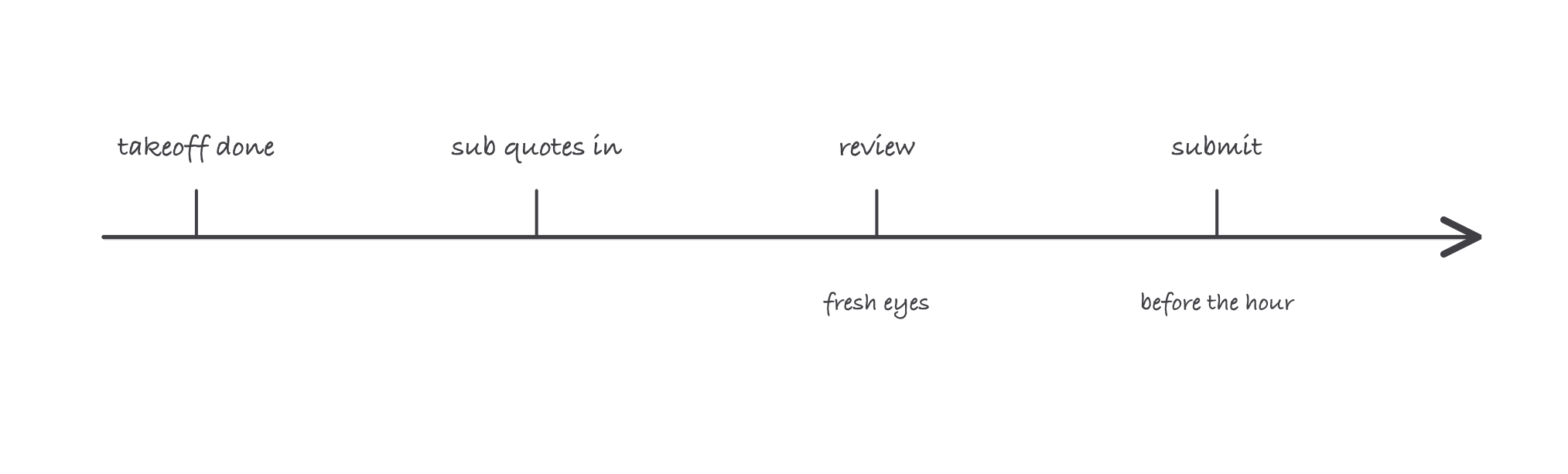
Bid day is a schedule with margins, and the review tick is the one that saves you
Where it bites
- The last-minute sub quote. A number phoned in at deadline minus ten minutes, scope unread, plugged straight into the summary: this is the single most common way a solid estimate turns into a bad contract.
- Arithmetic at the deadline. Transposition and addition errors cluster in the final hour. The cold recompute exists because tired eyes read what they expect.
- Alternates priced carelessly. Owners award on base bid plus chosen alternates. A throwaway alternate price can decide the award, or be the piece you eat.
- No bid file. Keep the whole package: takeoff, quotes, summary, the form as submitted. When the numbers are questioned, or the next similar job arrives, the file is the answer.