Business · General Contracting
Lien Deadlines and Preliminary Notices
Part of Contractor License, Start to Finish · step 16 of 21 · next: Prompt Payment Laws
In learning paths: Contractor License, Start to Finish
Assumes you know: Mechanics Liens
Lien rights die by calendar. Every state’s lien statute is a chain of deadlines: a notice near the start of the job, a recording window after the work ends, and an enforcement window after recording. Miss any link and the right from Mechanics Liens ceases to exist, no matter how legitimate the debt.
The specific numbers below the section heads are examples, not law. Every state sets its own, and they differ by your role on the job. The mechanism is what transfers; your state’s statute supplies the figures.
Why it matters on the job
Lien deadlines are unforgiving in a way almost nothing else in construction is. A court can excuse a lot, but a lien recorded one day past the statutory window is generally void, full stop. Contractors who understand the mechanism run notices as routine paperwork on every job and never have to think about it under pressure. Contractors who learn it during their first payment dispute usually learn they are already too late.
Clock one: the preliminary notice
Most states require parties who have no direct contract with the owner, subs and suppliers especially, to send a notice near the beginning of their work identifying who they are and that they are furnishing labor or materials to the property. Names vary: preliminary notice, notice to owner, pre-lien notice. The purpose is fairness: the owner learns who is on the chain and can demand waivers before money moves.
Two things to fix in your head:
- It is not a threat. A preliminary notice is not a lien and does not say anyone owes anything. Professional outfits send one on every job, first week, automatically. Owners who see them constantly read them as competence.
- It is usually a condition of the lien right. Skip it, or send it late, and in many states your later lien is void or covers only work performed after the notice date.
The trigger is typically your first furnishing of labor or materials, and the window is short, measured in days.
Clock two: recording the lien
When payment fails, you record a lien claim with the county recorder where the property sits. The window is measured from an end-of-work trigger defined by statute: your last furnishing, completion of the overall project, or the owner’s recorded notice of completion or cessation, which in many states shortens the window sharply. Roles matter here too: the general contractor’s window and a supplier’s window can differ in the same state.
Clock three: enforcing it
A recorded lien is a claim, not a judgment. To collect through it you must file a foreclosure lawsuit within the enforcement window, measured from recording. If you settle, you release the lien. If you do nothing, the lien expires and the cloud on title evaporates. Some states let an owner demand you sue within a shortened period or lose the lien.
Worked example: running the three clocks
Take a hypothetical state whose statute reads: preliminary notice within 20 days of first furnishing, lien recorded within 90 days of last furnishing, foreclosure suit within 180 days of recording. Your state’s numbers will differ; the arithmetic will not.
You supply and install trusses. First delivery hits the site June 3.
- Preliminary notice deadline: June 3 + 20 days = June 23. You send it June 5 with the first invoice. Right preserved.
- Your last day of contract work is September 12. Recording window: September 12 + 90 days. Count it: 18 days left in September, 31 in October, 30 in November, so day 79 lands on November 30 and the deadline is December 11.
- Unpaid, you record on October 2. Enforcement deadline: October 2 + 180 days. Count: 29 days left in October, 30 in November, 31 in December, 31 in January, 28 in February brings you to day 149 on February 28, plus 31 days is March 31.
Now the failure case: suppose you had skipped the notice and first thought about lien rights when the check bounced in October. In a state where notice is a strict precondition, clocks two and three never open for you. The $31,600 scenario from Mechanics Liens becomes a plain unsecured debt against an insolvent GC.
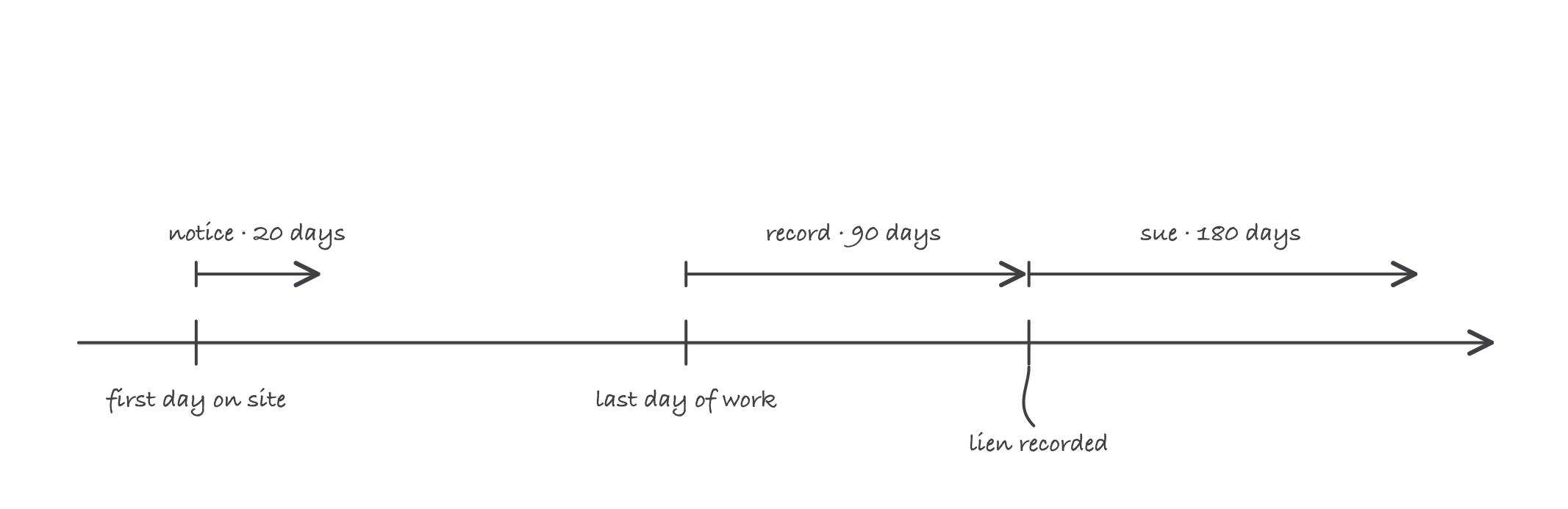
Three clocks in series, with example figures: each opens on an event and each must be beaten for the next to matter
Where it bites
- Last furnishing is not your last site visit. Warranty work, punch-list touch-ups, and returning for tools generally do not restart the clock. Counting from the wrong day is the classic way to record a void lien.
- A notice of completion can shrink your window. In states with this device, the owner’s recorded notice cuts the recording period, sometimes drastically. If you track only the long window, you can be extinguished while feeling safe.
- Your role sets your deadlines. The same statute often gives the prime, the sub, and the supplier different notice duties and windows. Read the column that applies to you.
- Recording without enforcing is theater. Opposing counsel can read a calendar; a lien 30 days from expiry with no suit filed is weak leverage.
- Service rules are part of the deadline. Statutes specify how notices are delivered, certified mail, personal service, and to whom, owner, lender, prime. A timely notice served the wrong way can fail with the same finality as a late one.
Exam relevance
Business and law exams, including those built on NASCLA materials, test the sequence and the vocabulary: preliminary notice, then recording, then enforcement, and which event starts each clock. Scenario questions hinge on trigger identification, first furnishing versus contract signing, last furnishing versus warranty visits. For your own state’s exam, memorize its actual day counts from the statute or the state board’s candidate bulletin, since those exact numbers are fair game.
Verified requirements
| Where | Expires | Renewal | Continuing education |
|---|---|---|---|
| California | Yes | 2 years (CSLB: 'Active licenses expire every two years.' Inactive licences expire every four years.) | Confirm with issuer |
| Florida | Confirm with issuer | Confirm with issuer | Confirm with issuer |
| Arizona | Confirm with issuer | Confirm with issuer | Confirm with issuer |
Information comes from issuing-authority sources. Confirm current rules, fees and eligibility with the authority before acting.