Business · General Contracting
Sequencing Trades
Assumes you know: Construction Scheduling Fundamentals
Sequencing trades is deciding the order in which the trades move through the work, and it is where a schedule stops being math and becomes construction knowledge. The logic between activities in your schedule is mostly trade sequence: who must be done, to what stage, before the next trade can start without damaging work or being damaged.
Why it matters on the job
Wrong sequence is expensive in both directions. Send a trade in too early and they work around others, productivity drops, and finished work gets destroyed: painted walls cut open for a forgotten rough-in, flooring installed before overhead wet work is done. Send them in too late and crews demobilize, and getting a sub back on site on your schedule instead of theirs is one of the hardest problems in the business. Good sequence is how a GC protects both the schedule and every sub’s productivity.
The backbone sequence
Interior work in nearly every building follows one skeleton, driven by physics and inspection:
- Frame: walls and ceilings define the spaces.
- Mechanical, electrical, plumbing rough-in: everything that lives inside walls and above ceilings goes in while it is reachable. Sequence within rough-in matters too: the biggest, least flexible systems first, typically ductwork, then plumbing with its required slopes, then electrical, which bends around the others.
- Rough inspections: the authority signs off on what is about to be hidden. This is a hard gate: cover before approval and you may be ordered to open it back up.
- Insulation, then drywall: the walls close.
- Finishes, from messy to delicate: tape and paint, then hard flooring and tile, then casework and trim, then finish paint touch-up, with carpet and final devices near the end.
The organizing principle behind the whole list: each trade’s work should be protected by the sequence, not by luck. Wet and overhead work before dry and floor-level work. Dust-making before dust-sensitive. Heavy traffic before scratchable surfaces.
Flow: trades move through areas
On any job bigger than one room, sequence has a second dimension: area. You do not finish rough-in everywhere, then insulate everywhere. You break the building into areas and run the trades through them in a wave: framers finish area 1 and move to area 2 while rough-in starts in area 1. Each trade follows the one ahead, area by area. Schedulers call the tidy version of this a trade train: consistent crew sizes, consistent area durations, nobody stacked on anybody.
Worked example: a 3-floor office fit-out
Each floor takes framing 5 days, rough-in 5 days, inspection and close-up 5 days. Sequenced floor by floor as a wave: framing runs floors 1, 2, 3 across days 1 to 15. Rough-in follows one floor behind: days 6 to 20. Close-up follows: days 11 to 25. Total: 25 working days, three trades continuously busy, no stacking. Now compare the panic version: all three trades pushed into floor 1 together to “get ahead.” Rough-in works around framers, close-up has nothing ready, and the same 15 crew-days per floor deliver less each day. The wave finishes faster than the pile-on because productivity, not presence, finishes buildings.
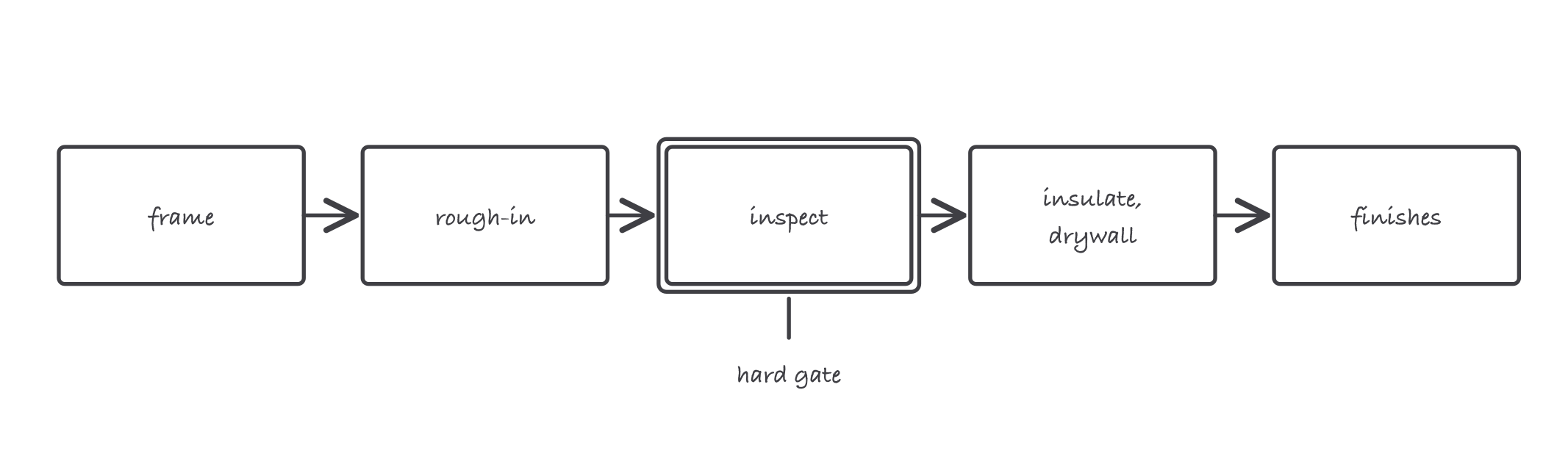
The interior skeleton every building follows: the inspection gate is the step you cannot negotiate with
Where it bites
- Stacking trades to show progress. A crowded floor looks busy and builds slowly. When an owner pushes for bodies, show the wave math: throughput comes from flow, not headcount.
- Covering work before inspection. The rework, open, repair, re-inspect, re-close, costs multiples of the day you “saved,” and it teaches the inspector to distrust the job.
- Forgetting the long-lead trade. Sequence is hostage to procurement: the perfect wave dies waiting for switchgear or trusses. Long-lead items belong on the schedule as activities with real durations, tied to the trades that need them.
- Sequencing for the first trade instead of the whole train. Letting the framer roam wherever is fastest for framing scatters incomplete areas behind them, and every following trade inherits the chaos. The GC owns the train, not any one locomotive.