Business · General Contracting
Mechanics Liens
Part of Contractor License, Start to Finish · step 15 of 21 · next: Lien Deadlines and Preliminary Notices
In learning paths: Contractor License, Start to Finish
Assumes you know: Construction Contract Fundamentals
A mechanics lien is a legal claim recorded against the property you improved, held as security until you are paid for the labor and materials that went into it. It exists because your work cannot be repossessed: once the framing is up or the pipe is in the slab, it belongs to the real estate. So the law lets the unpaid builder claim the real estate itself.
This lesson teaches the mechanism. The details, who qualifies, what notices are required, every deadline, are set by each state’s lien statute, and they differ widely. Read the pattern here, then read your state’s statute or have a construction attorney do it.
Why it matters on the job
Construction money moves down a chain: owner to general contractor, general contractor to subcontractors, subcontractors to suppliers. Every link is a place payment can die. The lien is the one tool that lets a party at the bottom of the chain reach all the way back to the property at the top. If you bill for work, in any position in the chain, lien law is the difference between a bad month and an unrecoverable loss.
Why the property owes you
A contract claim says a person owes you money. A lien says the property secures the debt. That distinction is the whole power of the device: a recorded lien clouds the title, which blocks sales and refinancing until it is resolved, and it can ultimately be enforced by forcing a sale of the property through a foreclosure action. Owners and their lenders take clouded title seriously in a way they may never take your invoice.
Who can record one varies by state, but the usual cast is the general contractor, subcontractors, sub-subcontractors, material suppliers, and equipment lessors, sometimes design professionals. States draw the line at some level of remoteness, and many condition the right on things you control: holding the required license, sending required notices, and hitting deadlines, all covered in Lien Deadlines and Preliminary Notices.
The double-payment squeeze
Here is the scenario that explains most of lien practice. An owner pays the general contractor in full. The general contractor fails to pay a subcontractor and disappears. The subcontractor records a lien against the property. In most states that lien is valid: the sub was not paid, and the property received the work. The owner now faces paying twice for the same framing, once to the GC, once to clear the lien, and their remedy is chasing the vanished GC.
Because owners carry this risk, they defend against it with paperwork: they demand lien waivers with every payment.
Lien waivers: the four types
A lien waiver trades lien rights for payment. Four standard types cover the combinations of two questions: is this a progress payment or the final one, and is the waiver effective now or only when the money clears?
- Conditional progress waiver: waives rights for this progress payment, effective only when the payment actually clears. The safe one to sign when the check is not yet good.
- Unconditional progress waiver: waives rights for this payment the moment you sign, whether or not the money ever arrives.
- Conditional final waiver: waives all rights on the job, effective when final payment clears.
- Unconditional final waiver: waives everything, immediately, unconditionally.
The rule that protects you: never sign an unconditional waiver for money you have not received and confirmed clear. An unconditional waiver signed against a bounced check can leave you with no lien and no payment.
Worked example: what the lien is worth
You frame a custom home under an $84,000 subcontract with the GC.
- Month 1 you earn $36,000. The contract holds 10% retainage, so $3,600 is withheld and the GC owes a progress payment of $36,000 − $3,600 = $32,400. With the check you sign a conditional progress waiver for $32,400. The check clears, so the waiver takes effect for exactly that amount.
- Month 2 you earn another $28,000. Before paying it, the GC’s business collapses.
- Your unpaid balance: retainage of $3,600 from month 1, plus the whole $28,000 from month 2. $3,600 + $28,000 = $31,600.
That $31,600 is your lien claim, recorded against the home, not against the dead GC. The month 1 waiver does not touch it, because a conditional waiver only ever covered the $32,400 that actually arrived. Had you signed an unconditional final waiver in month 1 “to keep the paperwork simple,” you could have waived the entire $31,600 before the money existed.
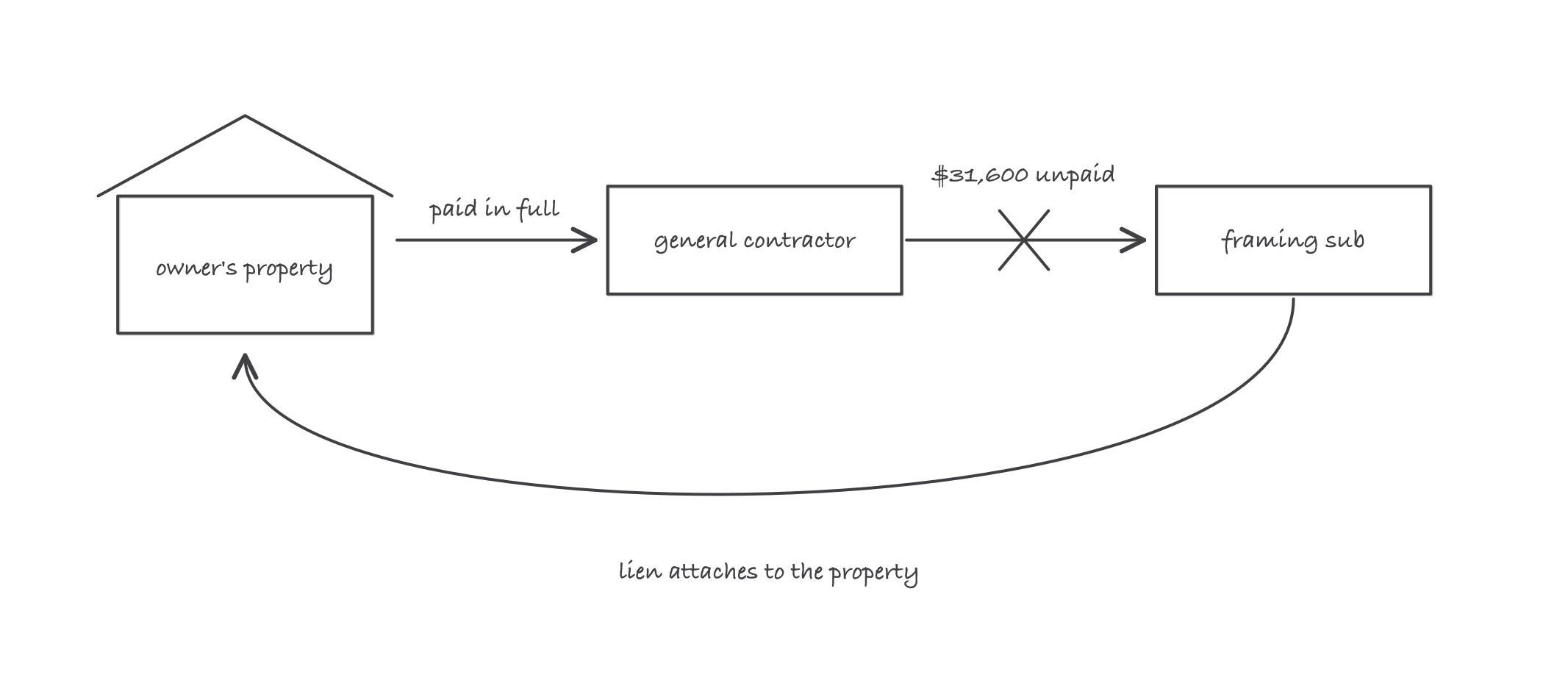
Payment failed one link down the chain, so the lien reaches past the chain to the property itself
Where it bites
- A lien is leverage, not payment. Recording it forces attention, but if the dispute does not settle you must file a foreclosure suit within your state’s enforcement window or the lien expires. Recording and forgetting achieves nothing.
- You lien the property, not the person. Contractors say “I’ll lien the GC.” You cannot. The claim attaches to the improved real estate, which is exactly why it works when the GC is broke.
- Unlicensed work usually kills lien rights. In most licensing states, a contractor who needed a license and lacked it has no lien and often no contract claim either. Unlicensed Work: Penalties and Enforcement covers how deep that hole goes.
- Waiver forms are not interchangeable. Some states mandate statutory waiver language; everywhere, the conditional versus unconditional distinction is the money question. Read the title line of every waiver before signing.
- Owner-occupied homes get special protection in many states, extra notices, shorter windows, or restrictions on liening a homestead. Residential work is where lien statutes are strictest.
Exam relevance
Every state business and law exam, including exams built on the NASCLA contractor’s business and law materials, tests lien fundamentals: who may claim, what a lien attaches to, and above all the four waiver types. Expect a scenario asking which waiver protects a contractor who has been handed a check that has not cleared: conditional, always. Learn your own state’s statute for the licensing exam, since the tested deadlines and notice rules are state-specific.
Verified requirements
| Where | Expires | Renewal | Continuing education |
|---|---|---|---|
| California | Yes | 2 years (CSLB: 'Active licenses expire every two years.' Inactive licences expire every four years.) | Confirm with issuer |
| Florida | Confirm with issuer | Confirm with issuer | Confirm with issuer |
| Arizona | Confirm with issuer | Confirm with issuer | Confirm with issuer |
Information comes from issuing-authority sources. Confirm current rules, fees and eligibility with the authority before acting.