Business · General Contracting
Progress Billing and Retainage
Assumes you know: Cash Flow: Why Profitable Contractors Go Broke
Progress billing means invoicing for work as it is completed each month instead of once at the end. Retainage is the share of every one of those invoices, typically 5 to 10%, that the owner holds back until the project closes out. The first is your best cash-flow tool; the second quietly takes it back unless you plan for it.
Why it matters on the job
The cash-flow lesson showed a $50,000 float on a one-invoice job. Progress billing is the standard cure: bill monthly and the money starts arriving while the job is still running. But retainage rides along on nearly every commercial and public contract, and its arithmetic surprises contractors who have never computed it: the held money routinely exceeds the entire profit on the job.
The schedule of values
Progress billing runs on a schedule of values: the contract price broken into line items agreed before work starts. Foundation $30,000, framing $46,000, and so on, summing to the contract amount. Each month you certify percent complete per line and invoice that share. Two practical rules: break the schedule fine enough that early work is billable early, and put real value on mobilization and general conditions so month one is not a donation.
Worked example: the retainage bite
Contract $200,000, four equal monthly draws of $50,000, retainage 10%.
Each month you invoice $50,000 and receive $50,000 × 0.90 = $45,000, with $5,000 held.
By completion: 4 × $5,000 = $20,000 of your money held, fully 10% of the contract.
Now put that against margin. At an 8% margin the job’s entire profit is $200,000 × 0.08 = $16,000. The owner is holding $20,000: your whole profit plus $4,000 of your costs. Until retainage releases, you have effectively financed the job at a loss out of your own pocket, on a job performing exactly to plan. Release commonly waits on substantial completion, punch list, lien releases, sometimes owner acceptance paperwork, and that can run months. Your bid and your cash forecast must both carry this number, because a shop running several jobs has several retainages outstanding at once.
Some contracts reduce retainage at the halfway point, say from 10% to 5%, and public rules in many places cap or phase it. The terms live in the contract; read them before bidding, and price the financing cost if the hold is long.
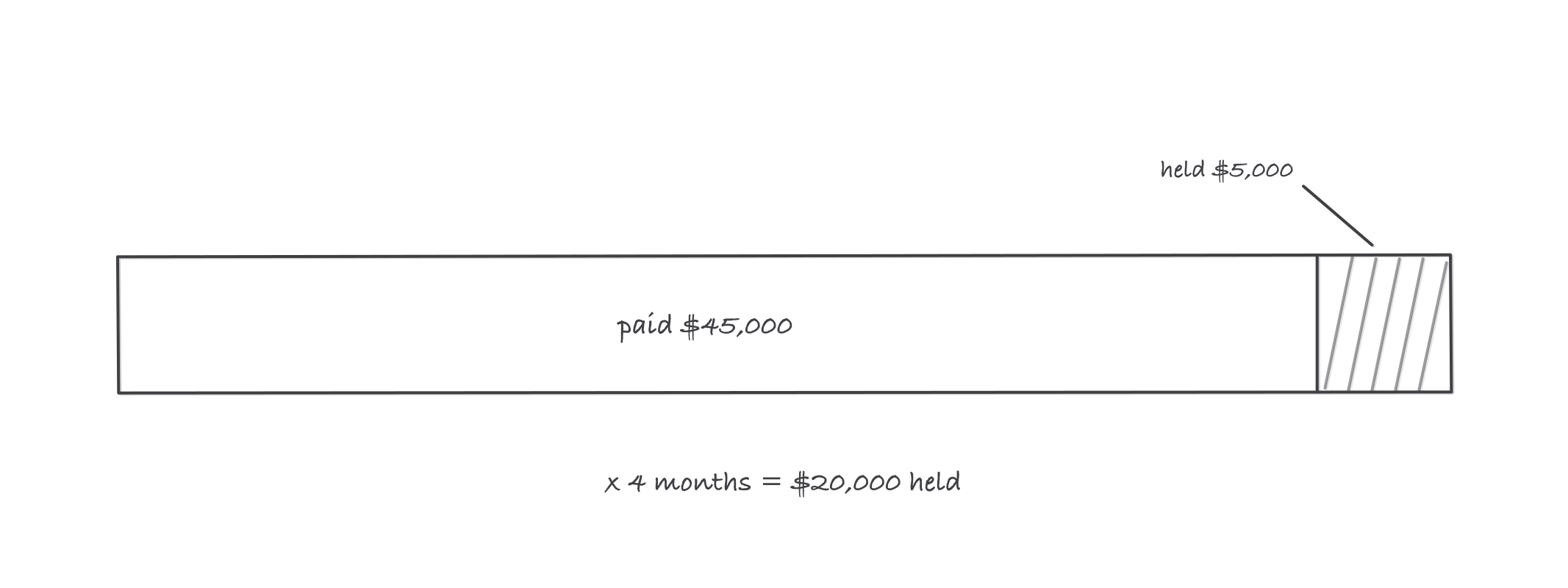
Ten percent of every draw: by closeout the held 20,000 dollars exceeds the job’s 16,000 dollar profit
Making both work for you
- Invoice on the day the application window opens. Every day late moves the payment a day. Late paperwork is the most common self-inflicted cash wound.
- Track retainage as its own receivable. It is real money with a real release path: substantial completion, punch, lien releases. Drive that paperwork as hard as the work.
- Mirror the terms downstream. If you hold no retainage on your subs while the owner holds 10% on you, you are financing everyone. Matching terms in sub agreements is standard practice.
- Chase the release. Retainage forgotten is retainage donated. A closeout checklist per job, with dates, keeps the last 10% from becoming a bad-debt line.
Where it bites
- Bidding as if retainage were income timing, not financing cost. Months of held profit has a real cost; long holds belong in the price.
- Front-loading the schedule of values too aggressively. Mild front-loading is normal; obvious front-loading gets applications rejected and sours the payment relationship you depend on.
- Forgetting the pay-when-paid clause next to the retainage clause. Your subs’ patience is part of your cash plan. Know what your sub agreements promise before the owner slows down.
- Letting punch list drift. Every open punch item is a reason to hold your $20,000. The last 2% of work releases the last 10% of money.