Business · General Contracting
Defining Scope of Work
Assumes you know: Reading Plans and Specifications
Scope definition is writing down exactly what your price includes, what it excludes, and what you assumed to get there. The number on your bid means nothing by itself; it only means something next to the scope statement that produced it.
Why it matters on the job
Two contractors pricing “the same job” almost never carry the same work. One includes the dumpsters, the other excludes them. If neither writes it down, the owner compares two numbers that are not comparable, picks the cheaper one, and the argument starts after the contract is signed, when you have no leverage. A clean scope statement protects your price on bid day and protects your profit afterward.
The three lists
- Inclusions. The work you measured and priced, stated in plain terms: which drawings, which spec sections, which addenda. Specific beats general: “demolition of interior partitions per A-101” is a scope; “demo” is a lawsuit.
- Exclusions. Work someone might reasonably expect you to carry that you deliberately did not price. Every assumption you could not verify belongs here, converted into a written exclusion.
- Qualifications. The conditions your price depends on: normal working hours, water and power available on site, quantity of mobilizations, the date your pricing holds until.
Allowances deserve their own mention. When the owner has not yet picked a product, carry a stated dollar figure instead of a guess: “includes a $4,000 flooring material allowance.” The bid stays comparable against other bidders, and the final selection moves the price up or down by a documented amount instead of by argument.
The discipline that makes this work: during takeoff, every time you catch yourself saying “I assume”, stop and write the assumption down. At bid time each one becomes either a verified fact, an exclusion, or a qualification.
Worked example
You are bidding interior demolition. Your takeoff carries six dumpster pulls at $475 each, $2,850, and the demolition permit at $600. That is $3,450 of real cost inside your number. Your competitor excludes both.
- Your bid: $24,450, including dumpsters and permit.
- Their bid: $21,000, excluding both.
Same work, $3,450 apart, and on a plain number-versus-number comparison you lose. Now add one line to your bid: “Includes 6 dumpster pulls and demolition permit ($3,450 value)”. The owner can finally compare like with like, and the cheaper-looking bid is exposed as the same price with the costs pushed back onto the owner.
The same logic runs in reverse for risk. You did not drill the soil, so you exclude what you cannot see: “Rock excavation and unforeseen subsurface conditions excluded; if encountered, priced as a change order.” That sentence converts an unlimited risk into a defined one.
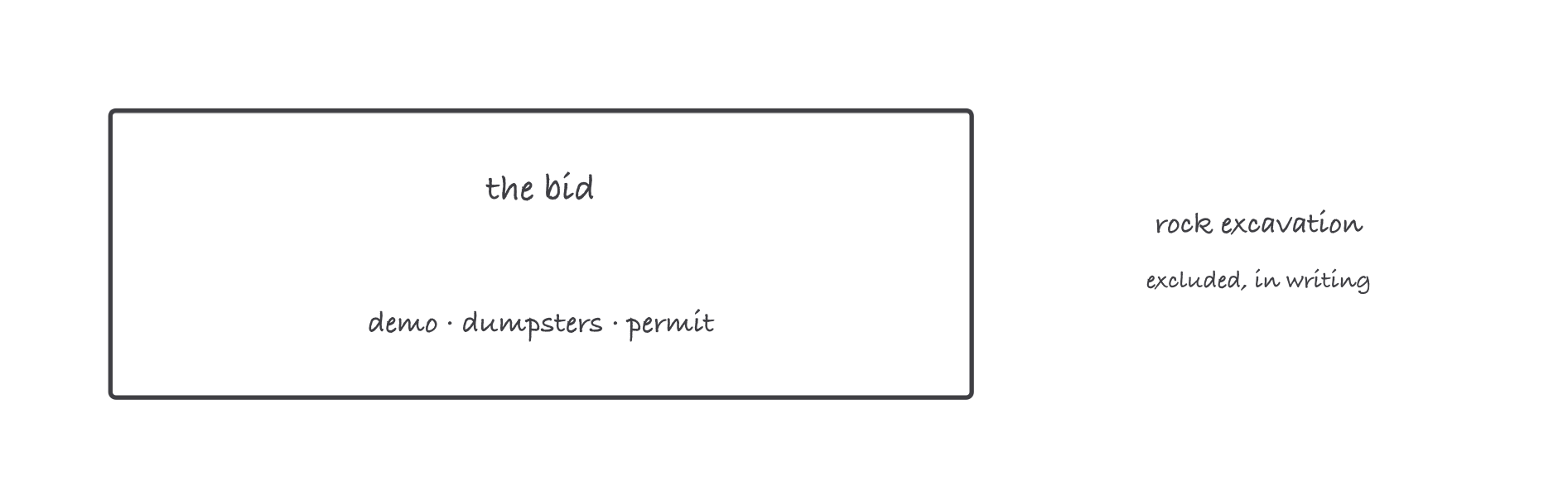
The price only means something next to the line that shows what is inside it and what is not
Where it bites
- The silent assumption. Anything you assumed but did not write became an inclusion the moment the owner read your number. Unwritten exclusions do not exist.
- Sub quotes with mismatched scopes. Your drywall sub excluded scaffolding, your painter assumed the drywaller had it. Scope-check every quote against a checklist before you carry it, or the gap is yours.
- Boilerplate exclusion lists. A page of 40 generic exclusions gets ignored by readers and thrown out by owners. Exclude the specific, plausible items on this job.
- Winning on a scope gap. Being low because you carried less is not winning; it is discovering the missing scope later, at your own expense, with the least sympathetic audience possible.