Business · General Contracting
Managing Subcontractors
Assumes you know: Subcontract Agreements
Managing subcontractors is managing companies, not crews. You direct the sub’s scope, schedule and quality through the subcontract and the sub’s own supervision; you do not run their people. The GCs who get the best work out of subs are not the loudest ones: they are the ones whose jobs are ready when the sub arrives, whose payments arrive when promised, and whose paperwork is airtight when it is not.
Why it matters on the job
Most of the work on your project is performed by companies you do not own. Your margin, your schedule and your reputation are delivered by subs, which means your real product as a GC is coordination: the conditions under which twenty companies can each do their best work. A sub who trusts your jobs bids them lower; the trade grapevine prices GCs just as GCs price owners.
Before mobilization: the gate
No sub starts work until three things are in hand, every job, no exceptions:
- A signed subcontract. Once a sub is mobilized, your leverage to get signatures collapses.
- Insurance certificates meeting the subcontract’s requirements, with additional insured status where required, verified before the first worker walks on, because an uninsured sub’s accident becomes your claim.
- Schedule commitment: the sub has seen the current schedule, agreed to their durations and crew sizes, and knows the update rhythm.
Add a pre-construction meeting for major trades: scope walked line by line, exclusions surfaced, submittals and long-lead deliveries dated, site logistics and quality expectations stated. An hour here removes weeks of dispute later.
During the work: rhythm and readiness
- Weekly coordination meeting. Every active trade, standing agenda: last week’s progress against the look-ahead, this week’s plan, conflicts, deliveries, inspections. Short, factual and minuted, because those minutes are evidence later.
- Readiness is your half of the deal. A sub’s productivity is mostly set by what you hand them: access, complete predecessor work, decisions and drawings in hand. Before you escalate on a slow sub, audit your own readiness; the most common cause of sub delay is GC-supplied.
- Payment discipline. Process pay applications on the contract’s timeline and pay when you said you would. Payment reliability is the single strongest lever you hold: subs staff reliable payers first when the market is tight.
- Performance problems, in escalating writing. Note the issue in the daily log, raise it in the meeting, then a written notice referencing the subcontract clause, the deficiency, and the cure period. If cure fails, the subcontract’s remedies, supplementing the sub’s forces or termination, only survive a dispute if the notice trail exists.
Worked example: the backcharge done right
Your painting sub damages installed cabinet faces; replacement costs $2,700. Wrong way: deduct $2,700 from their next payment with a one-line note, and spend closeout arguing. Right way: photograph the damage the day it is found, note it in the daily log, give the sub written notice with the photos and the option to repair at their own cost within the cure period, and when they decline, issue a written backcharge with the invoice attached, deducted per the subcontract’s backcharge clause. Same $2,700, but the first version is a payment dispute and the second is a file.
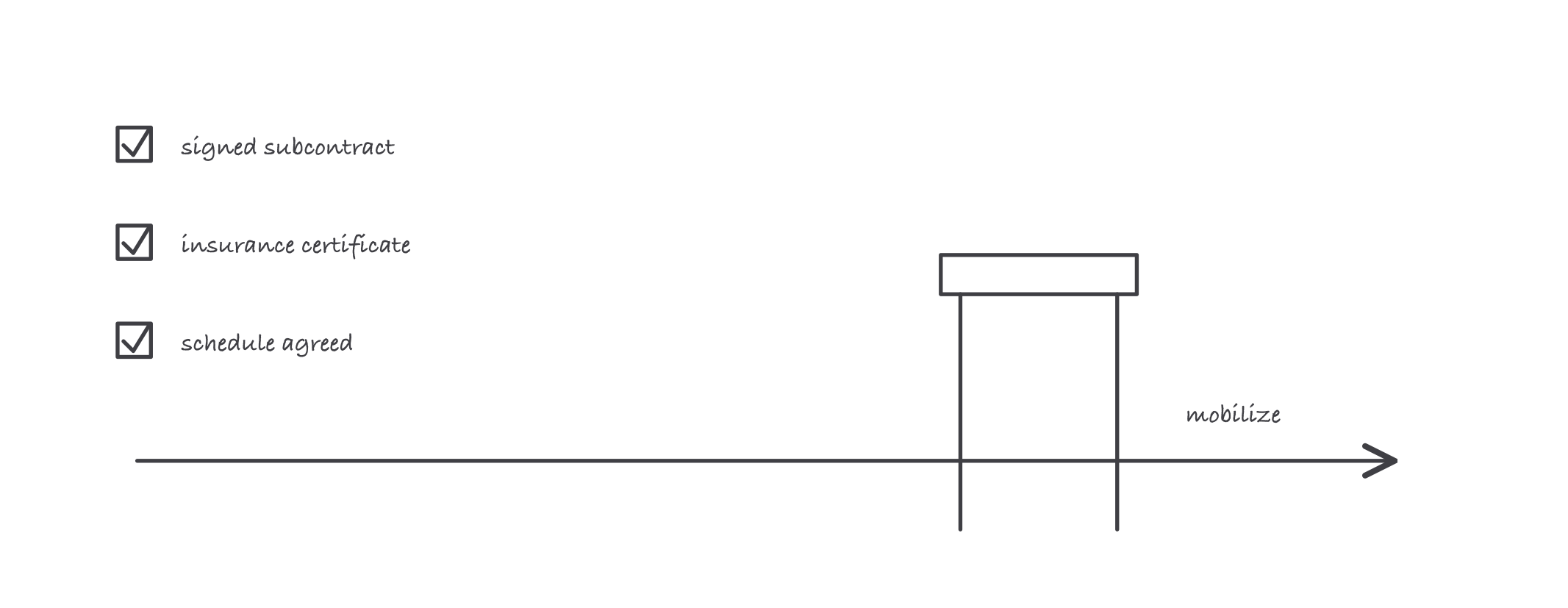
Nobody through the gate without the paper: signatures, certificates and a schedule commitment
Where it bites
- Letting a familiar sub start on trust. The sub you have used for years is exactly the one who mobilizes without a signed subcontract, and the relationship is exactly what a money dispute destroys.
- Managing the sub’s workers directly. Directing another employer’s crew blurs responsibility for means, methods and safety, and undermines the sub’s own supervision. Direct the foreman, document with the company.
- Escalating verbally forever. Six friendly reminders and no written notice equals, contractually, no notice at all. Kindness and documentation are not opposites; do both from the first miss.
- Squeezing subs as a profit strategy. Grinding pay applications and slow-paying to hold cash works exactly once per sub. The bid you get next year carries the memory as a line item you cannot see.