Business · General Contracting
Permits and Inspections
Part of Contractor License, Start to Finish · step 20 of 21 · next: Where to Take the Contractor Exams
In learning paths: Contractor License, Start to Finish
A building permit is the jurisdiction’s written permission to do regulated construction work, and inspections are how it verifies the work matches the adopted code and the approved plans. Permits and inspections are not bureaucratic decoration around the job: they are the legal spine of it, and knowing how the process runs is a basic trade skill before it is ever a business skill.
Why it matters on the job
Almost everything a contractor builds is regulated by a local building department, the authority having jurisdiction, or AHJ. Work that skips the permit runs on borrowed time: a stop-work order halts the crew mid-day, unpermitted work can be ordered opened up or torn out, penalty fees typically multiply the permit cost, and the problem resurfaces years later when the property sells and the records do not match the house. Crews that understand the inspection sequence build in the right order and never uncover finished work for an inspector.
When a permit is required
The adopted building code requires permits for most structural, electrical, plumbing, and mechanical work: new buildings, additions, alterations, and many replacements. Codes exempt genuinely minor work, think painting, floor coverings, small repairs, but the exemption list is written by each jurisdiction and interpreted by the AHJ. Two rules of thumb keep you safe: if the work is hidden inside a wall, underground, or structural, assume a permit; and when in doubt, a phone call to the building department costs nothing compared to an exposed wall.
Who pulls the permit matters. In licensing states the contractor performing the work typically pulls it, under their license. Owner-builder permits exist for owners doing their own work, with legal strings attached. Pulling a permit for work someone else performs, “permit for hire,” is a discipline offense against your license in many states.
The process, start to finish
- Application and plan review. You submit plans; the department checks them against the adopted code. Larger projects may cycle through corrections.
- Issuance. The permit is issued, fees paid, and the permit card posted on site. Approved plans live on site too.
- Inspections at defined stages. You call for each inspection when that stage is complete and still visible.
- Corrections and reinspection. A failed inspection produces a correction notice; you fix and call again.
- Final inspection and certificate of occupancy. The final approval closes the permit; on new buildings and changes of use, the certificate of occupancy is what legally allows the building to be used.
Permits also expire: let the job stall too long without an inspection and the permit lapses, with renewal fees and sometimes re-review to revive it.
Inspect before you cover: the sequence
The entire inspection system rests on one principle: the inspector must see the work while it can still be seen. That produces the classic sequence on a typical build, footing and foundation before concrete is poured, underground plumbing before the slab, framing and rough-in of electrical, plumbing, and mechanical before insulation, insulation before drywall, then finals. Names and groupings vary by jurisdiction; the before-you-cover logic never does.
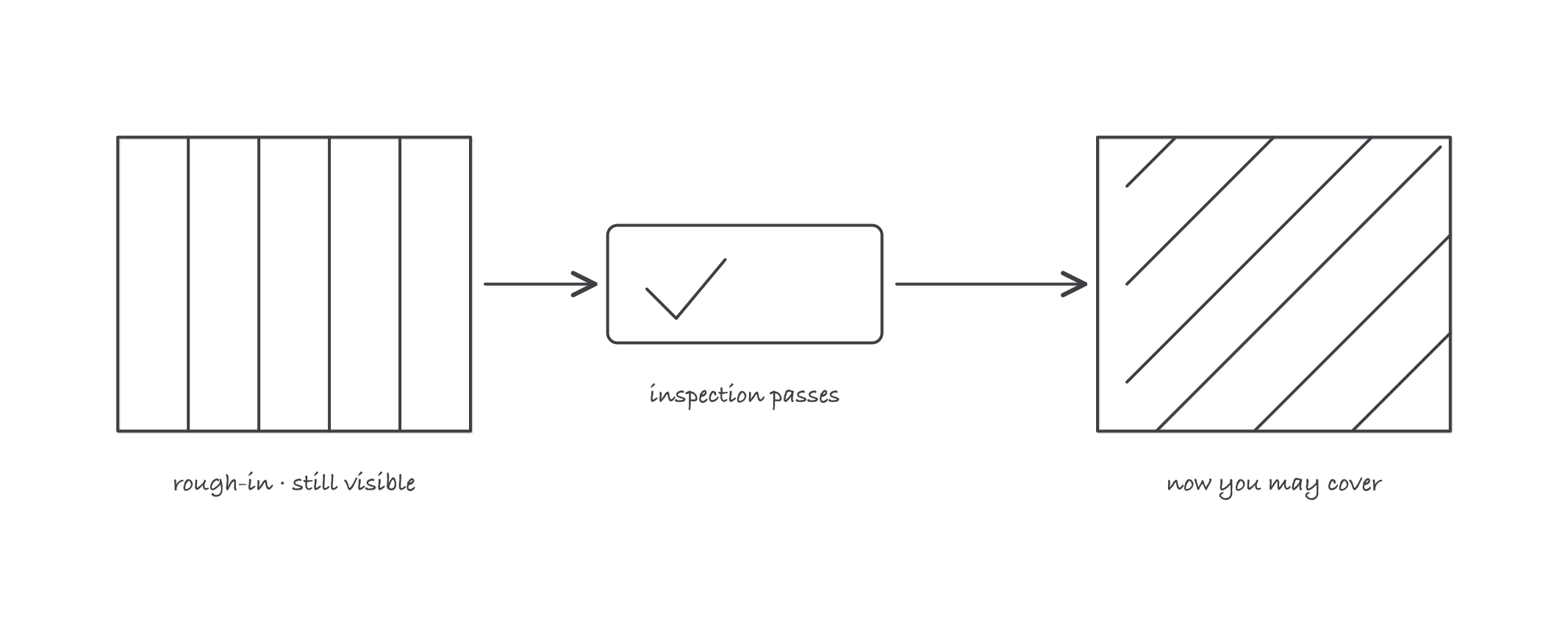
The inspection lives between the work and whatever hides it
Worked example: what skipping the permit costs
A hypothetical fee schedule, for the arithmetic: permit fee equals $150 plus $8 per $1,000 of job valuation.
You convert a garage to an office, valuation $60,000.
- Permit fee: $150 + ($8 × 60) = $150 + $480 = $630.
- Skip the permit instead, get caught at drywall. Many jurisdictions charge an investigation or penalty fee equal to the permit fee on top of it: $630 × 2 = $1,260.
- Now the required corrections: the rough-in was covered without inspection, so the inspector orders drywall opened at their discretion. Say demolition and re-hang of even a third of the new drywall runs $2,000 or more, plus a stalled schedule and a customer watching walls come back down.
The permit was the cheapest item on the job. It always is.
Where it bites
- Calling for inspection too late is self-inflicted. The crew that insulates before the frame inspection passes will remove insulation. Build the inspection sequence into the schedule, trade by trade, as Sequencing Trades teaches.
- The approved plans are part of the permit. Building something better than the drawing is still building something other than the drawing; significant changes go back through review as revisions.
- A stop-work order binds everyone on site. Working through one escalates the matter from fees to enforcement, and in licensing states it feeds straight into the discipline machinery covered in Unlicensed Work: Penalties and Enforcement.
- Unpermitted work never ages out. It surfaces at sale, at refinance, at the insurance claim after the fire. The buyer’s inspector finding an unpermitted addition creates a problem with your name on it years later.
- The AHJ’s interpretation governs. Two neighboring jurisdictions can read the same model code differently. The local amendment list and the local inspector outrank your memory of the code book.
Exam relevance
Business and law exams test the process: who may pull permits, that permits are required before work begins, the inspection-before-cover principle, stop-work orders, and certificates of occupancy. NASCLA-based exams like scenario questions about owner-builder permits and permit-for-hire violations. Trade exams test the sequence itself: which inspections precede which coverings on a standard build.
Verified requirements
| Where | Expires | Renewal | Continuing education |
|---|---|---|---|
| California | Yes | 2 years (CSLB: 'Active licenses expire every two years.' Inactive licences expire every four years.) | Confirm with issuer |
| Florida | Confirm with issuer | Confirm with issuer | Confirm with issuer |
| Arizona | Confirm with issuer | Confirm with issuer | Confirm with issuer |
Information comes from issuing-authority sources. Confirm current rules, fees and eligibility with the authority before acting.