Business · General Contracting
Scaling From Solo to Crew
Assumes you know: Employee vs Subcontractor Classification
Scaling from solo to crew is trading the profit of your own two hands for the smaller, repeatable profit on other people’s hours. The trade works, plenty of shops prove it, but the arithmetic dips before it climbs, and the contractors who survive the dip are the ones who saw it coming and hired on purpose.
Why it matters on the job
Solo, you are the ceiling: your billable hours are the whole business, and a flu week is a zero-revenue week. A crew raises the ceiling and makes the shop sellable, insurable against your absence, and able to bid bigger work. But the first hire is the hardest economics in contracting, because it cuts your production while adding cost, and nobody warns you.
Worked example: the first-hire dip
Solo baseline. You bill $90/hour and put in 30 billable hours a week (the rest is estimating, running for materials, paperwork): $2,700/week of revenue.
Now hire a carpenter at a loaded cost of $40/hour × 40 hours = $1,600/week (loaded rate per the hiring lesson). They produce 30 billable hours. But training, supervising and the extra coordination cut your own billable time to 15 hours. New week:
- Revenue: (30 + 15) × $90 = $4,050
- Added revenue vs solo: $4,050 − $2,700 = $1,350
- Added cost: $1,600
- Net change: $1,350 − $1,600 = −$250/week.
You hired, work is flying, and you are earning $250 a week less. This is the dip, and it is normal. It ends when the numbers move: the employee’s output rises as training pays off, your billable hours recover as supervision gets efficient, and your pricing starts charging for a two-person operation. Flip your recovery to 22 billable hours and the same week nets (30 + 22) × $90 = $4,680, which is $1,980 over solo revenue against $1,600 of cost: +$380/week and climbing. The dip typically runs months, not weeks: hire with cash reserve to cross it.
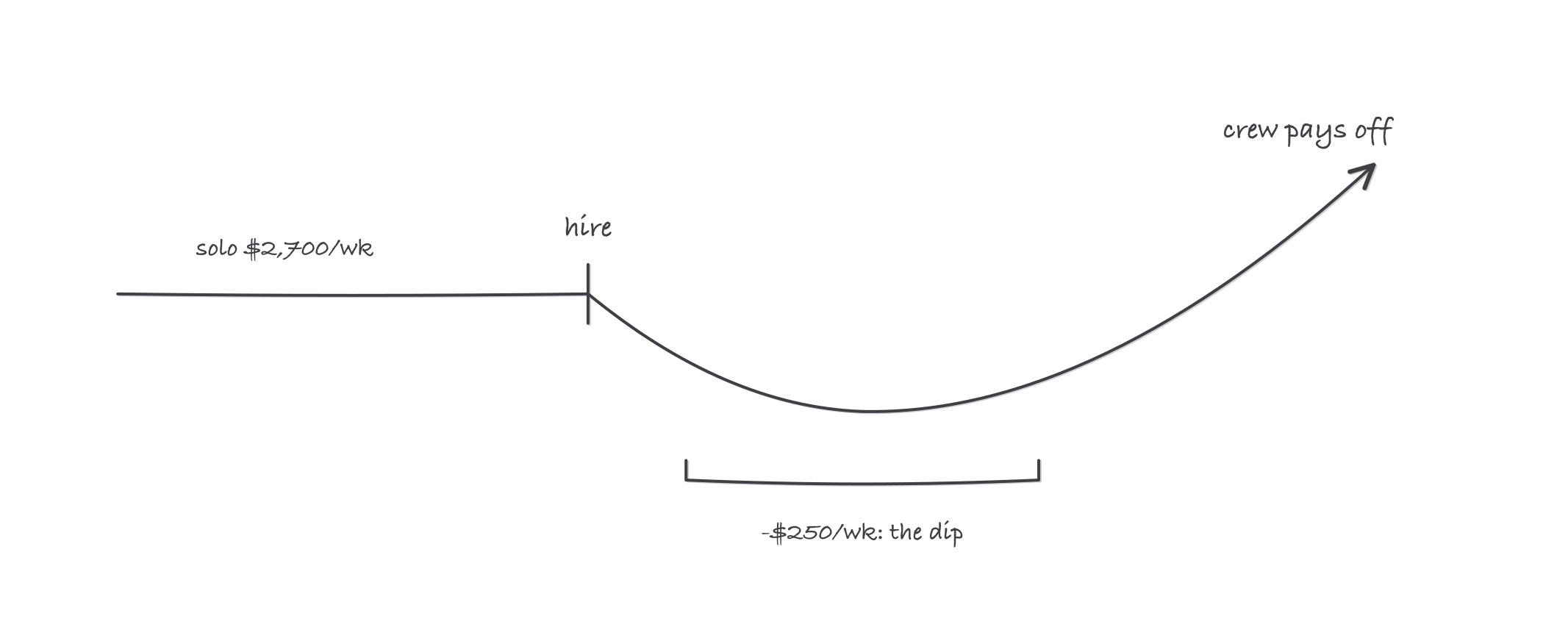
The first hire costs money before it makes money: plan the dip, do not discover it
Hire for the bottleneck, not the mirror
The instinct is to hire another you. Usually wrong. List where your hours actually go; hire to take the lowest-value hours first, so your high-value hours (estimating, selling, supervising) expand. A $22/hour laborer who returns 15 hours of your week to billable and bidding work often beats a $35/hour lead carpenter you then have to find work for. The bottleneck moves as you grow: each hire should attack the current one.
What must be in place before payroll number one
- The employer obligations from the hiring lesson: payroll, comp, wage-hour discipline. Day one, not eventually.
- Classification done right: crew you direct daily are employees, per the previous lesson. Building a “crew” of misclassified subs is building on sand.
- Licensing and supervision rules. Many jurisdictions regulate who may perform and supervise licensed trade work and at what ratios. Verify your board’s rules before the hire, not at inspection.
- Job costing per crew. The feedback loop that tells you whether hour thirty-one of someone else’s work actually makes money, and which crews earn their keep.
- Written scope and standards. The quality that lived in your head must move onto paper: checklists, photos of “done right”, a punch standard. You cannot scale what only you can see.
Where it bites
- Hiring under pressure instead of on purpose. Grabbing a body in a busy month, with no cash plan for the dip, is how the busy season produces a loss.
- Pricing like a solo after you grow. Your overhead just grew a payroll, comp premiums and supervision time. The overhead rate must be recomputed at every hire, or the new capacity sells at a loss.
- Keeping every hour of production yourself. If you cannot hand work down, you did not hire capacity, you hired an audience. Delegation is the skill the dip is pricing in.
- Scaling past your systems. Two crews without job costing, written scope and a scheduling habit is chaos at twice the burn rate. Systems first, then headcount; the order is not optional twice.