Business · General Contracting
Bonds: Bid, Performance and Payment
Assumes you know: Contractor Insurance Explained
A bond is not insurance, even though you buy it from an insurance-adjacent company. Insurance transfers risk away from you. A bond is a guarantee to someone else that you will perform, and if the surety has to pay on that guarantee, it comes back to collect from you. Every bond is a three-party arrangement, and the party the bond protects is never you.
Why it matters on the job
Public work and most sizable commercial work are closed to unbonded contractors: the bid documents require bonds. Many states also require a license bond just to hold a contractor license. Bonding capacity, the total value of work a surety will guarantee for you, becomes a hard ceiling on growth. Contractors who want bigger jobs discover that the path runs through their financial statements, not their tool trailer.
The three parties
Every bond has a principal (you, the contractor doing the promising), an obligee (the owner or agency being protected) and a surety (the company guaranteeing your promise). If you fail and the surety pays the obligee, your indemnity agreement, which you and usually your spouse signed personally, obligates you to pay the surety back. Read that sentence again before signing anything.
The bonds you will meet
License bond. Required by many states to hold a license at all. A small guarantee that you will follow contracting law; a consumer you wrong can claim against it, and you repay the surety.
Bid bond. Submitted with a bid on public work. It guarantees that if you win, you will sign the contract and provide the other bonds. Walk away from a winning bid and the obligee claims the bond, typically a percentage of your bid set in the bid documents.
Performance bond. Guarantees the job gets finished per the contract. If you default, the surety arranges completion, then pursues you for its costs.
Payment bond. Guarantees your subs and suppliers get paid, which is why public owners require it: liens generally cannot attach to public property, so the payment bond stands in for lien rights.
Worked example: what bonding actually costs and caps
You win a $400,000 public job requiring performance and payment bonds. Premium is quoted as a percentage of contract value; say your rate is 1.5%:
$400,000 × 0.015 = $6,000 of bond premium, a direct job cost that belongs in the bid, listed right beside insurance.
Capacity is the other number. A surety might set you a $500,000 single-job limit and a $1,000,000 aggregate: with the $400,000 job running, only $600,000 of aggregate room remains, and nothing bigger than $500,000 regardless. Those limits are set from your financials, chiefly working capital and net worth, plus your track record. Clean, CPA-prepared statements raise capacity; a thin balance sheet caps you no matter how good your crews are.
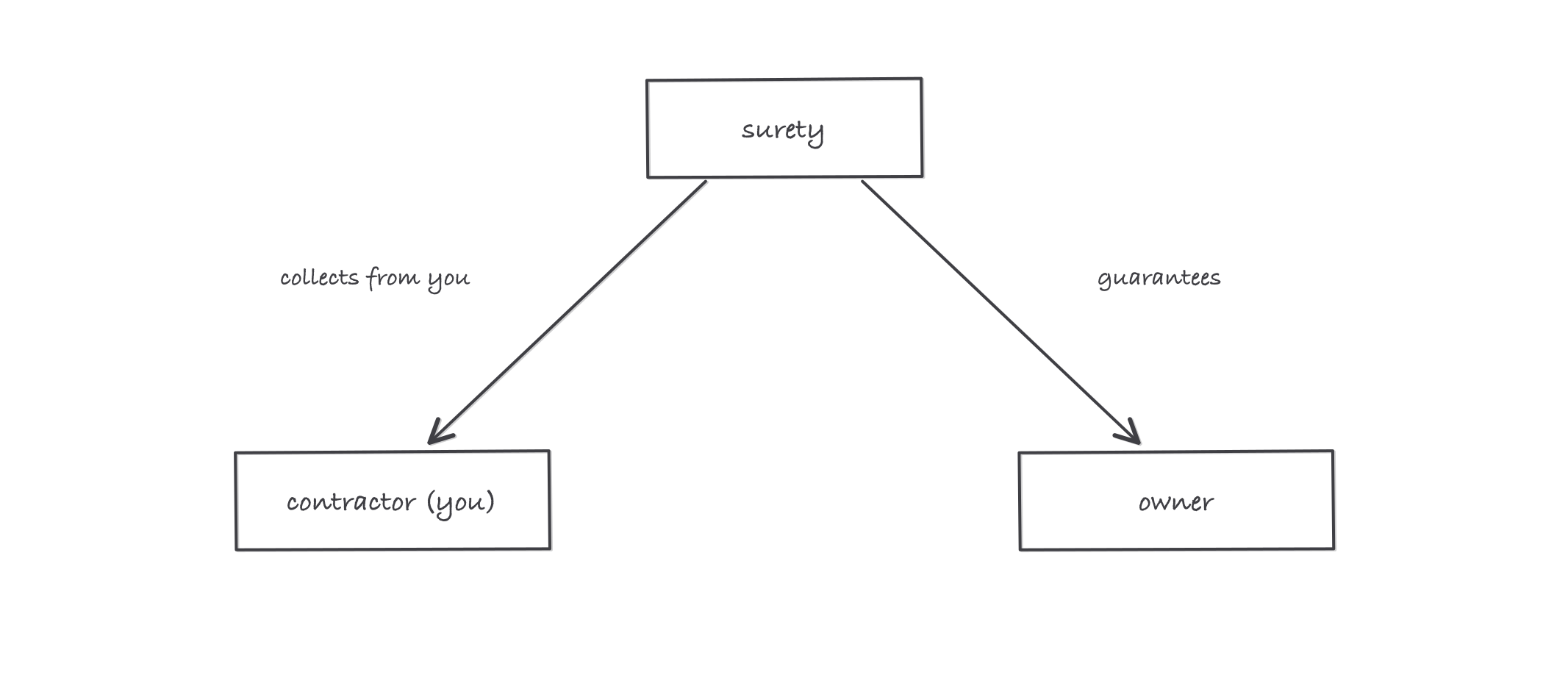
The bond protects the owner: if the surety pays, it comes back to you under the indemnity agreement
Where it bites
- Treating a bond like insurance. A paid claim is not the end of the matter; it is the beginning of the surety collecting from you personally. The indemnity agreement usually reaches personal assets, whatever your business structure says.
- Bidding bonded work without checking capacity first. Winning a job your surety will not bond means eating a bid bond claim. Confirm single and aggregate room before bid day.
- Ignoring the balance sheet. Pulling too much cash out of the company shrinks working capital, which shrinks capacity. Growth on bonded work is partly a decision to leave money in the business.
- Forgetting the payment bond replaces liens on public work. Subs on your public jobs claim against your bond instead. A sub’s valid claim there is a surety claim against you, with the collection machinery that follows.