Business · General Contracting
Choosing a Business Structure
A business structure is the legal container your company operates inside, and it decides two things that matter enormously: who can be made to pay when something goes wrong, and how profit is taxed on its way to you. This lesson teaches the decision factors. It is not legal advice: the right answer depends on your state, your income and your risk, and the last step is always a sit-down with a CPA and an attorney.
Why it matters on the job
Contracting is a high-liability trade. A screw through a water line, a ladder fall, a dispute over a $60,000 remodel: any of them can turn into a claim bigger than the job. Your structure decides whether that claim can reach your house and savings. It also follows you everywhere else: license applications, insurance quotes, bank accounts and bonding all ask what entity you are before they ask anything else.
The three containers you actually choose between
Sole proprietorship. You and the business are legally the same person. It is the default if you do nothing: cheapest, simplest, no separation at all. Business debt is your debt. A judgment against the business is a judgment against you.
LLC. A limited liability company is an entity you register with the state. Done right, it puts a wall between business obligations and personal assets: the claim stops at the company. Profit still passes through to your personal return by default, so forming an LLC does not by itself change your taxes. It changes who is exposed.
Corporation. A separate legal person with shareholders, officers and required formalities. Most small shops that want a corporate form get there through an LLC first; a corporation is rarely the first move for a one-truck operation.
The S-corp election is a tax choice, not a structure
An LLC or corporation can elect S-corp treatment with the tax authorities. The mechanism: you pay yourself a reasonable wage for the work you do, and that wage carries payroll taxes. Profit beyond the wage can come out as a distribution, which does not. The election earns its keep only when profit comfortably exceeds a fair wage, because it adds real cost: payroll runs, separate filings, more accounting.
Worked example: a decision walkthrough
Two partners run a remodeling outfit. Year one, they form an LLC for the liability wall and take default pass-through taxation, because profit is modest and simplicity is worth money. By year three the company clears $140,000 of profit after expenses. A reasonable wage for the work each partner actually performs might be $90,000 combined, which would leave $50,000 as potential distribution under an S-corp election. Whether the tax saved on that $50,000 beats the added payroll and accounting cost is a spreadsheet the CPA runs with real rates for their state and year. The pattern to copy is the sequence: wall first, tax election later, and only when the numbers say so.
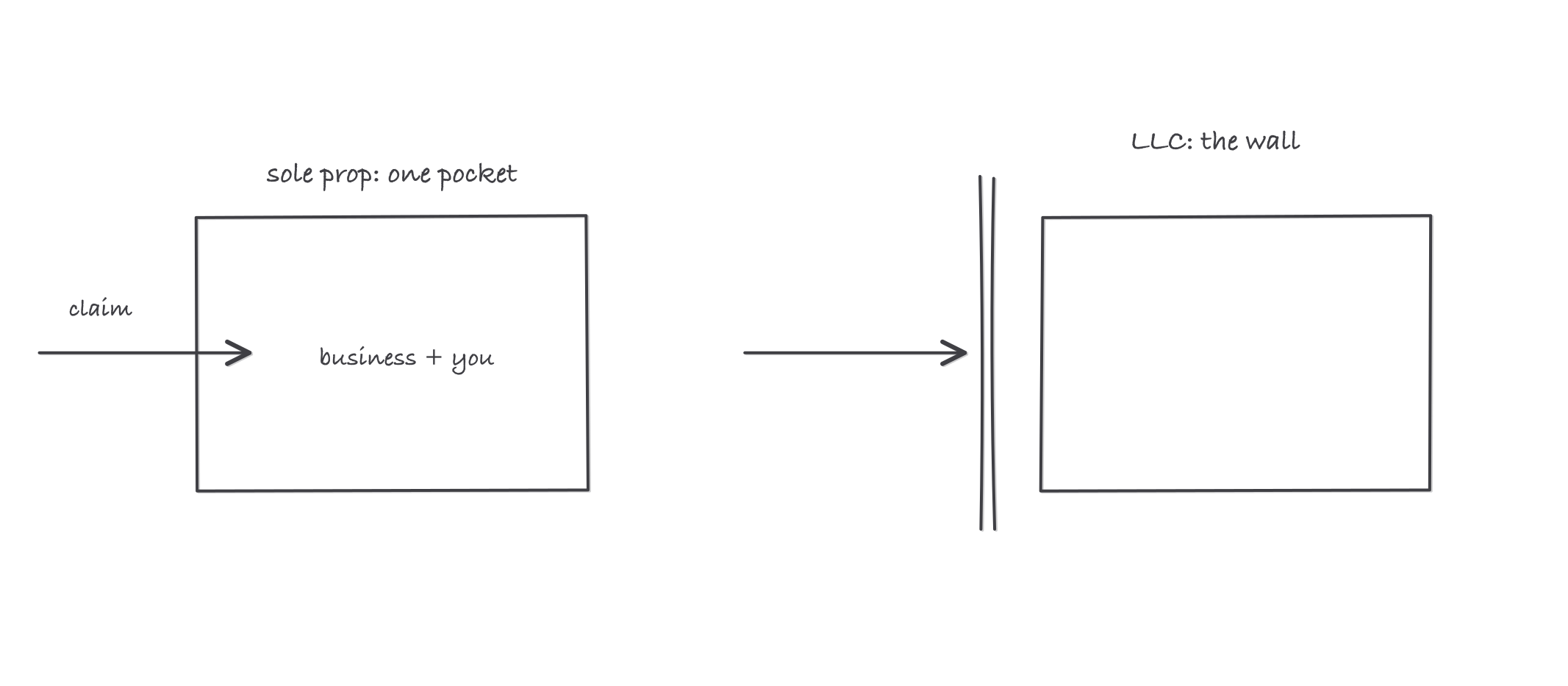
The wall only exists if you maintain it: separate money, contracts signed as the company
Where it bites
- Treating the LLC account as a wallet. Mixing personal and business money, signing contracts in your own name, skipping the formalities: courts can set the wall aside, and then you paid filing fees for nothing. Separate account, separate card, sign as the company, every time.
- Expecting the LLC to cut your taxes. By default it taxes exactly like what you were before. The wall is a liability tool. Tax savings come from elections and planning, through a CPA.
- An S-corp wage set unrealistically low. Paying yourself a token salary to maximize distributions is the classic audit trigger. Reasonable means what you would pay someone else to do your job.
- Confusing the wall with insurance. The structure protects personal assets after a claim exceeds coverage. Insurance is what actually pays claims. You need both, and insurance is the one that responds first.