Business · General Contracting
Tax Basics for Contractors
Assumes you know: Choosing a Business Structure
When you were an employee, taxes happened to you: withheld every check, settled every spring. When you run a shop, no one withholds anything. Every dollar that lands in the account looks like yours, and part of it is not. Contractor tax trouble is rarely exotic; it is spending the tax portion and meeting the bill without it.
This lesson teaches the concepts and the discipline. Rates, thresholds and elections change and depend on your structure and state: the specific numbers come from a CPA, and a contractor without one is underinsured.
Why it matters on the job
Tax debt is the quietest way a profitable shop dies. The money was earned, the money was spent, and the bill arrives months later with penalties and interest attached. The fix is not tax expertise; it is a habit that takes minutes per deposit.
Nobody withholds for you, so you withhold for you
Self-employed people generally prepay tax through quarterly estimated payments, four times a year, based on what you are earning. Miss them and penalties accrue even if you pay in full at filing. Your CPA sets the amounts; your job is having the money when each date comes.
The mechanism that makes that possible: a separate tax account, funded on every deposit. Pick the set-aside percentage with your CPA. Then treat it as law: money lands, the tax share moves, same day.
Worked example: the discipline in numbers
A progress payment of $18,000 lands. Suppose your CPA set your set-aside at one dollar in four, 25%, for this example (your real number is theirs to set):
$18,000 × 0.25 = $4,500 to the tax account, $13,500 stays operating.
Do that on every deposit and the quarterly date is a transfer, not a crisis. Skip it for a good quarter, say $120,000 of deposits, and you arrive at the payment date needing $30,000 that is now sitting in a truck you bought. The jar method is old because it works: the tax jar is not your money, it is money you are holding for someone with penalties at their disposal.
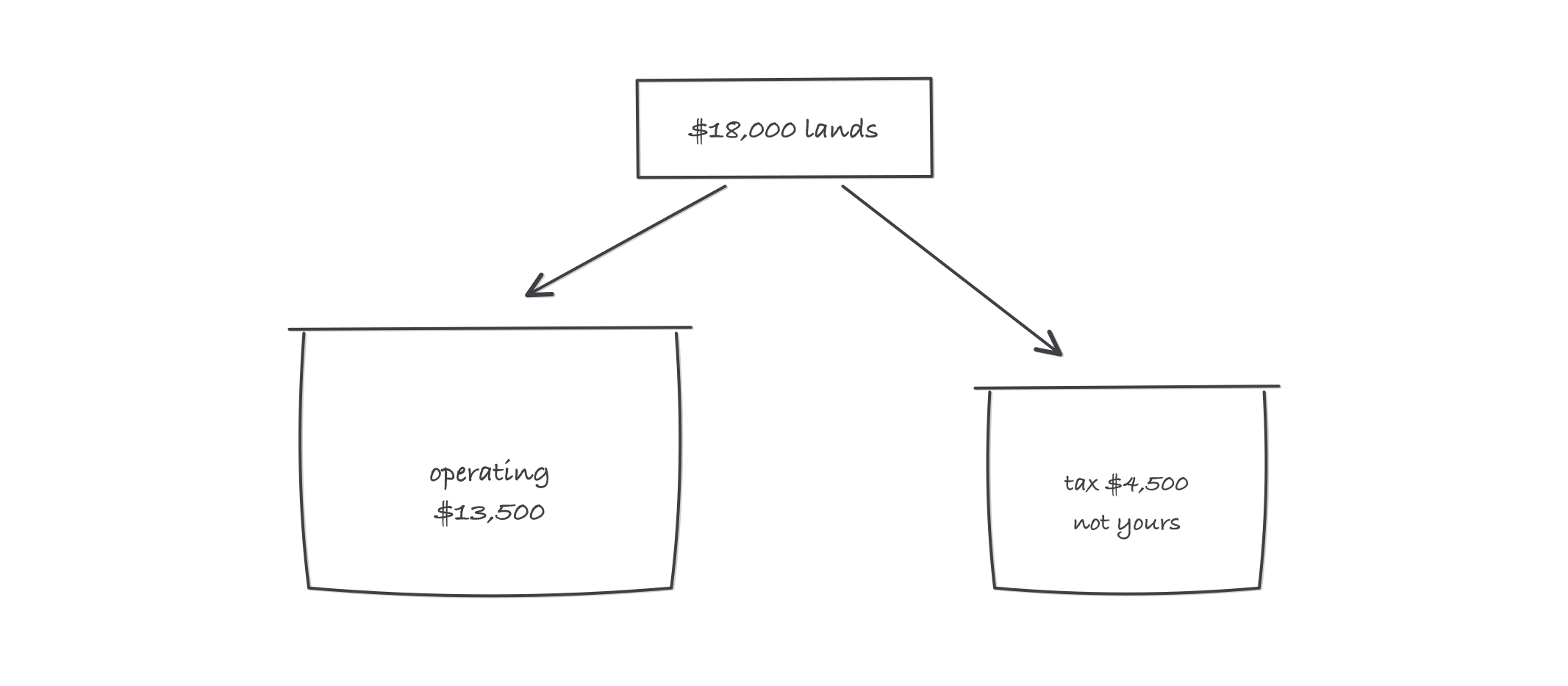
Fund the tax jar the day money lands: the quarterly payment becomes a transfer instead of a scramble
Deductions: concepts worth knowing before the CPA visit
- The truck. Business use of a vehicle is deductible, but only with records. Keep a mileage log (an app makes it painless): date, purpose, miles. Reconstructed logs fare badly under examination.
- Equipment. Big purchases are generally recovered over time as depreciation, and elections exist to expense more of the cost up front. Which treatment wins depends on your profit picture and the year’s rules: that is precisely a CPA conversation, ideally before the purchase, not after.
- Ordinary business costs. Materials, insurance, tools, phone, licenses, education. Deductible when documented; the bookkeeping habit is the deduction.
- Structure interactions. Your entity and elections (see the business structures lesson) change how profit is taxed and what payroll obligations exist. Another reason the set-aside percentage is a professional’s call.
The paperwork spine
Separate business bank account, every job’s money through it, books kept current monthly (software or a bookkeeper), receipts captured as they happen. Clean books are not for the tax authority’s benefit; they are your job costing, your loan applications and your bonding financials wearing a second hat.
Where it bites
- Spending the tax jar in a tight month. It converts a cash problem into a cash problem plus penalties plus interest. The jar is the last money you touch, after the line of credit, not before.
- A great year, an empty jar. Set-asides on a percentage self-scale; skipping them in the best quarter of your life produces the biggest bill of your life.
- No mileage log until March. The deduction is real and it evaporates without contemporaneous records. Start the log the day the business starts.
- Buying equipment in December for the write-off alone. A deduction reduces the tax on a dollar; it does not make the dollar free. Buy because the numbers work, then let the CPA optimize the treatment.