Business · General Contracting
Contractor Insurance Explained
Assumes you know: Choosing a Business Structure
Contractor insurance is a small set of policies, each answering one question: who gets hurt, and whose stuff gets damaged. Learn what each policy responds to and you can read your own coverage instead of hoping your agent guessed right.
Why it matters on the job
Nobody hires an uninsured contractor twice. GCs, property managers and public owners will ask for a certificate of insurance before you set foot on site, and your license likely requires minimum coverage. But the deeper reason is arithmetic: one liability claim can exceed the profit of every job you will do this decade. Insurance converts a ruinous possibility into a fixed overhead cost you can price into every bid.
The policies and what each one answers
General liability (GL). Damage your work does to other people and their property: the water line you hit, the ceiling that comes down a month later, the customer who trips over your cord. GL is the policy certificates are usually asking about. Note what it does not cover: your own work being defective is generally excluded, and so are your employees’ injuries.
Workers compensation. Your people, hurt on the job: medical bills and lost wages, regardless of fault. Most states require it once you have employees, and in exchange it is generally the employee’s exclusive remedy, meaning they cannot also sue you for the injury. Rules for owners and officers exempting themselves vary by state; verify with your state authority.
Commercial auto. The truck, driven for work. Personal auto policies routinely exclude business use, which surprises people at the worst possible moment.
Tools and equipment (inland marine). Your tools, wherever they are: the trailer break-in, the mixer that goes missing. Named for its history of covering goods in transit.
Builder’s risk. The structure under construction itself: fire, storm or theft damaging the unfinished work. Job-specific, usually bought per project, and the contract should say who buys it.
Umbrella. Extra limits stacked on top of GL and auto when a contract demands more coverage than your base policies carry.
Reading a certificate
A certificate of insurance shows each policy, its limits and its dates. GL limits commonly read as a pair: a per-occurrence limit, the most paid for one incident, and a higher aggregate, the most paid in the policy year. When a GC asks to be named additional insured, they are asking for protection under your policy for claims arising from your work. Expect it; price it.
Worked example: insurance as a line in your overhead
Say your policies total $14,400 per year: GL, workers comp, auto and tools together. You expect to put $1,200,000 of work in place this year:
$14,400 ÷ $1,200,000 = 1.2% of every job dollar.
On a $50,000 job, that is $600 of insurance cost that belongs in the price. A contractor who ignores it does not avoid the cost; they donate it. And when premiums rise at renewal, the rate gets recomputed and the pricing follows, the same discipline as any overhead item.
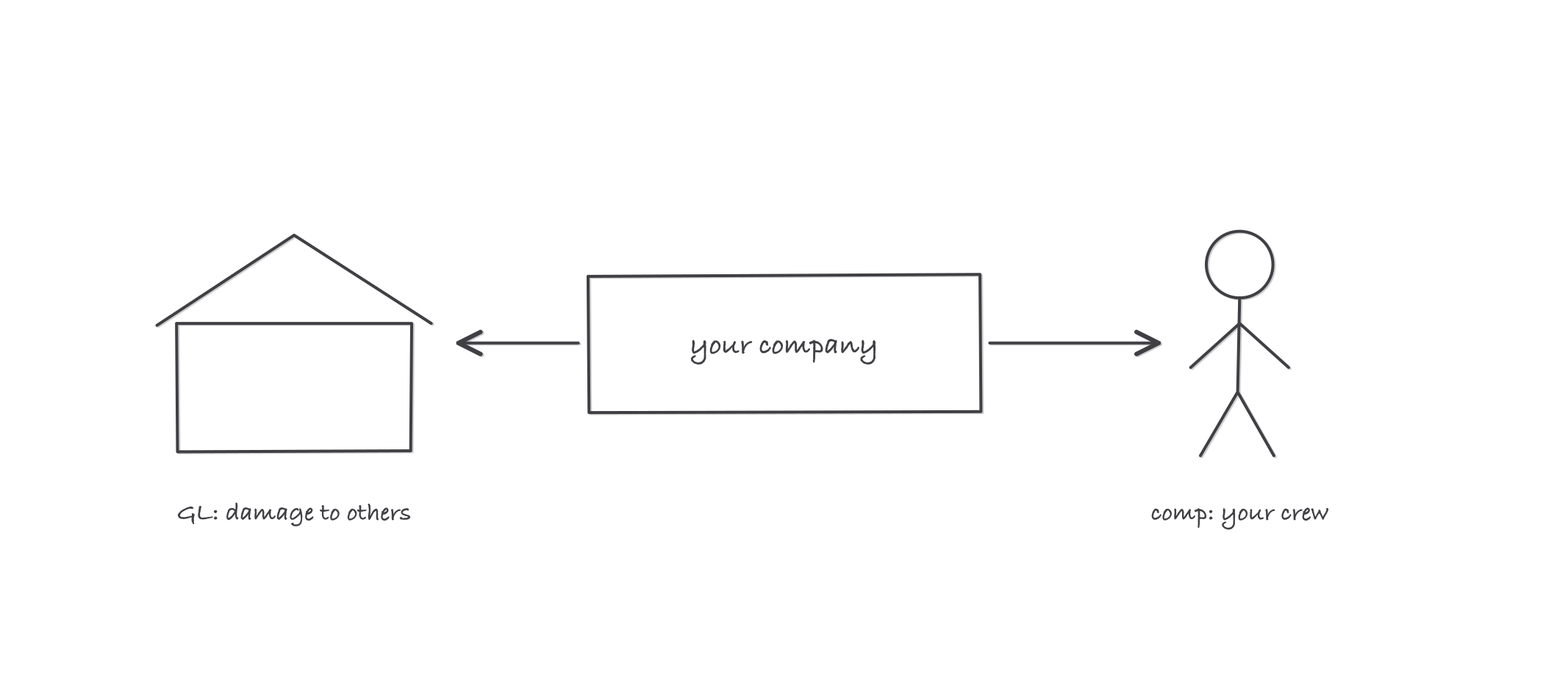
Two different policies for two different victims: GL faces outward, workers comp faces inward
Where it bites
- Assuming GL covers your crew. Employee injuries are the province of workers comp. A shop carrying GL only is naked against its own payroll, which is where most injuries actually happen.
- Assuming GL covers redoing your bad work. Faulty workmanship itself is generally excluded. GL responds to the damage the faulty work causes, not the cost of doing the job again.
- Driving the truck on a personal policy. Business-use exclusions are standard. One claim denied for commercial use costs more than years of the correct premium.
- Letting a policy lapse mid-project. Certificates carry dates, and GCs track them. A lapse can breach your contract and your license conditions at the same time. Put every renewal on the same calendar as your license renewals, and confirm state-specific requirements with your state and your agent.