Business · General Contracting
Bid or Pass: Choosing Your Jobs
Assumes you know: Overhead, Markup and Margin
The most profitable sentence in estimating is “we are not bidding this one.” Every bid you prepare costs real money, and a bid on the wrong job costs you either the estimate or, far worse, the win.
Why it matters on the job
Estimating capacity is a scarce resource: hours of skilled attention that could go to jobs you can actually win and profitably build. Spent on a job that does not fit, that money is gone whether you win or lose. The bid/no-bid decision is where you spend it on purpose instead of by reflex.
The questions that decide it
- Does it fit? Right trade mix, right size (a job 5 times your usual contract value is a different business), right location (drive time is labor cost, per the loaded rate lesson).
- Do we know the buyer, and do they pay? An owner or GC with a slow-pay reputation converts your profit into an interest-free loan. Check references the way they check yours.
- Who else is bidding? Eight bidders on a plans-room job means someone will buy it below cost. Three invited bidders you know is a market; a crowd is a raffle.
- Can we staff and finance it? Winning a job you cannot man, bond or cash-flow is the most expensive kind of winning.
- How complete are the documents? Sketchy drawings mean either fat contingencies (you lose the bid) or thin ones (you win the risk).
- Is there strategic value? A first job with a good repeat client can justify a lean price, once, deliberately, and never below cost.
Score these on paper: even a simple 1-to-5 sheet forces the conversation to happen before the takeoff starts instead of after the bid is lost.
Worked example: what a bid costs, and what a win costs
A mid-size bid takes your estimator about 40 hours. At a $50.00 per hour loaded cost, one bid costs 40 × $50.00 = $2,000.
Now the number that matters, the cost per win. It is the bid cost divided by your hit rate:
- Hit rate 1 in 8 (bidding everything): 8 × $2,000 = $16,000 of estimating cost per job won.
- Hit rate 1 in 4 (bidding selectively): 4 × $2,000 = $8,000 per job won.
Same estimator, same salary, and selectivity just cut the estimating cost buried in every winning bid’s overhead by half. That is $8,000 per win that can become price competitiveness or profit. Bidding less can literally make you cheaper.
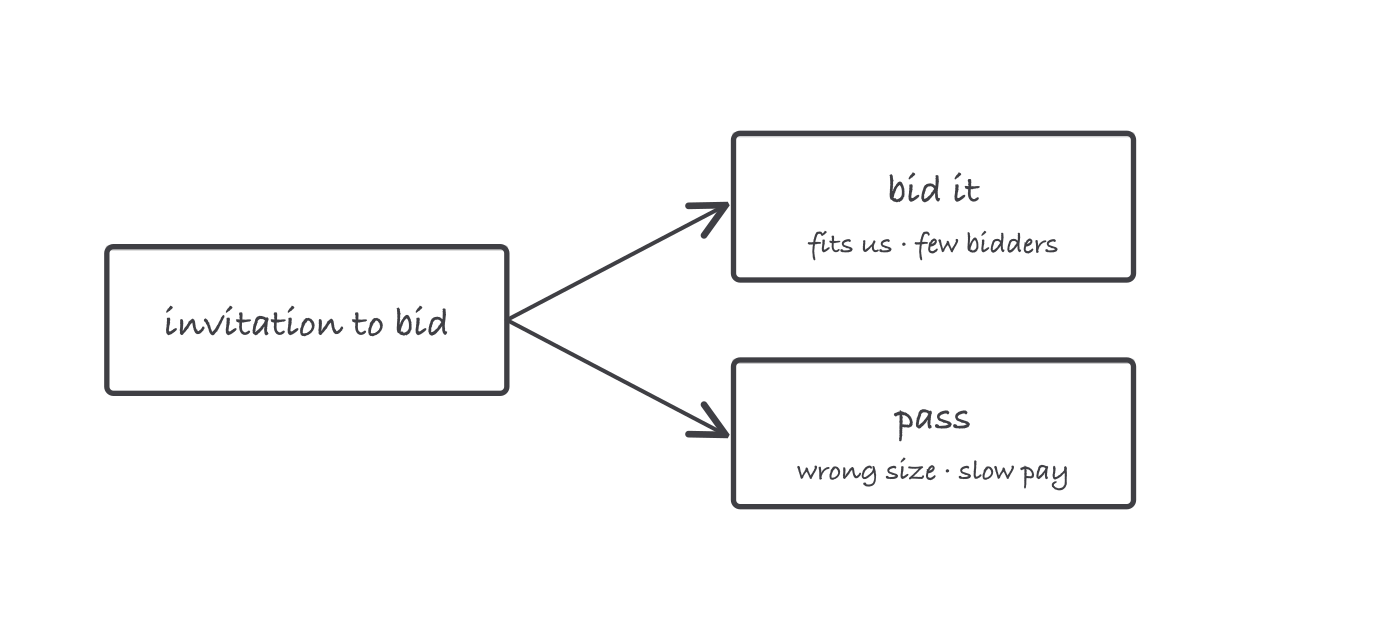
Pass is a priced decision, not a failure: every bid spends estimating money that only wins can repay
Where it bites
- Bidding to stay busy-looking. A full bid calendar with a 1-in-10 hit rate is not marketing; it is burning estimating money to feel productive.
- The relationship bid you cannot decline. If you must bid a bad-fit job to keep a client warm, bid it at a price that protects you, and know you have chosen marketing spend.
- Ignoring contract terms until after award. Pay-if-paid clauses, no-damages-for-delay, harsh liquidated damages: these belong in the no-bid conversation, not in a post-award surprise. The contracts lessons cover what the clauses mean; the bid decision is where you act on them.
- No record of why. Keep the score sheet. When a job goes bad, the note that says “we bid this against our own criteria” is how the next decision gets easier.