Business · General Contracting
Quality Control and Inspections
Assumes you know: Sequencing Trades
Quality control is verifying work against the contract documents while it can still be fixed cheaply, which almost always means before it is covered up. The punch list at the end of a job is not quality control; it is the bill for the quality control that did not happen during the job.
Why it matters on the job
Defects obey a brutal cost curve. A misplaced sleeve caught at layout costs a mark on the slab. Caught after the pour, it costs coring. Caught at closeout, it costs opening finished work, and caught after occupancy it costs warranty work plus a customer who tells the story for years. Every step downstream multiplies the price of the same mistake, so the entire craft of QC is moving discovery upstream.
The standard is the documents, not opinion
Quality on a construction site has a precise meaning: conformance with the drawings, specifications and referenced standards. Not “looks good,” not “how we usually do it.” That has two working consequences. First, the field needs the current documents: a crew building from a superseded drawing is manufacturing defects with perfect workmanship. Second, when the documents are ambiguous, the answer is a written request for information (RFI), not a field guess, because the guess that saves an hour today buys a dispute at closeout.
The three checkpoints
- First work in place. When each trade completes its first section, wall, room, or assembly, inspect it against the documents with the sub’s foreman before they build fifty more. Approved first work becomes the benchmark the rest of the trade’s work is judged against. This is the highest-leverage hour in QC: catch a systematic error at unit one instead of unit forty.
- Cover-up points. Anything about to be concealed, wall cavities, ceiling plenums, underground utilities, under-slab work, gets verified and photographed before it disappears: the authority’s required inspections plus your own checklist walk. The photographs cost minutes and end arguments for a decade.
- Milestone walks. At each area’s completion of a phase, walk it against a trade-specific checklist and log deficiencies with locations. Small lists corrected while the trade is still mobilized beat a thousand-item punch list after everyone has left.
Deficiencies get a written life: item, location, photo, responsible sub, date found, date corrected, verified by whom. A deficiency log that stays current is also your early-warning system: the sub with a growing open-items count is telling you something about the rest of their work.
Worked example: the benchmark walk
Your tile sub finishes the first of 24 hotel bathrooms. You walk it with their foreman against the spec: layout centered per the drawing, movement joints where the standard requires, lippage within the specified tolerance, slope to drain verified with a level. You find the niche shelf pitched the wrong way, water would pool, and it costs the sub twenty minutes to reset one shelf and adjust their jig. Without the walk, the error repeats 24 times and surfaces in month eleven as 24 warranty calls. One inspection, first article, converted a systemic defect into a twenty-minute fix.
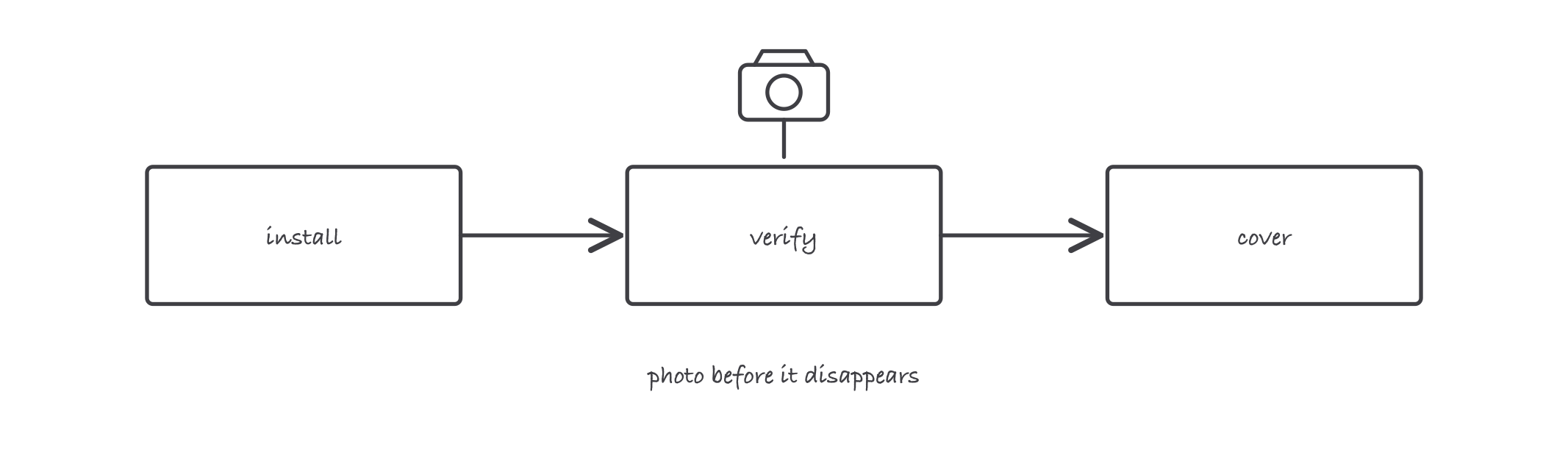
The unforgiving rule of QC: verification and the photograph come before the drywall, the backfill and the pour
Where it bites
- QC by punch list. Waiting for the end concentrates every defect at the moment of least leverage: trades demobilized, finishes in place, owner watching. The punch list should be a formality that confirms the QC already done.
- Covering ahead of inspection to hold schedule. The day saved is repaid as demolition. Schedule the inspection as a hard predecessor of cover-up in the schedule logic itself, so pressure cannot silently reorder them.
- Accepting drifting benchmarks. If unit twelve is sloppier than the approved first unit and nobody says so, the benchmark quietly becomes unit twelve. Hold the line at the standard, in writing, at the first drift.
- Ambiguity resolved by the crew. The field guess that conflicts with the spec is a defect with a schedule impact, however tidy it looks. Cheap RFIs now or expensive arguments later; there is no third option.