Business · General Contracting
Pricing for Profit
Assumes you know: Job Costing
Pricing for profit means every price you quote is built up from your own costs and your own profit target, and never negotiated below a floor you computed in advance. The market tells you whether your price wins; only your numbers can tell you whether it should.
Why it matters on the job
The overhead and markup lesson gave you the arithmetic; job costing gave you real cost data. This lesson is about holding the line those numbers draw, because pricing is where a year of good fieldwork is kept or given away. The margin for error is tiny: at typical contractor margins, a small discount granted in a driveway conversation can erase the entire profit of the job.
Build the floor before the phone rings
Three layers, computed per job:
- Direct cost, from your estimate, using loaded labor rates and current material quotes.
- Overhead recovery, at your computed rate. Say 15% of direct cost.
- Profit, as a true margin on price: divide, never multiply.
Worked example. Direct cost $76,000. Overhead at 15%: $11,400. Breakeven: $87,400. Target margin 8%:
Price = $87,400 ÷ (1 − 0.08) = $87,400 ÷ 0.92 = $95,000.
Check: profit is $95,000 − $87,400 = $7,600, and $7,600 ÷ $95,000 = 8%. The breakeven, $87,400, is the floor. Below it you are paying to work. Between $87,400 and $95,000 you are working for less than the business needs. Know both numbers before any negotiation starts, because the other side of the table will invent them for you if you arrive empty.
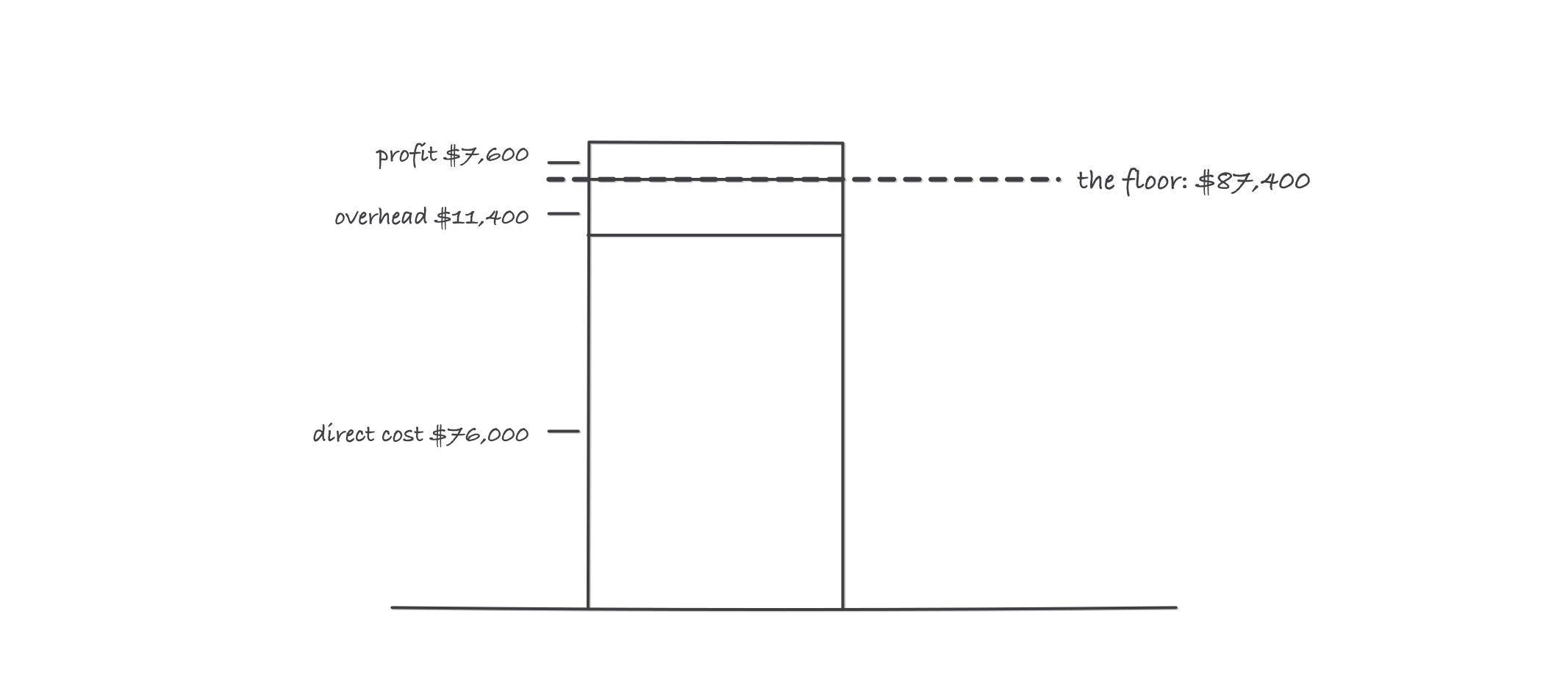
Everything below the line is other people’s money passing through; only the top slice is yours
What a discount actually costs
The most useful pricing arithmetic a contractor can memorize: a discount comes entirely out of profit. Cut the $95,000 price by 5%, giving $4,750 away, and cost does not care: profit falls from $7,600 to $2,850, a 62.5% cut in profit for a 5% cut in price. To earn the original $7,600 at the discounted margin you would need $7,600 ÷ $2,850 = 2.7 jobs for every one, nearly triple the work for the same money. “We will make it up on volume” is arithmetic’s oldest joke.
The same lever works in reverse. Raise the price 5%, to $99,750, and profit rises to $12,350, up 62.5%. Even losing a bid or two to the increase, the higher price frequently nets more total profit on less work. Small price moves are enormous profit moves; that asymmetry is the entire case for pricing discipline.
Your win rate is a pricing gauge
Track it from the winning-work pipeline. Winning nearly everything you bid is not good news; it means the market would have paid more, and your floor is set by fear, not numbers. Losing nearly everything means your costs are high, your market is wrong, or your overhead rate needs the recompute the overhead lesson prescribed. A healthy hit rate on qualified bids sits in a band, commonly cited around one win in three to four, and drifting outside it in either direction is a signal to investigate, not a verdict.
Charging for what only you carry
Price is defended with value, not apology: license, insurance, bond capacity, reviews, job photos, a clean contract, a real schedule. The customer comparing you to an unlicensed cash bid is not your customer; the qualifying screen from the winning-work lesson exists to find that out before the estimate, not after.
Where it bites
- Negotiating against yourself. Quoting $95,000 and dropping to $90,000 when the customer pauses hands over 66% of the profit for silence. Hold, offer scope changes instead: a smaller price for a smaller job is fine, a smaller price for the same job is a donation.
- Matching a competitor’s number. Their overhead, their burden, their desperation. You do not know which you are matching.
- Pricing from stale costs. Material quotes expire and loaded labor rates creep. Reprice cost, not just margin, on every bid; job costing keeps the inputs honest.
- Winning everything and celebrating. A 90% hit rate is the market applauding your underpricing. Raise prices until some bids start losing; the losses are data, and they are cheaper than the wins were.