Business · General Contracting
Contract Types: Fixed, Cost-Plus, T&M, GMP
Part of Contractor License, Start to Finish · step 12 of 21 · next: Contract Clauses That Matter
In learning paths: Contractor License, Start to Finish
Assumes you know: Construction Contract Fundamentals
Every construction contract type is an answer to one question: who carries the risk that the work costs more than expected? Fixed price puts that risk on you. Cost-plus puts it on the owner. Guaranteed maximum price splits it. Time and materials leaves it open-ended. Pick the type to match how well the scope is known, because pricing certainty you do not have is how contractors go broke.
Why it matters on the job
The same building, built by the same crew, can be profitable under one contract type and a loss under another. Owners push for the type that protects them; you need to know what each type does to your risk before you agree, and price accordingly.
The four working types
Fixed price (lump sum). One number for a defined scope. You keep every dollar you beat the estimate by, and you eat every dollar of overrun. This is the right tool when drawings are complete and scope is nailed down. It is the wrong tool for vague scope, because you will either pad the price to cover the unknowns or absorb them.
Cost-plus. The owner pays actual cost plus a fee, either a percentage of cost or a fixed amount. Your overrun risk is low, but your books are open: cost-plus contracts define reimbursable costs in detail and give the owner audit rights. The trap is the definition of “cost.” If your project manager’s time, small tools, or warranty work are not listed as reimbursable, they come out of your fee.
Time and materials (T&M). Labor at agreed hourly rates, materials at cost plus an agreed markup. Really a small-scale cousin of cost-plus, suited to repairs, service work and undefined scopes. Many owners insist on a not-to-exceed cap, which quietly converts the top end into a fixed price: you carry overrun risk above the cap with none of the upside below it, so treat a capped T&M as the fixed-price commitment it is.
Guaranteed maximum price (GMP). Cost-plus with a ceiling. Below the cap, the owner pays cost plus fee; above the cap, you pay. Savings below the cap are often shared under a negotiated split. GMP is common where an owner wants open-book pricing and a number they can finance against, typically with contingency held inside the GMP.
Worked example: one job, three contracts
Estimated cost of work: $220,000. Actual cost comes in at $230,000.
- Fixed price at $250,000: the owner pays $250,000. Your profit is $250,000 minus $230,000, which is $20,000. Had costs hit $255,000, you would have lost $5,000.
- Cost plus a 10 percent fee: the owner pays $230,000 plus $23,000, which is $253,000. Your fee is $23,000 no matter what, and notice the perverse optic: the overrun raised your fee, which is why owners watch cost-plus jobs closely.
- GMP of $245,000, fee included: cost plus fee is $253,000, which is $8,000 over the cap. The owner pays $245,000 and the $8,000 comes out of your pocket.
Same job, three different outcomes for the same actual cost. The contract type is a pricing decision, not paperwork.
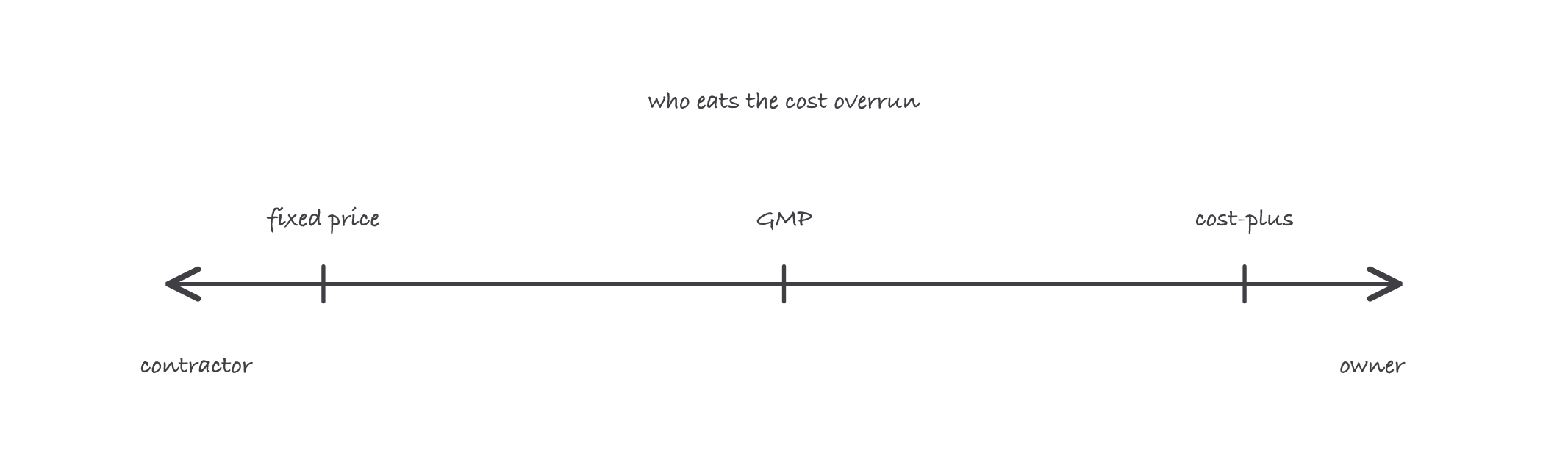
Cost risk slides along one line: fixed price puts it on you, cost-plus on the owner, GMP in between
Where it bites
- Fixed price on incomplete drawings. If the scope is not defined, a lump sum is a guess with a signature on it. Either qualify the price with allowances and exclusions or push for cost-plus until scope firms up.
- Cost-plus with a loose cost definition. Every cost category the contract does not name as reimbursable defaults to coming out of your fee. Negotiate the cost definition as hard as the fee percentage.
- Not-to-exceed treated as friendly. A capped T&M carries fixed-price downside with cost-plus upside for the owner. Price the cap like a lump sum.
- GMP contingency confusion. Be explicit about who owns contingency inside the GMP and what it may be spent on. Unwritten assumptions about contingency are a standing invitation to dispute.
Exam relevance
Business and law exams routinely present a scenario, a cost, a fee and a cap, and ask what the owner pays or what the contractor earns under each contract type. Know the mechanics cold: who bears overrun under lump sum, how a cost-plus fee is computed, and how a GMP cap and savings split work. Recompute the worked example above until each result is obvious.