Business · General Contracting
Construction Scheduling Fundamentals
A construction schedule is the project’s plan expressed in time: every significant chunk of work as an activity, each with a duration, tied to the others by logic. The bar chart everyone tapes to the trailer wall is the output. The schedule is the thinking underneath it: what depends on what, and therefore what must happen next.
Why it matters on the job
The schedule is how a GC turns twenty subcontractors into one project. Subs plan crews weeks out; suppliers quote lead times in months; owners plan move-ins and loan draws around your dates. A job run without a real schedule is run by whoever shouts loudest each morning, and it shows up as stacked trades, idle crews and a finish date nobody believes.
The building blocks
- Activities. The work broken into manageable pieces: “hang drywall, level 2” rather than “interior finishes.” A piece small enough to see progress on weekly, big enough that the schedule stays readable.
- Durations. How long each activity takes in working days, derived from quantity and crew production, not optimism. 12,000 square feet of drywall at 2,000 square feet per day for the planned crew is 6 working days. Durations you cannot back up with a production rate are guesses wearing numbers.
- Logic. The dependencies. Most are finish-to-start: footings finish, then walls start. Logic comes in two flavors worth distinguishing: hard logic, physics and code, you cannot hang drywall before rough-in inspection, and soft logic, preference, painting the west wing first. Know which is which, because soft logic is where a schedule can flex when trouble comes.
- Milestones. Zero-duration markers: permit issued, dry-in, substantial completion. They are the dates the outside world holds you to.
From these the schedule computes each activity’s start and finish, and the chain of activities that sets the end date. That chain, the critical path, gets its own lesson next.
The schedule is a cycle, not a document
The schedule you issue at the start is the baseline: the agreed plan of record, the yardstick delay claims are measured against. From then on the schedule lives on a cycle. Update it at a set rhythm, weekly or monthly, with actual dates: what started, what finished, what percent complete. Compare to the baseline: what slipped, and does the slip move the end date? Act: resequence, add crew, or issue notice if the cause was not yours. A schedule that is not updated is a drawing of a project that no longer exists.
The field tool that makes the master schedule real is the three-week look-ahead: a short extract, updated weekly, showing every trade exactly what runs for the next three weeks. Masters set strategy; look-aheads run the job.
Worked example: durations from production
You are scheduling foundations for a 40-unit townhome block. Quantities: 620 linear feet of footing forms. The crew forms 155 feet per day, so forming is 620 ÷ 155 = 4 working days. Rebar and inspection: 2 days. Pour and strip: 2 days. Logic: form, then rebar, then inspect, then pour, all finish-to-start. The chain is 4 + 2 + 2 = 8 working days, and you can defend every one of them with a quantity and a rate. When the owner asks for foundations in 5 days, the schedule gives you the honest answer: only with a second forming crew, and here is what that costs.
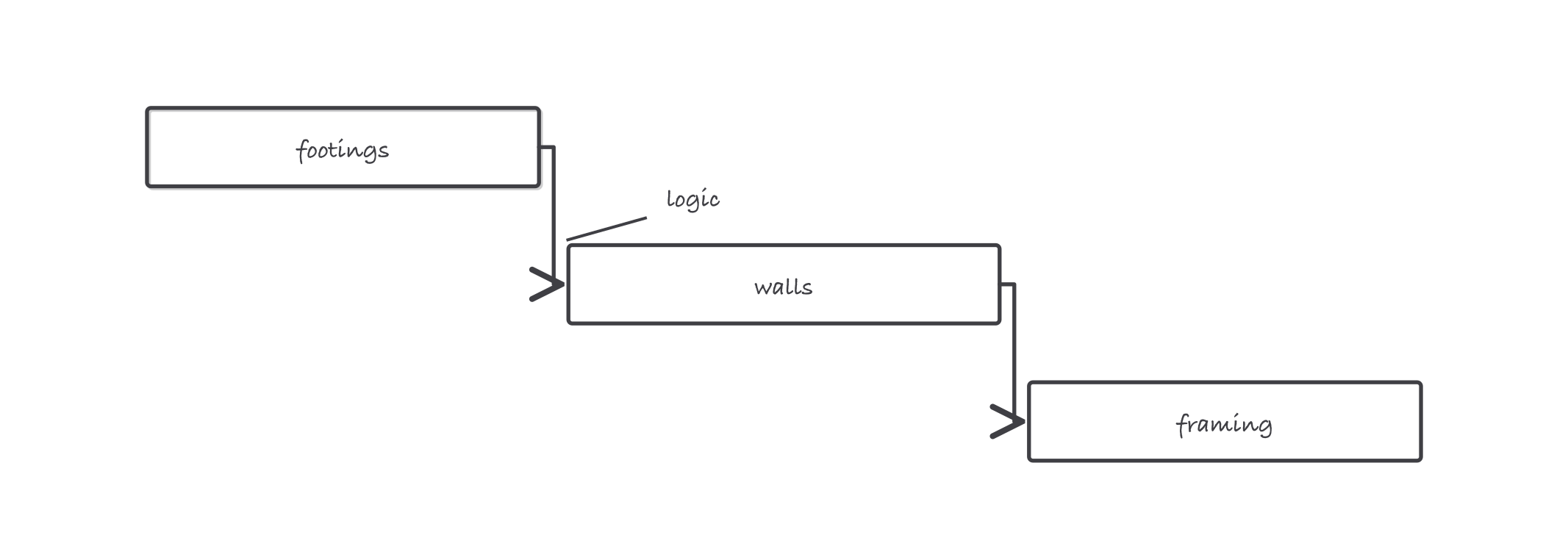
The bars show when; the arrows between them are the actual plan
Where it bites
- Bars without logic. A bar chart drawn by eye, with no dependencies behind it, cannot tell you what a slip does. When one activity moves, someone must hand-guess the ripple, and they will guess wrong.
- Optimistic durations. Durations set to make the end date work, instead of computed from production rates, produce a schedule that fails in month one and is ignored by month two.
- Never updating. The baseline is a photograph of day zero. Managing from it in month four means managing a fiction, and it also destroys your delay claims, which depend on updates showing when and why dates moved.
- No float ownership language. Who owns the schedule’s slack, the contractor, the owner, or the project, is a contract question with real money attached. Know what your contract says before you give slack away.