Business · General Contracting
OSHA Recordkeeping and Severe Injury Reporting
Assumes you know: OSHA Duties as an Employer
OSHA recordkeeping under 29 CFR Part 1904 is two obligations, not one. There are forms you keep in your own office (the 300 log, the 301 incident report, the 300A summary), and there is a report you make to OSHA on a clock when a worker is killed or badly hurt. Small employers are released from the first set. Nobody is released from the second.
Why it matters on the job
OSHA Duties as an Employer covers the duty set you inherit with your first employee. This is the part of it with a deadline attached. A compliance officer who arrives on your site can ask for the log and read your recent injury history straight off it, and a severe-injury report that goes in late is its own violation, separate from whatever standard the injury came from. Both failures happen in the hours after a bad day on the job, when paperwork is the last thing anyone is thinking about, and that is why they get missed.
Three forms, three jobs
OSHA 300, the Log of Work-Related Injuries and Illnesses. One line per recordable case, sorted into the log’s columns: who, when, where, what happened, and how the case was classified.
OSHA 301, the Injury and Illness Incident Report. The detail behind one line of the log, including what the worker was doing and what harmed them. One 301 goes with each 300 entry.
OSHA 300A, the Summary. The year’s totals off the log on a single page, for posting.
Two clocks govern the forms. Seven calendar days is the entry clock: a recordable case goes onto the 300 and gets its 301 within seven calendar days of your receiving the information that it is recordable (1904.29). Calendar days, so a Friday injury does not hand you the weekend back. February 1 to April 30 is the posting window: the previous year’s 300A stays posted where you customarily post notices to employees, through those three months (1904.32). A year with no recordable cases still produces a summary, because the form takes zeros.
Do not confuse that three-month window with the OSHA poster. The “Job Safety and Health: It’s the Law” poster required by 29 CFR 1903.2 stays up all year, in every establishment, and OSHA publishes it free. One posting is a summary of your year and comes down on May 1; the other is a statement of workers’ rights and never comes down.
Two partial exemptions, and only one of them can ever be yours
Part 1904 hands out exemptions from the routine records on two separate grounds.
By size (1904.1). A company with 10 or fewer employees at all times during the previous calendar year does not have to keep the routine records. That is a company-wide count across every job you are running, not the headcount standing on one site. The section carries its own catch: the exemption lifts if OSHA or the Bureau of Labor Statistics writes to you asking for records.
By industry (1904.2). Establishments in the low-hazard industries listed in Appendix A to Subpart B are also released from routine recordkeeping. That list runs from NAICS 4412 to NAICS 8139, which is retail, finance, professional and personal-service territory. NAICS 23 is construction, and NAICS 23 does not appear on it. No construction establishment is exempt on industry grounds, at any size, in any state.
Now the word that both exemptions are carrying: partial.
Neither one reaches 29 CFR 1904.39. A two-person framing company with no 300 log in the office still reports a work-related death within 8 hours, and an in-patient hospitalization, an amputation or the loss of an eye within 24 hours. The exemption covers routine records. A severe-injury report is not a routine record.
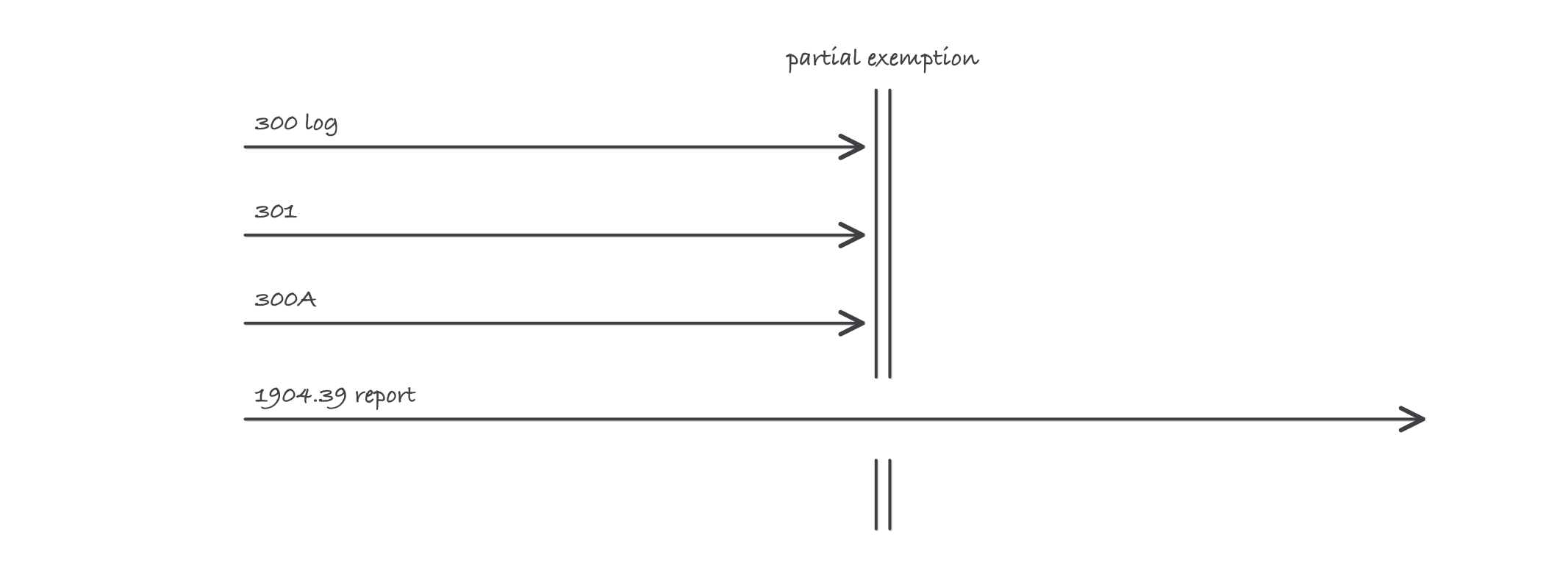
The partial exemption stops the paperwork you keep, never the report you owe
The reporting clocks
1904.39 sets two of them, and the difference between them is the severity of the outcome:
- 8 hours after a work-related fatality.
- 24 hours after an in-patient hospitalization, an amputation, or the loss of an eye.
The report goes to OSHA by phone to the nearest area office, by phone to the 24-hour hotline, or through OSHA’s online reporting form. Before you decide an emergency-room visit was not an in-patient hospitalization, or that a fingertip injury was not an amputation, read the definitions in 1904.39 itself. Both terms are defined in the section, and both are narrower than the everyday word.
Worked example: one afternoon, three clocks
Tuesday, March 10, 2026, 3:40 pm. A plank fails on your scaffold. One carpenter is admitted to a hospital for in-patient care that evening. A second suffers an amputation. Your superintendent is on site and reaches you within minutes, so nothing about the timing is in question.
Run the clocks from 3:40 pm Tuesday.
- The 24-hour clock covers both injuries. Hospitalization and amputation sit in the same tier of 1904.39, so the report on each is due by 3:40 pm Wednesday, March 11. Both incidents are reportable and both deadlines land at the same moment.
- The seven-day clock is separate and runs in parallel. Both cases go on the 300 log and get a 301 by Tuesday, March 17. Making the phone call enters nothing on your log; they are different obligations with different deadlines.
- The 8-hour clock is the one you did not have to run. Had either worker died, the report would have been due by 11:40 pm that same night. Eight hours from a mid-afternoon accident lands you inside the evening you are still dealing with the accident, and that is exactly why the fatality clock needs a plan made long before you need it.
Both cases belong to calendar year 2026, so they roll into the 2026 summary, which posts from February 1 to April 30, 2027.
Where it bites
- Partially exempt is not exempt. A small contractor reads “I do not have to keep OSHA records,” stops there, and misses that the sentence had the word partially in front of it. The 8-hour and 24-hour clocks run against a company of three the same way they run against a company of three hundred.
- Whether a case is recordable at all is decided somewhere else. The test lives in 1904.4 through 1904.7 (work-relatedness, new case, and the general recording criteria), and this page will not paraphrase it, because a paraphrased recording criterion is how a case quietly stays off a log. Read those sections, or make sure the person filling in your log has.
- Settle whose employee is whose before the day it matters. Part 1904 is written to an employer about its own employees, so on a site running six subcontracts there are six answers to “whose log does this go on,” and the argument is worse at 4:00 pm on the day of the accident than it is at contract signing.
- The 300A goes up whether or not anyone got hurt. Contractors who had a clean year assume there is nothing to post. The window is February 1 to April 30 regardless.
Exam relevance
Business and law exams ask this material in its plainest form: which form is which, what the 8-hour and 24-hour clocks attach to, and the February-to-April posting window. The exemptions are where the questions get subtle, because a construction company can never qualify on industry grounds and qualifies on size only below 11 employees, and the low-hazard list is the obvious distractor. Learn the two grounds separately, then learn the sentence that matters more than either: no exemption in Part 1904 reaches the severe-injury report.
Verified requirements
| Where | Expires | Renewal | Continuing education |
|---|---|---|---|
| California | Yes | 2 years (CSLB: 'Active licenses expire every two years.' Inactive licences expire every four years.) | Confirm with issuer |
| Florida | Confirm with issuer | Confirm with issuer | Confirm with issuer |
| Arizona | Confirm with issuer | Confirm with issuer | Confirm with issuer |
Information comes from issuing-authority sources. Confirm current rules, fees and eligibility with the authority before acting.